- ProductsSearch and BrowseRecommendationsCustomer Engagement
10 best AI-powered ecommerce site search features for 2026 [with performance data]


Key Takeaways
- AI-powered ecommerce site search significantly outperforms traditional keyword-based search by understanding user intent, not just matching exact terms.
- Higher conversions are driven by better query interpretation, dynamic ranking, and personalization, which directly impact revenue and engagement.
- Dynamic ranking uses 200+ behavioral and business signals to prioritize products based on conversion likelihood, inventory, and margins.
- Visual search and conversational AI unlock new discovery paths, capturing inspiration-driven and complex buying journeys.
- AI-powered search reduces bounce rates and increases AOV by surfacing more relevant products faster.
- Search users are the highest-intent audience, converting 3–5x more than non-search users, making optimization critical.
When shoppers try ecommerce site search, higher conversions separate winning platforms from the rest. That performance gap comes down to how your search engine interprets queries, ranks products, and adapts to shopper behavior.
Traditional keyword-matching search treats every visitor the same and shows identical results for identical queries.
AI-powered ecommerce site search, on the contrary, understands intent, learns from behavior, and personalizes results in real time.
The market for AI-powered ecommerce tools is projected to approach $17 billion by 2030, highlighting a major growth opportunity for brands that integrate smart technology into their operations.
Netcore Unbxd, recognized as a Strong Performer in Forrester's Q3 2025 Commerce Search & Product Discovery Wave, was the only vendor to achieve a 5.00 score for in-session personalization capabilities.
This guide breaks down the 10 features driving measurable search performance, backed by verified customer data and analyst validation.
What makes AI-powered ecommerce site search different?
Traditional ecommerce site search engines rely on keyword matching. Type "laptop under $1000" and you get every product with those exact words in the description, sorted by whatever default ranking your platform uses.
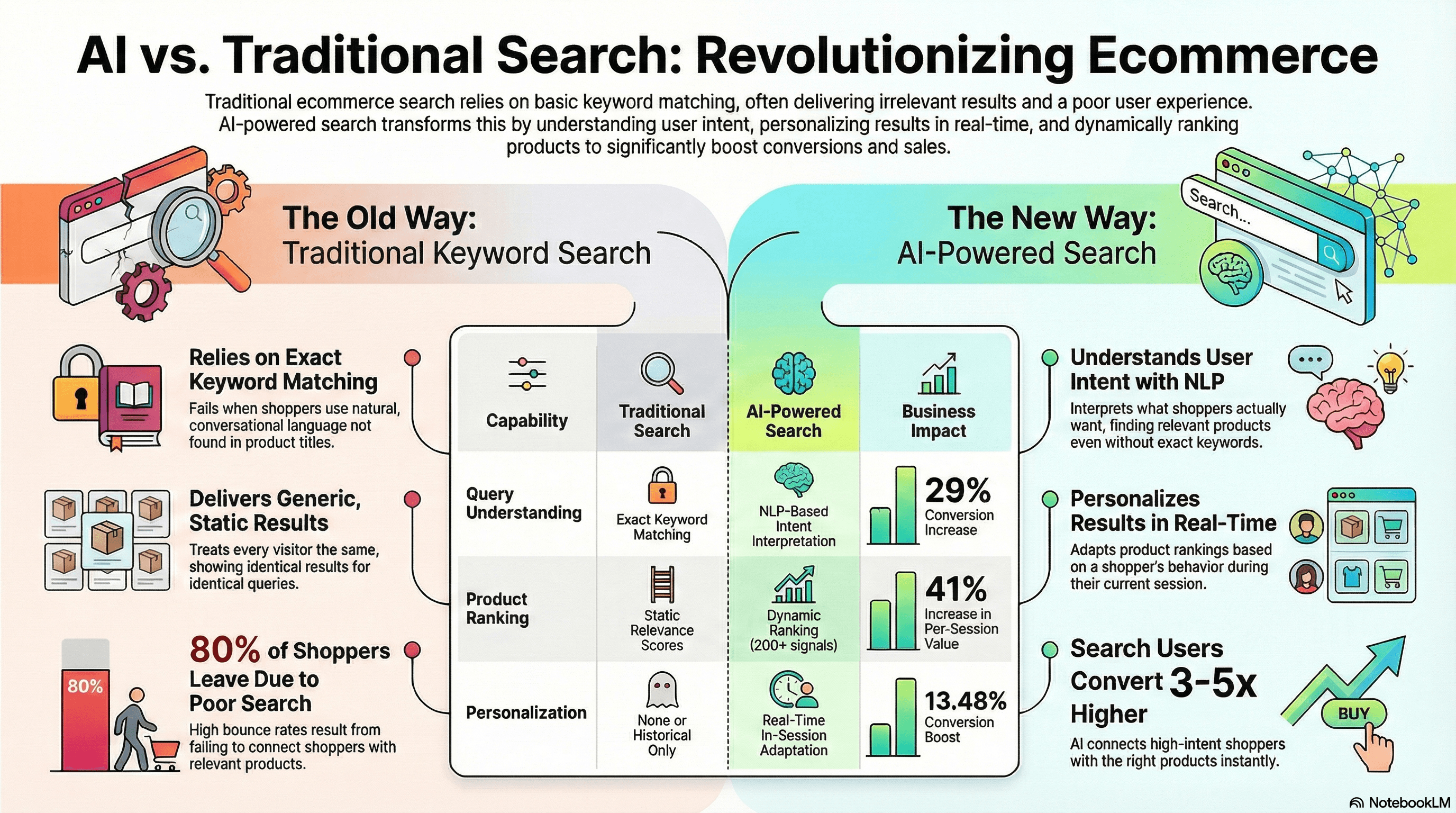
| Feature Type | Traditional Search | AI-Powered Search | Business Impact |
|---|---|---|---|
| Query Understanding | Exact keyword matching | NLP-based intent interpretation | 29% conversion increase (Fashion vertical) |
| Ranking | Static relevance scores | Dynamic ranking with 200+ signals | 41% increase in per-session value |
| Personalization | None or historical only | Real-time in-session adaptation | 13.48% conversion boost |
| Visual Discovery | Not supported | 3-second image-to-product matching | Enables inspiration-driven purchases |
| Results Speed | 100–300ms | <60ms with AI models | Better user experience, lower bounce |
AI-powered ecommerce site search engines work differently. They use natural language processing to understand intent, not just keywords. That same query triggers four distinct processes working together:
Query understanding breaks down "laptop under $1000" into product type (laptop), constraint ($1000 max), and intent (budget-conscious purchase). The system identifies what matters most to the shopper beyond surface-level words.
Semantic matching finds products described as "notebooks" or "portable computers" even without "laptop" in the title. This catches relevant inventory that keyword matching misses entirely.
Dynamic ranking prioritizes products based on conversion probability, inventory levels, and margin contribution rather than static relevance scores. Out-of-stock items drop in rankings regardless of keyword match quality.
Personalization adjusts results based on the shopper's browsing history and segment behavior, even for first-time anonymous visitors within their current session.
According to verified customer implementations, this approach delivered measurable outcomes across verticals.
The difference shows up in how shoppers interact with search results. AI-powered platforms reduce bounce rates, increase time on site, and drive higher average order values because results match what shoppers actually want, not just what they typed.
How does AI improve ecommerce site search performance?
How to improve ecommerce site search optimization
Improving ecommerce site search optimization requires three foundational shifts:
Replace exact-match algorithms with NLP-powered query understanding
Instead of matching "red dress" to products with those exact words, AI interprets color, style, occasion, and fit preferences from natural language queries like "cocktail dress for wedding guest." This handles a significant portion of queries that use conversational language not found in product titles.
Implement behavioral ranking signals Static relevance scores miss the point. For example, Netcore Unbxd dynamic ranking uses 200+ signals including click-through rates by query, add-to-cart behavior, purchase conversion data, inventory velocity, and margin contribution.
Platforms using AI models trained to identify and list products witness 35% increase in conversion.
Enable real-time personalization
Generic search results treat all visitors identically. In-session personalization adapts product rankings based on browsing patterns within the current session, product affinity signals, segment behavior, and device context. Netcore Unbxd differentiates as the only platform scoring 5.00 for in-session personalization in Forrester's evaluation, enabling personalization for new anonymous visitors without requiring login data.
These three changes form the foundation. The specific features that make them work follow below.
Ecommerce site search statistics: Performance benchmarks for 2026
Search Usage and Impact:
Site search users convert at 3-5x higher rates than non-search users across ecommerce verticals. Searchers demonstrate clear intent, making them your highest-value traffic segment. There has been a significant growth in natural language queries, almost 60%, in the past decade. The lingo used in these queries doesn't appear in product titles, requiring interpretation beyond exact keyword matching.
AI-Powered Search Performance:
Fashion retailers implementing AI-powered search see 40% conversion increases. Furniture and home decor brands improve conversions by 25% while increasing average order values through better product discovery.
Search Feature Engagement:
Autosuggest features prevent zero-results experiences and guide shoppers toward successful searches before they complete typing.
19% of U.S. retailers use visual search now, with 40% planning adoption in the next two years.
A significant amount of product search queries contain measurement or specification attributes, representing high-intent shoppers who know exactly what they need. According to a report, 69% of consumers go directly to the search bar when visiting an online retailer, but 80% of them leave due to a poor on-site search experience.
The 10 AI-powered features driving search performance
Natural language processing (NLP) for query understanding
Natural language processing improves ecommerce search by breaking down conversational queries into intent, constraints, and context. When a shopper searches "lightweight laptop for travel under $1,000," NLP identifies product type, desired attributes, use case, and budget constraints, matching products that satisfy all components even when exact terms don't appear in descriptions.
Why it matters: Traditional keyword matching fails when shoppers use natural language. Someone searching "dress for outdoor summer wedding" expects different results than "summer dress," but keyword engines treat them identically. NLP understands the occasion (wedding), setting (outdoor), season (summer), and formality level implied by the query.
Real-world example: Netcore Unbxd processes complex searches using 50+ AI models that deliver results in under 60 milliseconds. The platform interprets queries across categories, extracting product types, attributes, use cases, and constraints simultaneously.
One B2B industrial supplier saw 37% conversion increases after implementing NLP-powered query understanding because technical specification searches finally returned relevant products. Technical implementation: The system uses named entity recognition and intent classification models trained on ecommerce-specific query patterns, processing each search through multiple interpretation layers before matching to inventory.
In-session personalization
In-session personalization differs from historical personalization because it works for first-time visitors without login data. The system builds an anonymous profile during the current session based on browsing patterns, click behavior, category affinity, and device context, then adapts search results in real time.
Why it matters: Most personalization requires historical data, leaving 60-80% of your traffic seeing generic results. In-session personalization works immediately, even for anonymous first-time visitors, adapting product rankings as the shopper reveals preferences through behavior.
Real-world example: Netcore Unbxd achieved the only 5.00 score for in-session personalization capabilities in Forrester's Q3 2025 Wave evaluation.
“Real-time in-session personalization analyzes shopper behavior during their current visit to adapt recommendations instantly. AI processes signals including hover patterns, scroll depth, and quick views to update suggestions in milliseconds. This approach converts 20-30% better than historical-only personalization by responding to immediate intent.”
Technical implementation: The platform tracks behavioral signals including dwell time, category exploration, price range browsing, and attribute preferences, feeding this data into ranking algorithms that adjust product positions dynamically throughout the session.
Visual search
Visual search enables image-to-product matching, letting shoppers upload photos or screenshots to find similar items in your catalog. The system analyzes visual attributes including category, material, color, pattern, silhouette, and occasion, then matches against your product inventory.
Why it matters: Shoppers often see something they want but can't describe it in words. Visual search captures inspiration-driven purchases that text queries miss entirely. With 1.70 trillion images captured annually according to industry data, visual discovery represents a massive untapped opportunity for product discovery.
Real-world example: City Furniture explored visual search implementation to help customers find furniture pieces matching their home decor. The technology delivers results within 3 seconds while extracting multiple attributes simultaneously. Customers photograph furniture they like in showrooms or inspiration images online, then immediately see similar available inventory without needing to describe style, color, or material in text.
Technical implementation: Computer vision models trained on product imagery extract visual features and map them to catalog attributes, enabling similarity matching even when product descriptions lack detailed visual terminology.
Conversational AI Shopping Agent
Conversational AI shopping agents guide product discovery through natural dialogue, understanding multi-turn conversations where shoppers refine requirements through back-and-forth interaction. This differs from standard chatbots by maintaining context across exchanges and proactively suggesting relevant products based on stated preferences.
Why it matters: Complex purchasing decisions require guidance. Someone buying a laptop needs to balance performance, portability, battery life, and budget across dozens of options. Conversational AI helps narrow choices through dialogue, reducing decision paralysis that leads to abandonment.
Real-world example: City Furniture plans to implement conversational AI for customers shopping bedroom furniture who need to coordinate mattresses, frames, bedding, and accessories.
Technical implementation: Large language models fine-tuned on product catalogs and ecommerce interactions maintain conversation context, track stated preferences, and generate product recommendations while explaining tradeoffs between options.
Dynamic Ranking
Dynamic ranking differs from static relevance scoring because it adapts based on business goals like inventory velocity and margin contribution, not just keyword matching. The system evaluates 200+ signals including click-through rates by query, add-to-cart behavior, purchase conversion data, inventory levels, and profit margins.
Why it matters: Relevant products that are out of stock, low-margin, or never convert shouldn't rank first. Dynamic ranking optimizes for business outcomes, not just text matching. Inventory that needs movement gets visibility boosts. High-margin alternatives rank higher when equally relevant.
Real-world example: Mitre 10, a home improvement retailer, saw 41% increase in per-session value after implementing dynamic ranking. The system prioritized in-stock inventory over backorders, boosted seasonal products, and surfaced high-margin alternatives when multiple products matched query intent. Month-over-month increases reached 21% as the algorithm learned which products convert best for specific queries.
Technical implementation: Machine learning models continuously train on behavioral data, adjusting ranking weights based on actual conversion performance while incorporating inventory and margin signals to balance relevance with business objectives.
Catalog enrichment and attribute extraction
Catalog enrichment transforms unstructured product descriptions into structured, searchable attributes through automated extraction. The system identifies and categorizes product features, specifications, materials, styles, and use cases from free-text descriptions, images, and sparse data.
Why it matters: Most product catalogs have incomplete or inconsistent attribute data. Without structured attributes, long-tail searches fail because the information exists somewhere in descriptions but isn't extractable by search algorithms. Enrichment makes implicit product information explicitly searchable.
Real-world example: Netcore Unbxd's catalog enrichment uses 1 billion synonyms across 20+ product categories to standardize and enhance product data automatically. A fashion retailer with products described as "top," "shirt," and "tunic" gets unified categorization that makes all variants discoverable regardless of which term shoppers use. This improves long-tail query performance without manual data cleanup.
Technical implementation: Natural language processing and named entity recognition extract attributes from unstructured text, while computer vision analyzes product images to infer visual characteristics, creating comprehensive structured metadata without manual tagging.
Measurement search (Specification search)
Measurement search handles queries containing specifications, dimensions, capacities, and technical parameters, matching them precisely to product attributes. The system recognizes diverse measurement formats including metric and imperial units, ranges, and technical specifications.
Why it matters: Shoppers searching with measurements demonstrate high purchase intent because they know exactly what they need. These queries represent 16% of total search volume according to Netcore Unbxd customer data, but often fail on platforms that can't parse specifications correctly.
Real-world example: Bajaj Mall, selling electronics and appliances, implemented specification search for queries like "refrigerator 200 liter," "washing machine 7kg," and "TV 55 inch 4K." The system understands measurement variations ("200L," "200 liter," "200 liters") and matches them to structured capacity attributes. Conversion rates on specification queries increased significantly because shoppers got exactly what they specified.
Technical implementation: Named entity recognition identifies measurement attributes in queries, normalizes units and formats, then matches against structured product specifications using exact and range-based matching logic.
Autosuggest and type-ahead
Autosuggest predicts and suggests queries as shoppers type, using behavioral data to rank suggestions by conversion probability rather than just query frequency. The system corrects misspellings, suggests related terms, and surfaces popular products directly within the dropdown.
Why it matters: Half of shoppers abandon searches when they don't see immediate relevant suggestions. Autosuggest engagement rates above 50% indicate shoppers trust the predictions enough to click rather than complete their original query. This prevents zero-results experiences and guides discovery.
Real-world example: Deborah Lippmann, a beauty and cosmetics brand, achieved 40% conversion rate improvement partially through enhanced Netcore Unbxd autosuggest that surfaces trending products and corrects common misspellings of product names. The system learned that searchers typing "nail pol" want "nail polish" but those typing "nail ca" likely want "nail care" instead, differentiating intent from partial queries.
Technical implementation: Machine learning models trained on query logs and conversion data predict likely completions while factoring in current inventory, trending products, and individual shopper context to personalize suggestions.
Faceted navigation and dynamic facets
Dynamic facets generate context-aware filter options based on query results rather than showing static category menus. The system analyzes the result set to determine which attributes meaningfully differentiate products, then presents relevant filters in priority order.
Why it matters: Generic filter menus overwhelm shoppers with irrelevant options. Someone searching "winter coats" doesn't need a "sleeve length" filter showing only long sleeves. Dynamic facets show filters that actually help narrow the specific result set, improving navigation efficiency.
Real-world example: Fishpools, a furniture and appliance retailer, saw 51% AOV improvements through Netcore Unbxd’s dynamic faceted navigation. When shoppers searched "dining tables," the system surfaced seating capacity and material as primary filters because those attributes varied across results. For "office chairs," filters prioritized adjustability and ergonomic features instead. This reduced decision paralysis and increased average order values.
Technical implementation: The platform analyzes result set distribution across attributes, calculates entropy and coverage metrics, then dynamically generates filter options that maximize result differentiation while hiding attributes with insufficient variation.
A/B testing and analytics
Built-in A/B testing enables business users to test search algorithms, ranking strategies, and merchandising rules without IT involvement. The system runs multivariate tests, calculates statistical significance automatically, and provides detailed performance analytics across query types and customer segments.
Why it matters: Search optimization requires continuous testing, but most platforms need developer resources for every experiment. Business user testing accelerates iteration, letting merchandising teams optimize performance based on data rather than assumptions.
Real-world example: ResMed, a medical equipment supplier, increased conversion rate by more than 21% with Netcore Unbxd.
Technical implementation: The platform randomly assigns traffic to control and variant experiences, tracks conversion metrics, applies statistical significance testing, and automatically declares winners when confidence thresholds are met, all through a business user interface.
Choosing the right ecommerce search platform
The features above matter only when implemented together as a cohesive system. Individual capabilities in isolation deliver modest improvements, but integrated AI-powered search creates compound effects where each feature enhances the others.
Look for platforms with analyst validation, not just self-reported performance claims. Netcore Unbxd's Strong Performer recognition in Forrester's Q3 2025 Wave and highest score in the Current Offering category demonstrate verified capabilities across the features detailed above.
Request vertical-specific benchmarks during evaluation. Fashion, B2B, and furniture implementations show different performance profiles because shopper behavior and catalog complexity vary by industry. Generic promises of improvement matter less than proof from your specific vertical. Prioritize platforms offering business user control over testing and optimization. IT-dependent platforms create bottlenecks that slow optimization. The ability to test ranking changes, merchandising rules, and algorithm adjustments without developers accelerates performance improvements.
Explore how AI-powered search performs for your specific catalog and customer base? Explore Netcore Unbxd's platform capabilities and request vertical-specific benchmarks from implementations similar to yours.
Frequently Asked Questions
What is ecommerce site search?
Ecommerce site search is an on-site search engine that helps shoppers find products within an online store using keyword queries, filters, and navigation. Unlike general web search, ecommerce search prioritizes product discovery, inventory availability, and purchase conversion over information retrieval.
How does AI improve ecommerce search compared to traditional keyword matching?
AI-powered search interprets intent rather than matching exact keywords, uses behavioral signals to rank products dynamically, personalizes results in real time even for anonymous visitors, and understands natural language queries that don't match product descriptions. Traditional keyword matching treats all visitors identically and only finds products with exact term matches.
What is the difference between NLP, semantic search, and keyword search?
- Keyword search matches exact terms in product data
- Semantic search finds related concepts and synonyms
- NLP (Natural Language Processing) understands full query intent, including context, constraints, and use cases
AI-powered ecommerce search combines all three, with NLP acting as the foundation for interpreting complex queries.
What conversion improvements can I expect from AI-powered search?
Performance varies by vertical and implementation quality. Fashion retailers typically see 29% conversion increases. B2B companies achieve 37% improvements. Furniture and home decor brands improve conversions by 18%. These benchmarks come from verified customer implementations using comprehensive AI-powered search platforms.
Do I need historical customer data for AI search to work?
No. In-session personalization works for first-time anonymous visitors by building profiles based on current session behavior. While historical data improves personalization for returning customers, modern AI search platforms deliver results immediately without requiring login data or purchase history.
How quickly can AI-powered search process complex queries?
Leading platforms process natural language queries in under 60 milliseconds while applying NLP interpretation, behavioral ranking, personalization, and inventory filtering simultaneously. Visual search delivers image-to-product matches within 3 seconds while analyzing multiple visual attributes.
What makes Netcore Unbxd different from other ecommerce search platforms?
Netcore Unbxd is a Strong Performer in Forrester's Q3 2025 Commerce Search & Product Discovery Wave and was the only vendor to achieve a 5.00 score for in-session personalization capabilities. The platform received the highest score in the Current Offering category, demonstrating comprehensive feature coverage across NLP, visual search, dynamic ranking, and conversational AI.


