- ProductsSearch and BrowseRecommendationsCustomer Engagement
Federated search: The intelligence layer ecommerce can no longer ignore


Key takeaways
- Netcore Unbxd federated search transforms ecommerce search into a real-time intelligence layer
- Federated search in ecommerce removes data silos and expands discovery beyond SKUs
- Real-time trends and demand signals become visible instantly
- Single-query, multi-source results reduce friction and improve conversions
Every ecommerce leader understands the feeling when your search is technically solid (quick indexing, accurate relevance tuning, clean catalog data), yet somehow it still falls short. Shoppers leave without finding what they want. Conversion lags. Trending products stay buried.
The problem isn't your search engine. It's the data feeding it.
Most platforms today operate on a closed loop: product catalog in, ranked results out. This approach made sense for the early web. But in a world shaped by social commerce, AI-powered shopping assistants, and hyper-personalized expectations, it's no longer sufficient.
Shoppers don't just want to find products, they want to discover what's hot right now, validate purchases through real reviews, and be guided by context that extends far beyond a SKU.
Federated search in ecommerce is the architectural answer to that gap. It's not a feature; it's a paradigm shift.
What is federated search in ecommerce?
Federated search is the ability to augment product discovery by querying multiple data sources (internal and external), simultaneously, and synthesizing the results into a single, unified search experience.
Traditional search pulls exclusively from your product catalog, on-site user behavior analytics, and basic content assets like blogs and FAQs.
Federated search breaks that boundary, expanding the data ecosystem to include shopper reviews and product feedback (on-platform and third-party), social media signals like trending hashtags, viral posts, and influencer mentions, external content ecosystems including press, editorial, and community forums, and demand intelligence from adjacent platforms and marketplaces.
The result is a richer, more contextual understanding of both what products mean and what shoppers actually want, right now, not just historically.
Why traditional search has hit its ceiling
Today's standard search stack is engineered for retrieval, not understanding. It excels at matching queries to catalog attributes. What it cannot do is answer the questions that increasingly drive purchase decisions: What products are genuinely trending right now? What are shoppers saying about durability, sizing, or quality? Is this product gaining cultural momentum outside my platform? Why is demand for this item spiking today?
Without external signals, search relevance is permanently backward-looking. It optimizes for what was popular, not what is emerging. It reflects catalog data, not cultural context. And as shopper expectations grow more sophisticated, shaped by social media trends, influencer reviews, and conversational AI, the gap between what traditional search delivers and what shoppers actually need continues to widen.
The search systems that win the next decade won't be the fastest at retrieving SKUs. They'll be the most intelligent at understanding intent.
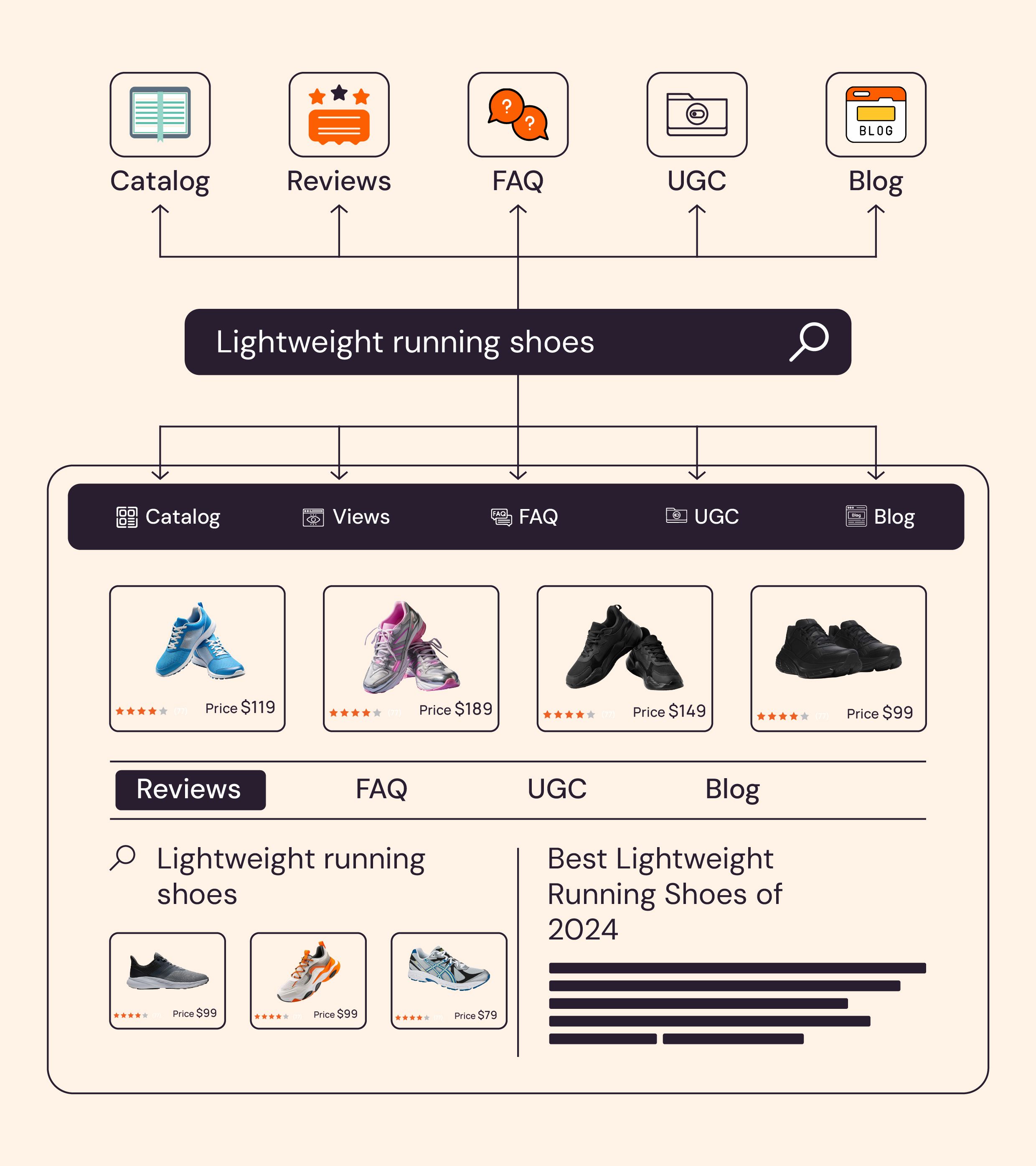
How does Netcore Unbxd's federated search architecture work?
Netcore Unbxd federated search doesn't replace your existing search infrastructure; it extends it. Here's how the three-layer architecture operates in practice.
Layer 1: Multi-source data integration
External and internal sources are ingested in parallel. This includes review platforms like Bazaarvoice and Yotpo, social listening feeds from Instagram, TikTok, Reddit, and X, third-party content repositories, and real-time demand signals from marketplaces. Each source is treated as a distinct data stream, normalized and enriched before entering the intelligence layer.
Layer 2: Semantic transformation via vectors
Raw data, whether a five-star review, a trending sound, or a product description, is converted into vector representations. This enables semantic understanding rather than brittle keyword matching. The system can understand that "lightweight trail shoe" and "featherweight hiking sneaker" express the same intent, and that a viral post about "cloud-like cushioning" signals emerging demand for a specific product attribute.
Layer 3: Unified intelligence for search and AI systems
The enriched dataset flows into a shared intelligence layer that powers both your search engine and your AI agents. Ranking algorithms gain access to sentiment, trend velocity, and social proof. AI assistants gain the grounding data they need to move beyond generic responses to genuinely contextual recommendations.
How federated search transforms product discovery in commerce
1. Conversational search that actually knows the answer
When a shopper asks "Which trail running shoes are trending right now?" or "What do shoppers say about durability in this category?," a federated search system can draw on live social signals and aggregated review sentiment to provide a genuinely useful answer, not just a keyword-matched product grid. This is the foundation of search that feels like a conversation with an expert, not a query against a database.
2. Shopping agents that operate with real context
AI-powered shopping assistants are only as good as the data they can access. Without federated inputs, they're intelligent but uninformed, capable of reasoning, but lacking the real-world grounding that makes recommendations trustworthy.
Federated search gives AI agents the connective tissue they need: live review sentiment, emerging trend data, cross-channel demand signals. The result is an assistant that doesn't just suggest products, it advises with confidence.
3. Trend-aware merchandising at scale
Merchandisers today rely heavily on internal analytics and manual curation to surface what's relevant. Federated search changes that dynamic. By continuously ingesting external trend signals, a style going viral on Instagram, a product category surging on Reddit, merchandising becomes dynamic and self-correcting. Emerging demand surfaces before it peaks. Relevance is maintained not through weekly rule updates, but through continuous external intelligence.
4. Sentiment-driven product ranking
Review sentiment isn't just useful for product pages; it's a powerful ranking signal. A product with high click-through but poor review sentiment should rank differently than one with steady demand and consistently positive feedback. Federated search enables this nuance. Ranking models can weight social proof, sentiment trajectory, and external validation alongside traditional behavioral signals, producing results that are both more relevant and more trustworthy.
Transformation into an intelligent search engine
This is the reframe that matters most for ecommerce leaders thinking about long-term strategy.
Traditional search is a retrieval system, as its job is to find things. Federated search is an intelligence engine. Its job is to understand the market, the moment, and the shopper's intent to surface the most contextually relevant response.
The practical implication: federated search doesn't just improve your search results page.
It improves every downstream system that depends on search data, recommendations, personalization, AI agents, and merchandising tools. When the data foundation is richer, every intelligence layer built on top of it becomes more capable.
The agentic commerce connection
The commerce industry is moving rapidly toward autonomous, agent-driven shopping experiences. Consumers will increasingly delegate discovery and purchasing decisions to AI agents operating on their behalf. These agents will browse, compare, validate, and transact, often without a human actively involved at each step.
For these agents to function well, they need data that reflects reality, not just a product catalog. They need to know what's trending, what shoppers are saying, what the market considers credible. Federated search is the data architecture that makes this possible.
Without federated data, AI agents operate in isolation: intelligent but blind to context. With it, they operate as genuinely informed advisors.
Platforms that invest in federated search infrastructure today are building the data moat that will define competitive advantage in the agentic commerce era. Those that don't will find their AI features constrained by the limits of their internal data, capable in theory, but underperforming in practice.
Why federated search is critical for ecommerce search optimization
Federated search directly impacts ecommerce search optimization by:
- Improving search relevance ecommerce
- Increasing engagement and conversions
- Enabling multi-source search capabilities
- Creating a unified search experience
It replaces static ranking models with intelligence-driven systems that reflect current market conditions.
Here's a side-by-side comparison showing how federated search transforms ecommerce from static, catalog-driven lookup into a real-time, intelligence-led discovery experience that drives better relevance, personalization, and revenue:
| Dimension | Traditional Ecommerce Search | Federated Search (Netcore Unbxd) | Why It Matters |
|---|---|---|---|
| Data Scope | Limited to catalog + on-site behavior | Multi-source: reviews, social, external content, demand signals | Expands understanding beyond SKUs to real-world context |
| Time Orientation | Historical, backward-looking | Real-time, continuously updated | Captures emerging trends before they peak |
| Search Capability | Keyword matching | Semantic + vector-based intent understanding | Interprets meaning, not just words |
| Shopper Experience | Static product grids | Context-aware, conversational responses | Feels like expert guidance, not search |
| Relevance Signals | Clicks, conversions, catalog attributes | Adds sentiment, trend velocity, social proof | Produces more trustworthy rankings |
| Merchandising | Manual rules, periodic updates | Dynamic, trend-aware, self-adjusting | Reduces manual effort and lag |
| AI Readiness | Limited, data-constrained | Fully supports AI agents with rich context | Enables smarter recommendations and automation |
| Personalization Depth | Based on past behavior | Combines behavior + external intent signals | More accurate and timely personalization |
| Competitive Edge | Optimization within known demand | Discovery of unknown and emerging demand | Unlocks new revenue opportunities |
What comes next: The path to federated search maturity
Implementing federated search is not a single deployment; it's an evolving capability that matures over time. The trajectory typically follows three phases.
Phase 1 - Foundation:
Integrate high-value external sources (review platforms, key social signals) alongside the existing catalog. Establish vector pipelines and semantic indexing.
Phase 2 - Intelligence:
Deploy trend-aware ranking and sentiment-weighted relevance. Begin powering AI agent integrations with federated data.
Phase 3 - Ecosystem:
Build continuous enrichment loops. Establish deep integrations across the full external data landscape. Federated intelligence becomes a self-improving, real-time capability.
The brands and platforms moving fastest toward Phase 3 today will be the ones setting the standard for everyone else tomorrow. The window for first-mover advantage is open, but not indefinitely.
Search has always been the front door of ecommerce. For decades, optimizing that front door meant better indexing, faster results, and smarter ranking algorithms, all operating on internal data.
That era is ending.
The next generation of search is defined not by how fast it retrieves, but by how deeply it understands a shopper's intent, the market's pulse, and the product's place in the cultural moment. Federated search is the architecture that makes that understanding possible.
It's not about finding products faster. It's about knowing which products matter, right now and why.
For ecommerce teams building toward the future of AI-driven, agent-powered commerce, federated search isn't optional infrastructure. It's the foundation everything else is built on.
Get in touch with our experts to understand how federated search and transform your ecommerce business.
Frequently Asked Questions
What is federated search in ecommerce and how does it work?
Federated search in ecommerce is a multi-source search approach that queries internal catalog data along with external sources like reviews, social signals, and third-party content to create a unified search experience. Unlike a traditional ecommerce search engine, it combines semantic search ecommerce and vector search ecommerce techniques to interpret intent and deliver more relevant results.
How does Netcore Unbxd federated search improve ecommerce search optimization?
Netcore Unbxd federated search enhances ecommerce search optimization by integrating real-time demand signals, shopper sentiment analysis ecommerce, and external data in ecommerce search. This improves search relevance ecommerce, leading to better product discovery ecommerce and higher conversions.
What are the limitations of traditional ecommerce search?
Traditional ecommerce search relies heavily on catalog-based search and keyword matching, which creates gaps in understanding shopper intent. Common ecommerce search challenges include outdated results, lack of social proof, and inability to capture real-time trends. These limitations of traditional ecommerce search often result in poor engagement and missed revenue opportunities.
How does federated search improve ecommerce conversion rates?
Federated search improves ecommerce search conversion by delivering more relevant, intent-driven results through AI search for ecommerce product discovery. By incorporating review-based product ranking, social proof in product discovery, and trend-aware ecommerce search, it helps shoppers make confident purchase decisions.
What role does AI play in federated search in ecommerce?
AI-powered ecommerce search enables semantic understanding, intent mapping, and contextual recommendations. Technologies like generative AI ecommerce search and vector search ecommerce allow systems to process diverse data inputs and deliver intelligent search in ecommerce experiences.
How do AI shopping assistants and autonomous shopping agents benefit from federated search?
AI shopping assistants and autonomous shopping agents rely on federated search to access real-time, multi-source data. This enables conversational commerce search and more accurate AI product recommendations ecommerce, making interactions more contextual and trustworthy.
How does federated search support real-time product discovery in ecommerce?
Federated search enables real-time product discovery ecommerce by continuously ingesting social commerce trends ecommerce, external data sources, and real-time demand signals ecommerce. This ensures that search results reflect what is trending and relevant at the moment.
Can federated search help with trend-based merchandising in ecommerce?
Yes, federated search powers trend-based merchandising ecommerce by using external signals and shopper sentiment analysis ecommerce. This allows AI-driven merchandising to dynamically adjust rankings and highlight products gaining traction across channels.
How does federated search contribute to agentic commerce?
Federated search is a core enabler of agentic commerce by providing the data foundation required for AI shopping assistants and autonomous shopping agents. It supports contextual product discovery and helps AI systems act as informed decision-makers.
What should businesses look for in an ecommerce search platform?
Businesses should look for an enterprise ecommerce search platform that supports federated search, semantic search ecommerce, AI-driven merchandising, and real-time data integration. Solutions like Netcore Unbxd ecommerce search deliver these capabilities to improve product discovery ecommerce and overall performance.


