- ProductsSearch and BrowseRecommendationsCustomer Engagement
From confusion to clarity: Query Category Prediction simplifies B2B catalog search


When a procurement manager searches for "industrial gloves," your search engine has one job: understand whether they need cut-resistant gloves for manufacturing, nitrile gloves for cleanrooms, or disposable gloves for food service. Get it wrong, and they're gone.
B2B buying isn't browsing; it's sourcing.
Buyers arrive with specific SKUs, part numbers, or component specs in mind. They're not exploring. They're executing. And when search fails to interpret intent, it doesn't just slow down procurement - it sends buyers straight to competitors who can.
The problem compounds with vague but common queries. "PVC fittings" could mean elbows, couplings, tees, or reducers. "Hydraulic hose" might refer to a specific pressure rating, diameter, or application. Without understanding category context and product relationships, search results become noise. Buyers waste time filtering through irrelevant matches, or worse, they assume you don't carry what they need.
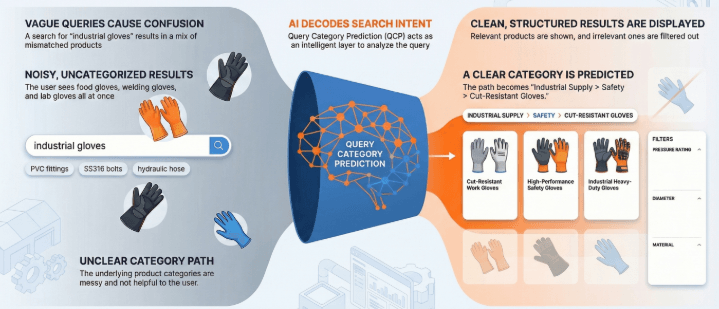
Query Category Prediction (QCP) solves this issue. It’s like giving your search engine a bit of common sense. QCP understands the intent behind a shopper’s query - figuring out what they probably meant - and then lines up the most relevant products.
So when someone searches for “stainless fasteners,” QCP knows they’re likely looking under Industrial Hardware > Bolts & Screws, not Cookware > Steel Utensils.
Key Takeaways
-
QCP interprets the real intent behind B2B search terms and routes queries to the correct product categories.
-
B2B buyers rely on shorthand, material grades, and technical codes, and QCP translates these into precise category matches.
-
Accurate category prediction increases conversions, reduces bounce rates, and strengthens visibility for high-value SKUs.
-
QCP enhances search performance by turning vague or incomplete queries into clear, actionable demand signals.
What is Query Category Prediction (QCP)?
Query Category Prediction (QCP) is an AI method that determines the most relevant product category for any search query by analyzing language patterns, catalog structure, and behavioral signals. It assigns confidence scores to potential categories and uses them to shape results so buyers see products that match their intent.
You can think of it as a system that interprets the “true meaning” of a search term, then routes the query to the right product family.
Why QCP matters for B2B buyers
B2B buying differs from retail. It revolves around precision, repeatability, and strict specifications. QCP supports this environment in several ways:
1. Buyers enter with concrete intent: Procurement workflows rely on exact requirements. A category prediction layer reduces the cognitive load by eliminating irrelevant branches of the catalog. Example reasoning: When searching for “industrial gloves,” the system must disambiguate between cut resistance, chemical protection, thermal safety, or food-grade compliance.
2. Many B2B queries are incomplete or shorthand: Procurement users often type material grades, part codes, diameter or pressure class, chemical abbreviations. Generic search logic misinterprets these terms. QCP decodes them into clear category paths, which reduces time spent cross-checking.
3. B2B catalogs carry complex hierarchies: Industrial supply catalogs run tens of thousands of SKUs across deep hierarchies. Misclassified results disrupt workflows because buyers expect a direct route to their exact component. QCP contains that complexity by steering queries to the correct branch.
4. Every irrelevant result increases abandonment risk: In B2B, abandonment is structural. If search causes friction, buyers shift vendors for efficiency rather than preference. QCP improves relevance at the top of the funnel so procurement teams continue sourcing from the same supplier.
5. It drives measurable operational efficiency: Shorter session times, fewer refinements, and fewer product mis-selections reduce total procurement effort. B2B suppliers gain higher conversion rates and stronger repeat-order reliability.
Why QCP drives ecommerce growth
• Higher conversions from faster discovery • Lower bounce rates due to reduced irrelevant output • Stronger SKU visibility through intent alignment • Better understanding of buyer language for continuous optimization
QCP - Decoding shopper intent in real time
Netcore Unbxd’s AI-driven QCP algorithm predicts which product categories are most relevant for every query.
Depending on the configuration, QCP can:
-
Filter out irrelevant SKUs (e.g., remove “PVC sheets” from results for “PVC pipes”)
-
Boost results from high-confidence categories (e.g., prioritize MRO > Hydraulic Fittings for “pressure couplings”)
Every search returns precise, business-ready results that match buyer intent, not just text input.
How Query Category Prediction works: The smart layers behind better search
At its core, QCP operates through three intelligent steps:
-
Query analysis: When a shopper types a search term, QCP immediately analyzes the query against historical search data, product catalog information, and user behavior patterns. It doesn't just look at the words; it understands the context.
-
Category prediction: Machine learning models trained on millions of B2B search sessions predict category relevance with confidence scores. A query like “safety helmet” might score 92% under Safety Equipment, 55% under Construction Gear, and 10% under Industrial Apparel.
-
Result optimization: Based on these predictions, QCP dynamically adjusts what shoppers see. Products from high-confidence categories get priority placement, while irrelevant items get filtered out or pushed down. The result? Shoppers find what they want faster, with fewer distractions.
QCP's advanced capabilities
Modern QCP systems go beyond simple category matching:
-
Learning from user behavior: Every click, add-to-cart, and purchase teaches QCP something new. If shoppers consistently ignore certain categories for a particular query, QCP learns to deprioritize them. This continuous learning means search results get smarter over time.
-
Personalization layer: For returning customers, QCP can prioritize SKUs or categories they frequently order, such as “medical gloves” defaulting to Latex, Size M for a healthcare supplier.
-
Handling typos and synonyms: QCP is built to interpret the technical vocabulary, shorthand, and abbreviations that dominate B2B searches. In industries like manufacturing, construction, or automotive, buyers rarely type full product names - they use industry codes, material grades, or shorthand terms that generic search engines fail to connect.
For example:
-
A buyer searching for “MS plates” expects mild steel plates, not miscellaneous metal sheets.
-
“SS316 bolts” should instantly surface stainless steel 316-grade fasteners rather than general hardware.
-
“HDPE fittings”, “PVC 4-inch elbows”, or “NBR seals” all carry material and dimensional context that needs decoding.
Why it matters for ecommerce growth
-
Higher conversion rates: Shoppers find what they’re looking for faster.
-
Lower bounce rates: Fewer irrelevant results mean fewer drop-offs.
-
Better product visibility: Products are surfaced based on intent, not keyword match.
Richer search insights: Learn what your customers actually mean when they search. In short, QCP takes the guesswork out of search. Understanding shopper intent, filtering irrelevant results, and boosting relevant products make every search faster, smarter, and more accurate. For ecommerce, that means higher conversions, fewer frustrated shoppers, and better visibility for the products that matter. Simply put: QCP turns confusion into clarity.
Know more about how Netcore Unbxd’s QCP algorithm works. Connect with us today!
FAQs
Does QCP help with vague or incomplete queries?
Yes. Queries like “PVC fittings” or “hydraulic hose” are mapped to the correct product families using context, which reduces irrelevant output.
How does QCP impact conversions?
By filtering noise and surfacing the right SKUs faster, QCP increases conversion rates, reduces bounce, and strengthens repeat-order reliability.
Does QCP help returning buyers?
For repeat customers, QCP can prioritize the categories or SKUs they frequently purchase, which shortens replenishment cycles.
Is QCP only useful for large catalogs?
Any catalog with multiple product families, technical attributes, or overlapping categories benefits from category prediction, especially in B2B environments.
How does QCP handle products that belong to multiple categories?
QCP assigns confidence scores across multiple possible categories. Instead of forcing a single match, it prioritizes results from high-confidence categories while suppressing low-relevance ones. This ensures buyers still see the most probable matches without losing edge cases.


