- ProductsSearch and BrowseRecommendationsCustomer Engagement
From black box to glass box: How to evaluate an AI powered search engine for ecommerce


Key takeaways
-
AI powered search engines are now core revenue drivers in ecommerce, but without transparency, teams cannot diagnose ranking issues or optimize effectively.
-
There is a clear difference between cosmetic explainability and true decision-level transparency in an AI search engine.
-
AI search relevance must be measurable and interpretable. If merchandisers cannot understand why products rank the way they do, relevance cannot be strategically controlled.
-
A transparent AI driven search platform provides real-time audit trails, plain-language ranking explanations, and human-in-the-loop override controls.
-
Netcore Unbxd believes that explainability must extend beyond search to browse, recommendations, and personalization to eliminate blind spots in the AI website search journey.
-
Opaque AI based search engines create operational delays, campaign risk, compliance exposure, and slower experimentation cycles.
-
A structured evaluation scorecard helps ecommerce teams benchmark their current AI search for ecommerce maturity and identify gaps.
-
Netcore Unbxd’s Glass box AI powered search transforms explainability from a compliance requirement into a competitive growth advantage.
AI is already running your ecommerce experience:
Your AI powered search engine ranks products.
Your AI driven search system personalizes results.
Your AI search engine determines which SKUs surface, which disappear, and which convert.
But when something goes wrong, can anyone explain why?
A shopper searches “running shoes” and sees dress shoes.
A high-margin product drops from category rankings.
A promotional boost doesn’t move conversions.
You ask your vendor what happened, and the answer is vague.
This is the black box problem in AI search for ecommerce.
As ecommerce teams adopt increasingly complex AI based search engines, explainability is no longer optional. It is the difference between optimization and guesswork.
The gap between “explainable AI” and a truly transparent AI search engine
Nearly every AI search engine claims to be explainable. What that actually means varies significantly.
There are three levels:
Level 1: Post-hoc narratives
The system generates results first, then produces a plausible explanation afterward. This is cosmetic explainability.
Level 2: Feature importance reporting
The AI-based search engine shows weighted signals such as price, brand, or click-through rate. Useful for analysts but rarely actionable in real time for merchandisers.
Level 3: Decision-level transparency
A genuine glass box AI-powered search engine shows exactly why a product ranked where it did for a specific query, category page, or personalized session. It explains ranking signals in plain language and allows intervention.
Level 3 is what defines a mature AI-driven search platform. It transforms AI search relevance from a mystery into a controllable lever.
When evaluating vendors, your first question should be:
At what level does your AI search engine operate?
Five capabilities that define a transparent AI-powered search engine
Use this checklist when evaluating any AI search for ecommerce.
1. Real-time decision audit trails
Every ranking decision should carry a visible audit trail.
A merchandiser investigating why Product A ranked below Product B should be able to click and instantly see:
- Relevance score
- Behavioral data weight
- Inventory signals
- Active boost or pin rules
- Personalization factors
2. Interpretable AI search relevance signals
Relevance drives revenue.
A glass-box AI search engine should explain ranking in business terms, not in terms of model weights.
For example:
“This product ranked first because it has a 94% semantic match to the query, 3x higher click-through rate than category average in the past 7 days, and meets your inventory threshold.”
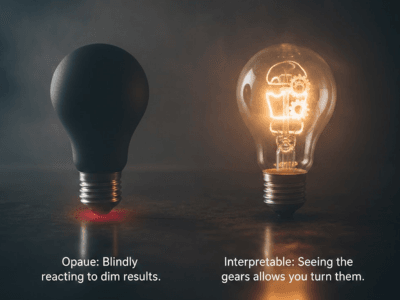
When AI search relevance is interpretable, merchandisers can refine it.
When it is opaque, they can only react to outcomes.
3. Human-in-the-loop controls that layer on AI logic
Explainability without control creates visibility without authority.
The best AI-powered search engines allow business rules to coexist with machine learning logic.
A layered system works like this:
- AI-driven search provides the baseline ranking
- Merchandisers apply boosts, pins, and filters
- The system clearly shows how overrides interact with AI logic
This prevents conflict between business strategy and algorithmic learning.
4. Explainability across the entire AI website search journey
Some platforms offer transparency in search but remain opaque in:
- Category page ranking
- Personalized recommendations
- Cross-sell and upsell modules
- Email product blocks
True AI search for ecommerce requires end-to-end explainability across:
- Search
- Browse
- Recommendations
- Personalization
An explainability gap at any point in the journey introduces operational and compliance risks.
5. Verifiable continuous learning
Modern AI-based search engines continuously adapt.
That adaptability creates a new requirement: visibility into behavioral change.
Questions you should be able to answer:
- Did a recent model update alter AI search relevance in key categories?
- Is personalization drifting away from seasonal strategy?
- Which signals caused performance improvements?
A glass box AI-powered search engine provides:
- Before and after ranking comparisons
- Signal attribution
- Model update logs
- Trend analysis tied to KPIs
Without this, continuous learning becomes continuous uncertainty.
AI search relevance: The core growth lever
AI search relevance directly impacts:
- Conversion rate
- Average order value
- Bounce rate
- Customer satisfaction
Research shows that poor search relevance significantly increases abandonment rates in ecommerce environments. When shoppers cannot find relevant results quickly, trust erodes rapidly.
A transparent AI-driven search system makes relevance adjustable and measurable. You can understand:
- Why certain products outrank others
- How behavioral data influences results
- Where business rules intervene
- How personalization reshapes ranking
This turns AI search from an opaque algorithm into a controllable revenue engine.
How Netcore Unbxd delivers glass box AI-powered search
Netcore Unbxd’s AI-powered search solution is built on a glass box foundation.
Explainability is embedded into:
- Search rankings
- Category browse ordering
- Recommendations
- Personalization
Within the merchandising console, teams see exactly why products rank where they do. Ranking signals including behavioral data, catalog relevance, business rules, and personalization factors are surfaced in plain language.
When merchandisers apply boosts or pins, the system clearly shows how those rules interact with AI driven search logic.
The Agentic AI layer extends transparency further. Autonomous ranking adaptations are logged, attributed, and reviewable. Teams see not only that KPIs improved, but which signals drove that improvement.
For ecommerce brands evaluating an AI website search platform, this level of transparency transforms search from reactive infrastructure into strategic advantage.
Making the internal case for a transparent AI search engine
Different stakeholders care for different reasons.
CMO and commercial leadership:
AI search relevance clarity reduces campaign risk and improves revenue attribution.
Merchandising teams:
You move from AI operator to AI overseer. Your expertise shapes machine intelligence.
Technology and compliance teams:
Audit trails and governance reduce regulatory exposure and support overhead.
Explainability strengthens alignment across teams.
The competitive advantage of glass box AI
Demanding transparency in your AI powered search engine is not just risk management.
It enables:
- Faster iteration
- Cleaner attribution
- Higher relevance
- More precise merchandising control
- Stronger personalization strategies
See explainability in action across search, browse, and recommendations.
Request a Glass Box Demo with Netcore Unbxd.
FAQs
What is the black box problem in AI search?
It’s when your AI powered search engine ranks products but cannot clearly explain why. When rankings shift, promotions underperform, or personalization misfires, teams lack visibility into the decision logic.
That leads to guesswork instead of optimization.
What defines a truly transparent AI search engine?
There are three levels:
- Post-hoc explanations that justify results after the fact
- Signal reporting that shows feature weights like price or CTR
- Decision-level transparency that shows exactly why Product A ranked above Product B for a specific query or session
Only decision-level transparency provides real control.
Why does AI search relevance matter so much?
Search relevance directly influences:
- Conversion rate
- Average order value
- Bounce rate
- Customer satisfaction
Research shows that poor onsite search relevance significantly increases abandonment.
Relevance is a revenue lever. If it cannot be interpreted, it cannot be optimized.
How can I test if a vendor’s AI search is transparent?
Ask them to demonstrate:
- Real-time ranking audit trails
- Plain-language ranking explanations
- Clear visibility into boosts and overrides
- Before/after comparisons after model updates
- Transparency across search, browse, and recommendations
If they cannot show this live, transparency is likely superficial.
What is human-in-the-loop control?
It means:
- AI sets the baseline ranking
- Merchandisers apply strategic overrides
- The system clearly shows how overrides affect results
Without this balance, AI either dominates strategy or becomes overly manual.
Why must explainability extend beyond search?
Ranking logic affects:
- Category pages
- Recommendations
- Personalization
If only search is transparent, blind spots remain in the discovery journey. End-to-end visibility is essential for governance and performance control.
How does Netcore Unbxd deliver glass box AI?
Netcore Unbxd embeds decision-level transparency across search, browse, recommendations, and personalization.
Merchandisers can:
- See why products rank where they do
- View behavioral and catalog signals in business language
- Understand how boosts interact with AI logic
- Review autonomous ranking updates
This turns explainability from a compliance requirement into a growth advantage.


