- ProductsSearch and BrowseRecommendationsCustomer Engagement
Beyond Intent: Why Situational Discovery Is the Next Era of Ecommerce Search


A shopper lands on an outdoor retailer’s site on a Tuesday afternoon and types two words into the search bar: trail jacket.
To the search engine, that query is clean and simple. It retrieves 140 jackets tagged for trail use, boosts the bestsellers, and ranks them by relevance. Technically, the engine did its job.
Except it missed the entire reason the shopper came to the site.
She lives in Portland, and the local forecast calls for five straight days of heavy rain. She doesn't need a lightweight windbreaker designed for desert running, and she doesn't need an insulated parka built for January in Minnesota. Meanwhile, another shopper in Phoenix typing the exact same two words is staring down a 104°F afternoon with a monsoon watch on the horizon.
Rain in Portland and heat in Phoenix shouldn't produce the same product grid. Yet on almost every retail site today, they do. Better query parsing can’t fix that problem, because neither shopper ever typed the word "rain" or "heat."
For the last decade, ecommerce leaders have invested heavily to make search smarter. Still, the gap between what a shopper types in the search bar and why they actually clicked into the store remains wide open. Closing that gap requires moving past what the shopper typed and starting to read their situation.
From keywords to intent to situation
Online product discovery has moved through three generations.
Generation 1: Keyword. This is where online retail started. The engine matches the literal words a shopper types against the words stored in your product catalog, and every shopper gets the exact same page. If the catalog says "crimson" and the shopper types "red," they hit a dead end unless someone manually writes a rule to connect them.
Generation 2: Intent. Starting in the mid-2010s, search engines began reading the meaning behind the query using named entity recognition (NER), synonyms, and vector search. If a shopper types "crimson," the engine understands they mean red. If they type "couch for a small apartment," it knows to look for loveseats and apartment-sized sectionals. This was a real improvement, and it is where most platforms today still sit. But intent-based search has hard ceiling limits. It still requires a typed query to do its best work. It still demands constant manual tuning to keep bad results from creeping onto page one. Most importantly, it only understands the sentence and not the person.
Generation 3: Situation. This is where the category is moving now. Instead of waiting for a detailed query and trying to dissect its grammar, a situation-aware engine reads the whole context around the shopper, whether or not they typed it, and builds the online experience for that specific moment.
Across most retailers we speak to today, the single most common reason for leaving their existing product discovery solution was simply that it wasn't smart enough, with most pointing directly to AI or semantic gaps.
Across those conversations, a clear pattern emerged: leaders felt their "AI search" still behaved like dressed-up keyword matching. It didn't truly understand shoppers.
What Is a "Situation"?
A situation is the real-world reason the shopper is in your store at all. The search box only ever sees a tiny fraction of it. Intent parses the query. Situational discovery reads the situation. Instead of treating every visit as a blank slate until the shopper types a five-word prompt, situational discovery pulls together the real-time signals surrounding the visit:
- Location: The shopper is browsing from Phoenix, Arizona.
- Local weather: It is currently 104°F with an active storm watch.
- Season: It is late summer, right on the edge of the seasonal transition.
- Local inventory: What is actually in stock at the two retail locations within 20 miles of their zip code.
- Past shopping behavior: When logged in, their history shows they consistently prefer dark colorways and buy gear geared toward multi-day backcountry trips.
- Local trends: Sun hoodies and hydration packs are surging within a 50-mile radius this week.
No single signal does much on its own. The shift happens when the discovery engine synthesizes all of these signals simultaneously with what the shopper is doing on the page, shaping the product selection and the guidance in real time.
Situations Hide in Plain Sight
Once you start looking for situations, you realize every shopper brings one to your site, even when their search queries look generic.
- Apparel: A shopper searches for a midi dress because they are attending an outdoor wedding in Tuscany in June. They need breathable fabric that packs well and fits a semi-formal dress code, not a heavy velvet evening gown.
- Electronics: A shopper searches for a laptop. What the query leaves out: they need a machine capable of 4K video editing and they have a hard budget under $1,500, even though they never clicked a price filter or typed "video editing."
- Beauty: A shopper searches for moisturizer. The part they never typed: they have chronically dry skin, it’s the middle of a harsh winter, and they need a strictly fragrance-free formula.
- Furniture: A shopper searches for a sectional. What the search box never hears: the apartment is 600 square feet, the elevator is narrow, and there is a dog in the house. They need something compact that ships in pieces and comes in a fabric that cleans easily, not the biggest seller in the category.
In every one of these cases, intent-based search looks at the noun (dress, laptop, sectional, moisturizer, jacket) and dumps the shopper into a massive, generic category grid. The shopper is left to do the work, clicking eight filters, reading dozens of spec sheets, and opening ten browser tabs to figure out which product actually fits their life.
What a Situation-Aware Experience Looks and Feels Like
Here is what happens when a site actually understands the situation.
Go back to the Portland shopper who typed "trail jacket."
A situation-aware experience sees the five days of rain in her forecast before she types another word. Instead of 140 jackets ranked by bestseller, it leads with waterproof, seam-sealed shells and moves the desert windbreakers and insulated parkas down the page. The Phoenix shopper who typed the same two words sees lightweight, breathable layers first.
Above the results, a short, scannable note explains why these specific items were chosen for a wet week on Portland trails. On the product grid below, the engine automatically preselects the darker colorways on the product cards because it knows that’s what this shopper usually buys.
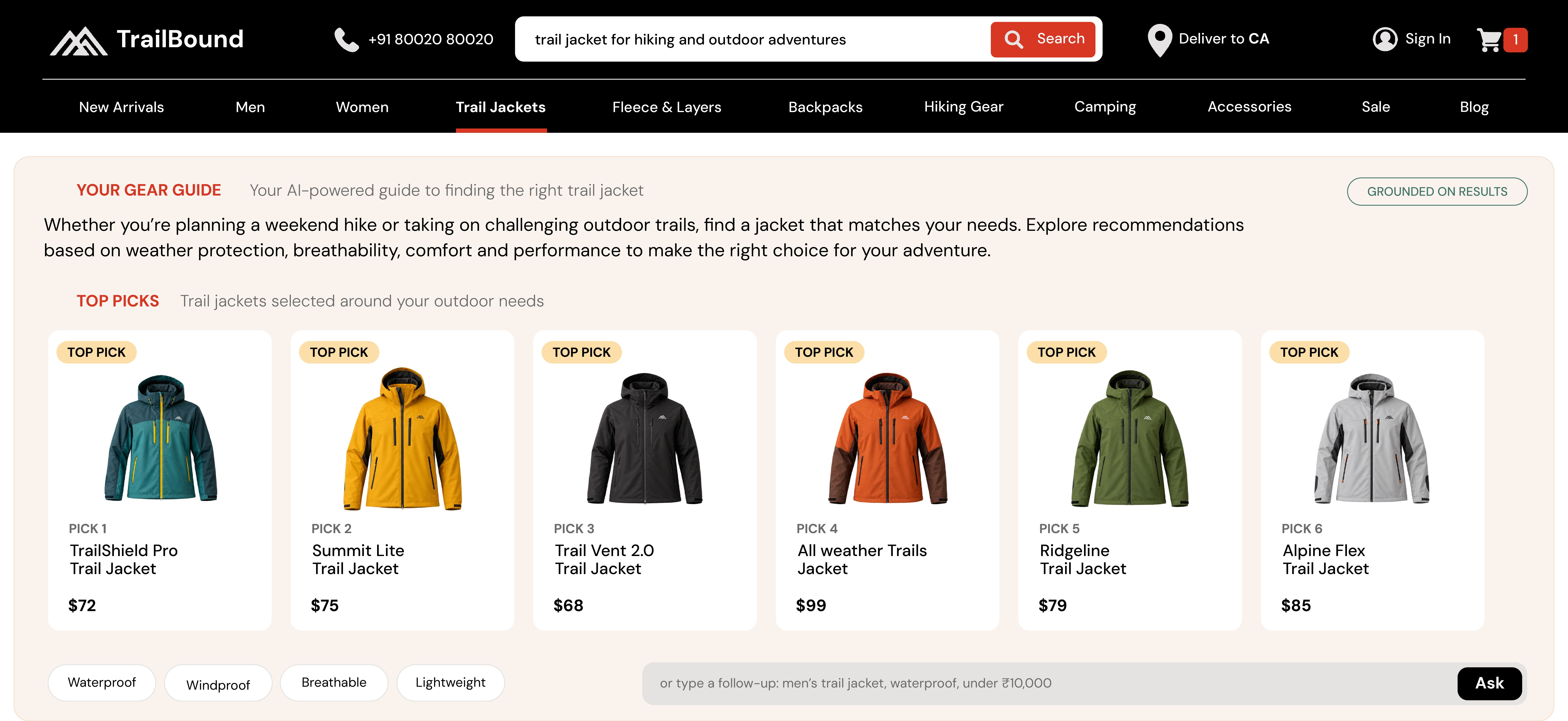
The familiar store stays intact. The product grid, the facet filters, and the sort dropdowns are all still right where the shopper expects them. Nothing replaces the store or forces the shopper into a weird, unfamiliar interface.
This is also why situational discovery is not a chatbot.
We have all seen the chat widgets bolted onto the bottom corner of retail sites. Shoppers don't want to interview a bot in a sidebar window just to buy a jacket.
In a situation-aware experience, answers live right where the shopper already is:
- On the product card: As the shopper hovers or taps on a jacket, they can ask a question about that specific item, right on the item. Better yet, the card surfaces smart, suggested questions like "Will this hold up in all-day rain?" or "Does it pack into its own pocket?" so the shopper doesn't even have to type.
- Above the results: Suggested refinements sit right at the top of the grid. One tap on "Packable" or "Under $150" reshapes the entire page instantly. There is no starting a new search from scratch, and no leaving the store layout.
Shoppers aren't surprised by this format anymore. Tools like Google’s AI Mode have already trained consumers to expect instant context at the top of the page, connected to real options below.
Why Transparency Builds Trust
Whenever personalization gets smarter, smart retail leaders ask the same question: Will this feel creepy to my customers, and can I trust what the AI says?
Situational discovery addresses the trust problem through three guardrails:
- It shows its work. The experience explicitly tells the shopper why it picked what it picked. That plain-spoken openness is exactly what keeps personalization feeling helpful rather than invasive.
- It respects privacy boundaries. If a shopper isn't logged in, the experience relies strictly on ambient context: general location, local weather, and season. Personal purchase history and style preferences are layered in only when the retailer already has an established, opted-in relationship with that shopper.
- It stays grounded in your catalog. Unlike open-ended conversational bots that can hallucinate advice or recommend products you don't even carry, every explanation and answer is strictly anchored in your live catalog data, specs, and inventory.
One Question to Ask About Your Site
You don’t need a massive replatforming roadmap to see where your current discovery experience stands. Just open your storefront on your phone today, step into the shoes of a customer with a real project or trip in mind, and run a few searches.
Then ask yourself one question:
Does your discovery engine know why your shopper came to your store today or does it only know what they typed?
Frequently Asked Questions
Traditional intent-based search focuses on parsing what a shopper typed into the search bar (e.g., matching keywords and synonyms for "trail jacket" to tagged attributes). Situational discovery goes a step further by understanding why the shopper is searching in that specific moment. By factoring in real-world context, such as local weather forecasts, seasonal timing, device context, or the broader project the shopper is tackling, it dynamically adjusts product rankings so the results match their actual situation rather than returning a generic list of bestsellers.
No. While situational discovery can incorporate opt-in user preferences or past behavior, much of its power comes from non-invasive, real-time ambient signals, like regional weather, time of year, or the sequence of queries within a single active session. This allows retailers to deliver highly relevant, context-aware product grids even to anonymous, first-time visitors without relying on heavy tracking or third-party cookies.
Retailers can start by layering context-aware signals onto their existing semantic or AI-powered search engine. Practical first steps include enriching product catalogs with situational attributes (such as "waterproof," "high-heat breathable," or "beginner-friendly"), configuring dynamic merchandising rules triggered by location or weather APIs, and leveraging conversational or guided search interfaces that invite shoppers to share their specific use case directly in the search bar.


