- ProductsSearch and BrowseRecommendationsCustomer Engagement


Shoppers today don’t just browse; they expect instant recognition, inspiration, and accuracy. Visual discovery bridges that expectation. Instead of typing vague keywords, shoppers simply upload or select an image and instantly find relevant products.
But for business leaders, the core question goes beyond experience:
Does visual search actually drive measurable ROI?
The answer is yes when measured through the right lens. Instead of just enhancing UX, visual search increases conversions, lifts revenue, reduces operational costs, and strengthens customer loyalty.
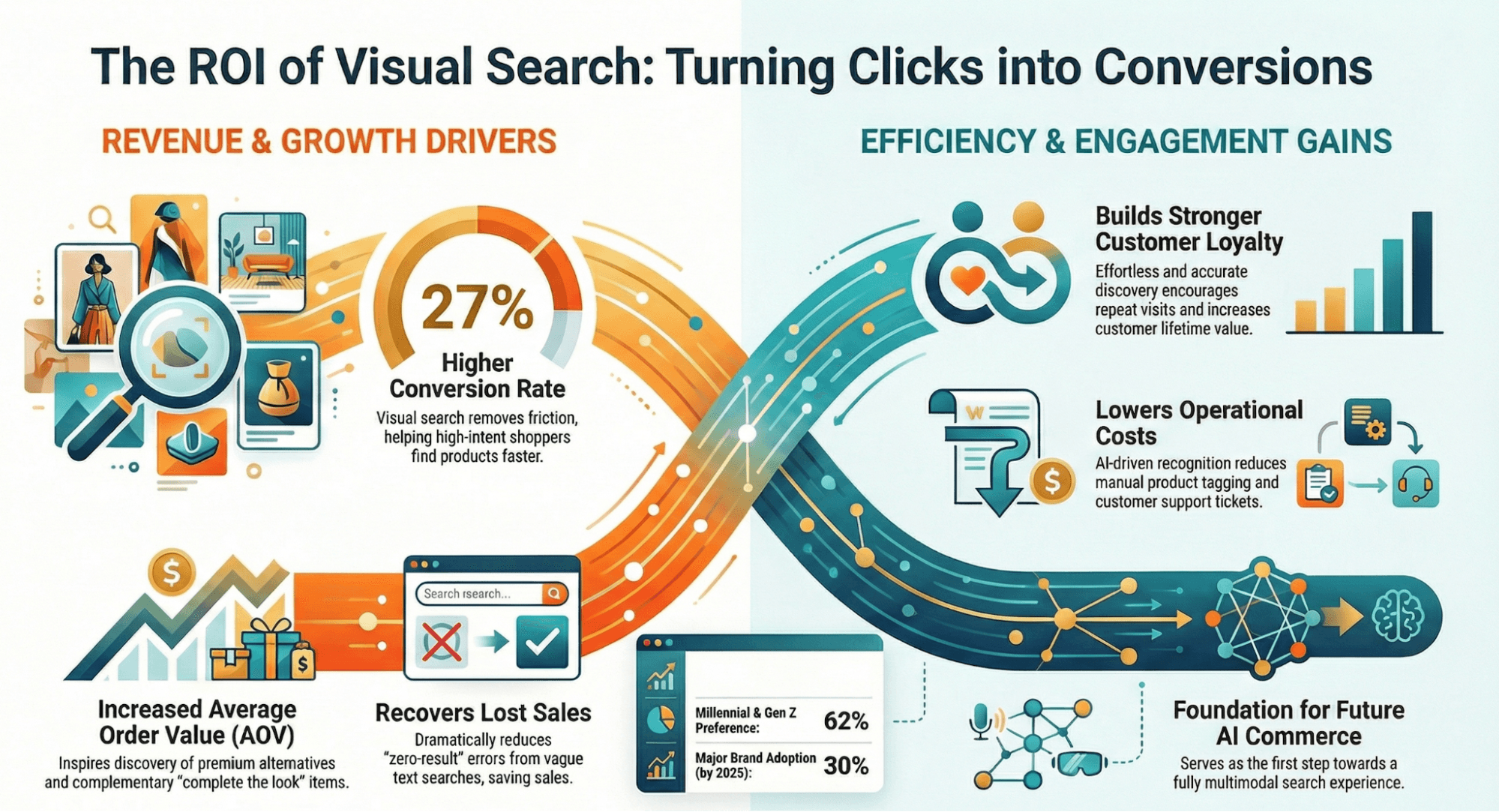
Quick fact: By 2025, 30% of major ecommerce brands are expected to integrate visual search into their platforms.
Key Takeaways
- Higher conversions: Visual search captures high-intent shoppers and lifts conversion rates by up to 27%
- Bigger baskets: Inspiration-led discovery increases AOV, items per basket, and cross-sell rates
- Fewer zero-results: Image-based discovery recovers lost searches and reduces abandonment
- Stronger loyalty: Effortless discovery drives repeat visits and higher lifetime value
- Lower costs: Automated visual tagging reduces manual merchandising and support effort
- Compounding ROI: Growing adoption improves relevance and personalization over time
- Future-ready: Visual search sets the foundation for multimodal, AI-driven commerce
Here are the performance metrics that truly define its business impact.
Conversion rate impact: Turning high intent into purchases
Visual search attracts shoppers who already know what they want. They may not know how to articulate it like “floral midi dress with ruffled sleeves,” but they know it when they see it. Visual search shortens the distance between intent and product discovery.
What to measure
- Conversion rate of visual search users vs traditional search users
- Checkout completion rate
- Time from discovery to purchase
Why it matters
By eliminating keyword dependency and friction, visual search helps shoppers land on relevant products faster. When frustration disappears, purchase likelihood rises. In fact, according to a report, visual search leads to a 27% higher conversion rate on ecommerce platforms.
Average order value and basket size uplift: Enabling inspiration-led shopping
Visual search is not about finding. It is about discovering. When shoppers see visually similar and complementary items, they explore more and buy more.
What to measure
- Average order value uplift
- Items per basket
- Cross-sell or attach rate
Business outcome
- Shoppers discover premium alternatives
- “Complete the look” bundles become natural
- Complementary suggestions elevate basket value
Visual search becomes a subtle but powerful revenue growth engine. About 62% of millennials and Gen Z prefer using visual search when compared to other types of search.
Zero-result rate reduction: Recovering revenue lost in failed searches
Zero results equal lost revenue and frustrated customers. Visual search dramatically reduces this problem by understanding attributes text often fails to capture, style, shape, texture, pattern, and context.
What to measure
- Reduction in zero-result rate
- Successful search completion rate
- Post-search bounce rate
According to a study, when ‘No Results’ pages fail to offer alternate paths for users to continue exploring, shoppers often abandon the site, yet 50% of websites still don’t provide these options. So, every recovered search is a recovered sale and a saved customer.
Customer engagement impact: Building loyalty through effortless discovery
When shoppers experience accurate, instant product recognition, they return. Visual discovery becomes a natural part of their shopping journey.
What to measure
- Repeat visual search usage
- Session depth
- Time on site
- Frequency of return visits
Effortless discovery leads to higher satisfaction, stronger loyalty, and increased lifetime value. A study reveals that 60% of users are more likely to return to a site that offers visual search over one that doesn't.
Cost efficiency gains: Reducing operational effort and support dependency
ROI isn’t only about revenue gained; it's also about cost saved. Visual search reduces manual and operational burden across teams.
Where to measure efficiencies
- Reduction in manual product tagging
- Fewer product discovery support tickets
- Lower merchandising intervention
AI-driven recognition automates catalog understanding and reduces dependency on human effort, allowing teams to focus on strategy rather than firefighting discovery gaps.
Adoption and feedback: Ensuring ROI compounds over time
Visual search ROI strengthens as adoption grows and experience improves.
What to measure
- Adoption rate across devices and categories
- Usage growth trends
- Shopper satisfaction and feedback
Strong adoption signals trust. And every optimization round compounds business gains.
Linking visual search Analytics to core business KPIs
Visual search should never exist in isolation. Its performance must directly map to broader ecommerce and revenue outcomes.
Connect visual search metrics to
- Revenue per session
- Gross margin impact
- Reduction in abandonment
- Inventory discoverability and movement
- Personalization performance uplift
When integrated into your analytics strategy, visual search becomes a strategic growth lever.
The bottom line
Visual search delivers ROI through:
- Higher conversions
- Bigger baskets and higher AOV
- Reduced zero-result frustration
- Stronger engagement and loyalty
- Lower operational costs
- Continuous optimization
- Direct linkage to business KPIs
For ecommerce leaders, the question is no longer whether visual search delivers ROI; it is how quickly you can implement, measure, and scale it.
Visual search as the first step toward multimodal search
Visual search strengthens the entire discovery stack in meaningful ways:
- It enriches product catalogs by automatically deriving visual attributes such as color, pattern, style, and structure, enhancing metadata quality and helping AI systems better interpret shopper intent.
- It reduces zero-result frustrations, accelerates product finding, and makes mobile discovery significantly more intuitive, turning inspiration discovered on social platforms or real-world moments into shoppable experiences.
- Most importantly, visual search becomes the practical first step toward a fully multimodal future, where images, text, behavior, and contextual signals converge to understand shoppers more holistically. By immediately improving relevance, conversion, and discovery success, visual search delivers measurable returns today while building the technological foundation for next-generation AI commerce experiences.
What makes Netcore Unbxd visual search an ideal solution for your business
Netcore Unbxd Visual Search is built to transform inspiration into action by allowing shoppers to discover products using images instead of text. It is an API-enabled capability that ingests an image, extracts meaningful visual attributes, converts them into embeddings, and returns highly relevant product matches.
Designed for visually expressive categories like apparel, footwear, and furniture & home decor, it ensures shoppers find what they want, even when they don’t have the words to describe it.
Best practices for maximizing performance
Successful outcomes depend on image quality, catalog readiness, and thoughtful UX placement. Retailers see best results when they use high-quality product images, maintain structured catalog attributes, position “search by image” prominently in the UI, and leverage insights from visual search queries to shape merchandising and taxonomy decisions.
Powered by the Netcore Unbxd ecosystem
- Supports hybrid search (image + text)
- Enhances recommendations with visually similar items
- Improves personalization by learning visual preferences
- Feeds engagement data into unified analytics
The bottom line
Netcore Unbxd visual search aligns human visual behavior with machine intelligence. It simplifies discovery, reduces effort, increases engagement, boosts conversion, and prepares retailers for the next generation of AI-driven commerce.
Brands can start by piloting the Netcore Unbxd Visual Search API, integrating it into storefront UX, tracking usage patterns, and optimizing experiences based on visual behavior signals.
Ready to turn visual discovery into measurable business growth?
If you’re ready to:
- Benchmark visual search against your current search performance
- Understand its direct revenue and cost impact
- Build a strong business case for investment
It’s time to see it in action.
Book a personalized ROI analysis with Netcore Unbxd and discover how visual search can accelerate discovery, delight shoppers, and drive measurable business growth.
FAQ
How does visual search reduce revenue loss from failed searches?
Visual search reduces revenue loss from failed searches primarily by eliminating the "zero-result" pages that occur when traditional text queries fail to match a product in the catalog. Because a significant portion of lost revenue stems from frustrated customers who cannot find what they are looking for, recovering these searches directly impacts the bottom line.
Which metrics measure visual search's impact on basket size?
To measure the impact of visual search on basket size and the overall value of a shopping session, several specific metrics are used to track how inspiration-led discovery translates into larger purchases.
The primary metrics for evaluating this uplift include:
- Items per Basket
- Average Order Value (AOV) Uplift
- Cross-sell or Attach Rate
- Revenue per Session
- Inventory Discoverability and Movement
- Session Depth
Why do millennials and Gen Z prefer visual search tools?
According to the sources, 62% of millennials and Gen Z prefer using visual search over other search methods because it aligns with their expectations for a fast, intuitive, and inspiration-led shopping experience. This preference is driven by several key factors like Overcoming the "Vocabulary Gap”, Instant recognition and discovery, Reduced friction and frustration.
Why is visual search effective at reducing zero-result searches?
It understands visual attributes like color, pattern, and style, enabling discovery even when text queries fail.
Is visual search only suitable for fashion?
It performs best in visually expressive categories like fashion, footwear, beauty, and home décor, but can add value anywhere visual attributes matter.


