- ProductsSearch and BrowseRecommendationsCustomer Engagement
Turn search analytics into revenue-driving actions


Key takeaways
-
Search intent is the most valuable signal: Every query reflects immediate buying intent. Teams that act on it in real time outperform those relying on delayed reports.
-
Reactive merchandising limits growth: Weekly or monthly reporting cycles create lag, fragment insights, and increase manual effort, which directly impacts revenue.
-
Unified analytics unlock clarity: Connecting query data, product performance, and user behavior into a single view enables faster, more accurate decisions.
-
Query intelligence drives relevance: Understanding how customers search, and how those searches convert, helps identify gaps like low-converting high-volume queries.
-
Product and query mapping is critical: Linking SKUs to search behavior creates a feedback loop that improves both discovery and conversions.
-
AI turns insights into action: Features like query expansion, synonym suggestions, and automated redirects help capture missed demand and fix poor experiences instantly.
-
Human strategy + AI execution = scale: AI handles pattern detection and optimization, while merchandisers focus on strategy, campaigns, and business outcomes.
Search has always been the highest-intent signal in ecommerce. When a shopper types “men’s watches” or “summer dresses,” they are expressing clear intent. Yet most merchandising teams still operate in a reactive loop, spotting issues in reports days later and then manually fixing them.
That lag quietly erodes revenue.
Modern merchandising demands a shift. Instead of reacting to what already happened, teams need to anticipate, guide, and optimize experiences in real time. The bridge between these two worlds is search analytics, when it is connected directly to action.
Why reactive merchandising falls short
Traditional workflows look like this:
- Pull reports weekly or monthly
- Identify low-performing queries or products
- Create manual rules or campaigns
- Wait to measure impact
This approach creates three problems:
Delayed response to shopper intent
By the time trends are identified, demand may have already shifted.
Fragmented insights
Query data, product performance, and campaign impact live in separate views.
Heavy manual effort
Merchandisers spend more time analyzing than acting.
The result is a system that is always catching up instead of leading.
Turning search analytics into a decision engine
The real value of search analytics emerges when it becomes continuous, connected, and actionable.
1. Build a real-time view of site performance
A unified dashboard should allow teams to:
- Track conversion rates, revenue, and engagement trends
- Analyze performance over custom time ranges
- Segment users based on behavior or cohorts
Instead of static reporting, this becomes a live control panel for merchandising decisions.
2. Decode the voice of the customer through queries
Query-level insights reveal what shoppers actually want.
A strong query report helps teams:
- Identify top-performing and underperforming search terms
- Track how query performance evolves over time
- Understand which products users ultimately purchase after searching
This creates a direct link between intent (search terms) and outcomes (purchases).
For example, if “vest” shows high search volume but low conversion, it signals a mismatch between expectation and results, something that can be fixed immediately.
3. Connect product performance to search behavior
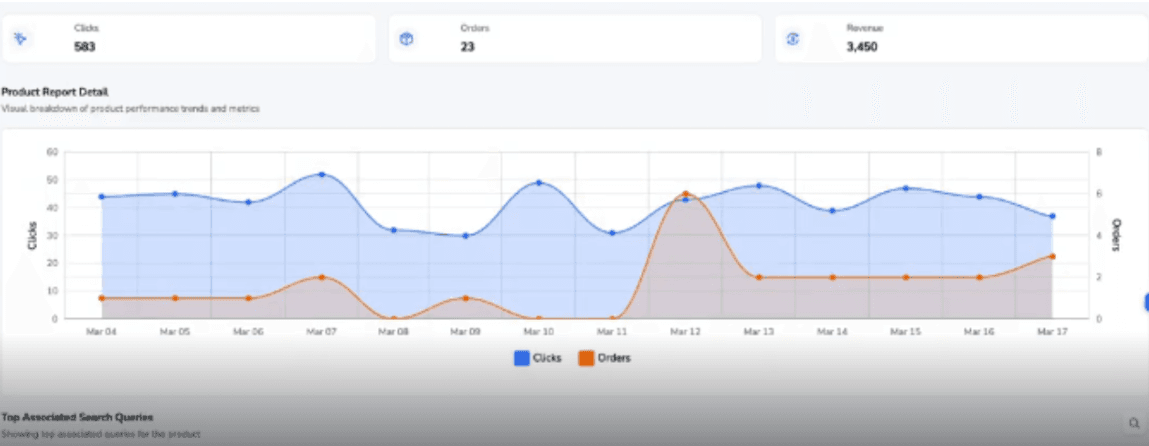
Product-level analytics complete the picture.
Teams can:
- Identify top-performing SKUs
- Analyze which queries drive traffic to specific products
- Generate detailed performance report cards for each SKU
This two-way visibility, queries to products and products to queries, allows for precise optimization.
Moving from insights to proactive action
Analytics alone does not drive revenue. Action does.
The next evolution is embedding AI directly into merchandising workflows so that insights automatically translate into opportunities.
4. Expand reach with AI-suggested queries
Shoppers rarely use the same phrasing. A single intent can have dozens of variations.
AI-suggested queries help:
- Identify alternative ways users express the same intent
- Automatically expand trigger points for campaigns
- Capture incremental traffic without manual effort
For instance, a campaign for “summer dresses” can be extended to include variations like “beach dresses” or “lightweight dresses,” ensuring broader coverage.
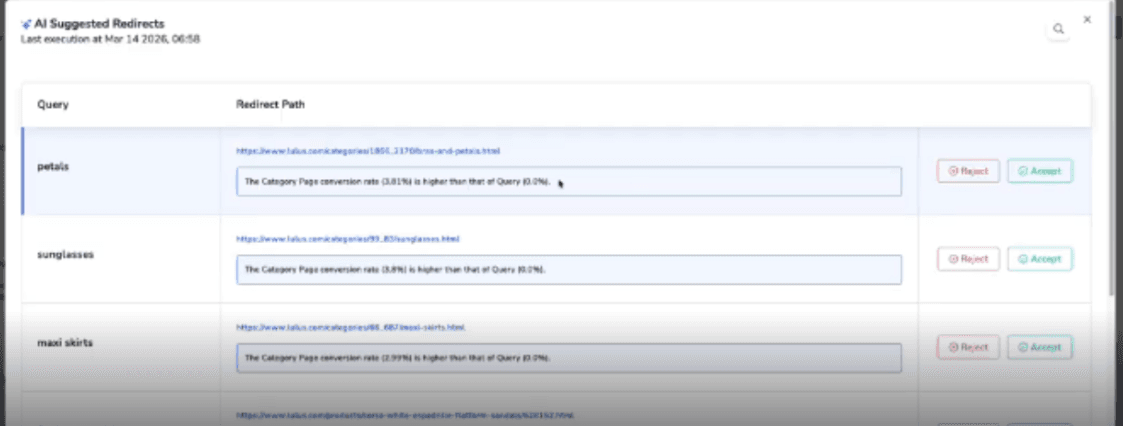
5. Fix dead ends with AI-powered redirects
Low-performing or ambiguous queries often lead to poor experiences.
AI can:
- Detect underperforming queries
- Map them to relevant product or content pages
- Provide performance predictions before activation
This ensures that even imperfect queries lead to meaningful outcomes instead of drop-offs.
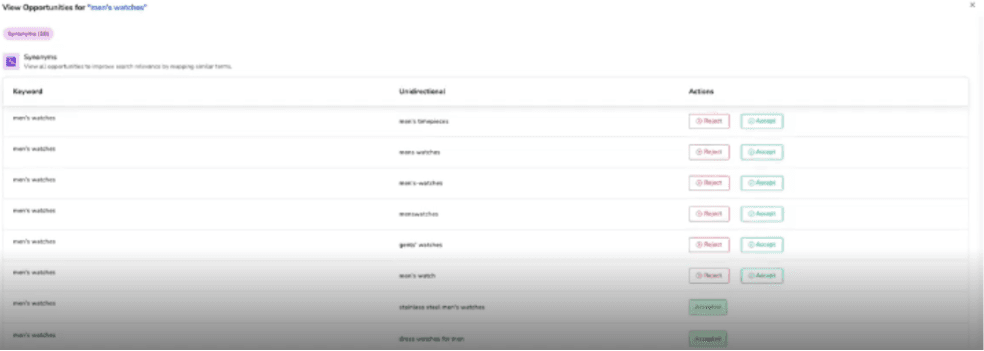
6. Surface hidden opportunities automatically
The biggest shift from reactive to proactive merchandising comes from identifying opportunities before they become problems.
A dedicated opportunities layer can highlight:
- Keyword enrichment gaps
- Missing synonyms
- Redirect opportunities
- Translation and transliteration needs
- Measurement-based search improvements
For example, in a category like “men’s watches,” the system might suggest adding synonyms such as “stainless steel watches” or “formal watches,” allowing teams to improve relevance instantly.
Instead of digging through reports, merchandisers receive prioritized, actionable recommendations.
From manual workflows to intelligent merchandising
This shift fundamentally changes how teams operate:
| Reactive merchandising | Proactive merchandising |
|---|---|
| Periodic reporting | Continuous insights |
| Manual rule creation | AI-assisted recommendations |
| Lagging indicators | Leading signals |
| High effort, low speed | Low effort, high impact |
The goal is not to remove human control, it is to amplify it.
AI handles pattern detection and suggestion generation, while merchandisers focus on strategy and decision-making.
The revenue impact of going proactive
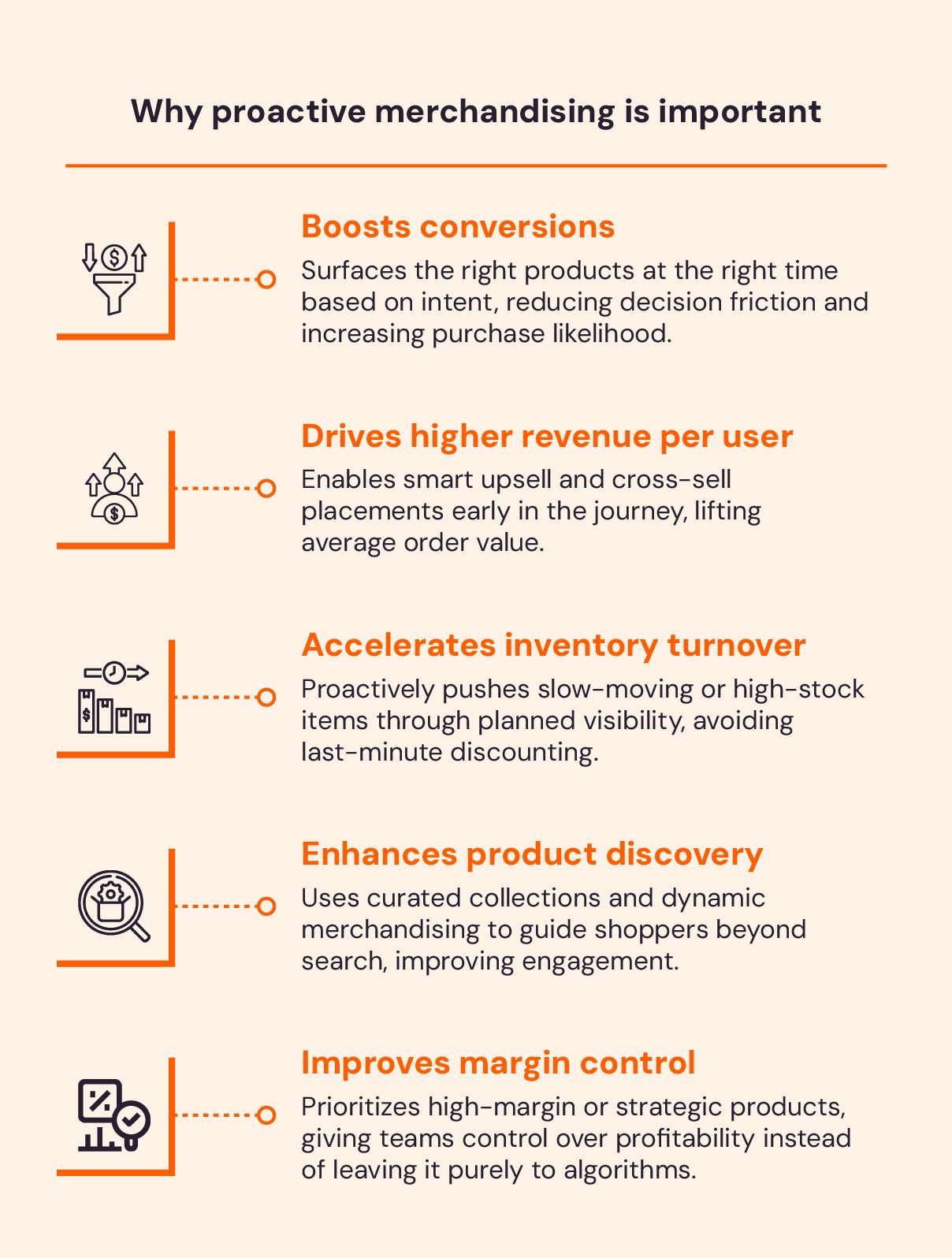
When search analytics directly drives action, the benefits compound:
- Higher conversion rates through better relevance
- Increased revenue per search by aligning intent with results
- Reduced bounce rates by eliminating dead-end queries
- Faster campaign execution with AI-assisted workflows
Most importantly, teams move from reacting to yesterday’s data to shaping today’s customer experience.
How Netcore Unbxd powers proactive merchandising
Turning search analytics into action requires a system that tightly connects insights, intelligence, and execution. This is where Netcore Unbxd shines.
Netcore Unbxd is designed to move merchandising teams from reactive workflows to continuous, AI-driven optimization by embedding action directly into analytics.
1. Unified analytics that drive decisions
Netcore Unbxd brings search, browse, and product performance into a single, real-time view. Merchandisers can:
- Track query-level performance alongside SKU-level outcomes
- Identify revenue-impacting trends instantly
- Analyze user behavior across segments and journeys
Instead of switching between reports, teams get a connected view that is ready for action.
2. AI that converts insights into recommendations
Rather than leaving teams to interpret data manually, the platform surfaces:
- Query expansion opportunities
- Synonym and attribute enrichment suggestions
- Underperforming search terms that need intervention
These are not just insights, they are prioritized recommendations that can be executed with minimal effort.
3. Built-in execution across merchandising levers
Netcore Unbxd closes the loop between insight and action by enabling teams to:
- Boost, bury, or pin products directly from analytics views
- Create redirects for low-performing queries
- Launch campaigns across search and browse without switching tools
This tight integration ensures that every insight can immediately translate into a revenue-driving action.
4. Balance between AI automation and human control
While AI continuously identifies patterns and opportunities, merchandisers retain full control over strategy. Teams can choose to automate routine optimizations while focusing their time on high-impact decisions like seasonal campaigns, promotions, and assortment strategy.
5. Continuous optimization at scale
With Netcore Unbxd, merchandising is no longer a periodic activity.
The system continuously:
Monitors performance
Identifies gaps
Recommends improvements
This creates a feedback loop where every search interaction improves the next one.
Conclusion
Search is not just a reporting tool, it is the most powerful merchandising signal available.
The real opportunity lies in closing the gap between insight and action.
When analytics, AI, and merchandising workflows come together, search stops being a diagnostic function and becomes a revenue engine.
FAQs
1. What does it mean to turn search analytics into action?
It means moving beyond reporting and using real-time insights to directly influence merchandising decisions, such as boosting products, fixing search gaps, or launching campaigns instantly.
2. Why is reactive merchandising ineffective?
Because it relies on historical data. By the time issues are identified and fixed, customer demand may have already shifted, leading to missed revenue opportunities.
3. How do search queries help improve conversions?
Search queries reveal customer intent. By analyzing which queries convert well and which do not, teams can optimize results, add relevant products, or fix mismatches.
4. What role does AI play in modern merchandising?
AI identifies patterns, detects gaps, and recommends actions like synonym creation, query expansion, and redirects. This reduces manual effort and speeds up optimization.
5. What are AI-suggested queries?
They are alternative search phrases generated by AI to capture variations of the same intent, helping expand reach and improve campaign performance without manual input.
6. How do redirects improve search performance?
Redirects guide users from low-performing or ambiguous queries to more relevant product or category pages, reducing drop-offs and improving conversions.
7. What is a unified analytics dashboard?
It is a single interface that combines search, product, and user behavior data, allowing teams to monitor performance and take action without switching tools.
8. How does proactive merchandising impact revenue?
It improves relevance, reduces friction, and captures more demand in real time, leading to higher conversion rates, increased revenue per search, and better user engagement.


