- ProductsSearch and BrowseRecommendationsCustomer Engagement
Measurement in agentic commerce: New KPIs and experiment frameworks for AI shopping agents


Key takeaways
- Traditional ecommerce metrics such as CTR, session duration, and last-click attribution often misrepresent the performance of AI shopping agents, a challenge that is already evident in early deployments and becomes even more significant as AI-driven shopping scales.
- Agentic commerce measurement requires new KPIs that account for conversational interactions, intent resolution, and assisted purchase journeys.
- A comprehensive measurement framework should cover the four layers: discovery metrics, engagement metrics, transaction metrics, and operational metrics.
- Metrics such as agent query success rate, assisted conversion, agent-assisted revenue, and regret rate provide a more accurate view of agent performance.
A specialty retailer deployed an AI Shopping Agent to help customers discover products through conversational search. Three weeks later, the Head of Digital asks a simple question: Is it working?
Traditional dashboards painted a concerning picture:
- CTR declined by 12%
- Session duration dropped by 8%
- Last-click conversion appeared unchanged
Initial conclusions suggested the deployment was underperforming.
However, when the retailer analyzed performance using agent-assisted attribution and the four-layer measurement framework described in this article, a different story emerged. The Shopping Agent was driving an 18% increase in assisted conversions and generating an estimated $2.1 million in incremental annual revenue.
The problem was not agent performance. The problem was measurement.
Why traditional KPIs fail for agentic commerce
The biggest measurement challenge in agentic commerce is that most existing metrics were designed for human-driven navigation, not AI-assisted decision-making.
Last-click attribution breaks
Traditional attribution models assign credit only to the final interaction before a purchase.
This works reasonably well when shoppers move directly from search results to product pages and checkout.
AI Shopping Agents introduce longer, more complex decision journeys.
A shopper may receive personalized recommendations from an agent, leave the site, and return later to complete the purchase.
In such cases, the AI agent influences the buying decision but receives no credit under last-click attribution.
As agent-assisted shopping becomes more common, traditional attribution models increasingly underreport the true impact of AI on revenue and conversions.
Session duration becomes inverted
Longer session durations have traditionally been viewed as a sign of higher customer engagement.
Agentic commerce challenges this assumption by helping shoppers find products faster.
An AI Shopping Agent can reduce the time needed to discover and evaluate products.
Shorter sessions may indicate greater shopping efficiency and a better user experience, not lower engagement.
The metric remains useful, but its interpretation must evolve in AI-assisted shopping environments.
CTR becomes less meaningful
Click-through rate (CTR) has traditionally been a key metric for measuring search performance.
AI Shopping Agents often deliver recommendations and answers directly within the conversation.
Shoppers may make decisions with fewer clicks and fewer product page visits.
As a result, CTR can decline even when the shopping experience is more effective.
Traditional dashboards may misinterpret lower CTR as a relevance issue, when it may actually reflect improved efficiency and decision-making.
In reality, the agent may be performing exactly as intended.
| Metric | Traditional ecommerce | Why it fails in agentic commerce | Agentic equivalent |
|---|---|---|---|
| Click-through Rate | Measures engagement with results | Agents answer questions without requiring clicks | Intent Resolution Accuracy |
| Last-click Conversion | Credits final touchpoint | Ignores agent influence across journeys | Assisted Conversion |
| Session Duration | Measures engagement time | Efficient agents reduce journey length | Agent Session Completion Rate |
| Bounce Rate | Measures immediate exits | Some exits occur after successful recommendations | Agent Query Success Rate |
| ROAS | Measures campaign return | Does not capture conversational influence | Agent-Assisted Revenue |
Traditional ecommerce metrics remain useful, but they require agent-specific counterparts to accurately measure AI-assisted journeys.
A measurement framework for agentic commerce
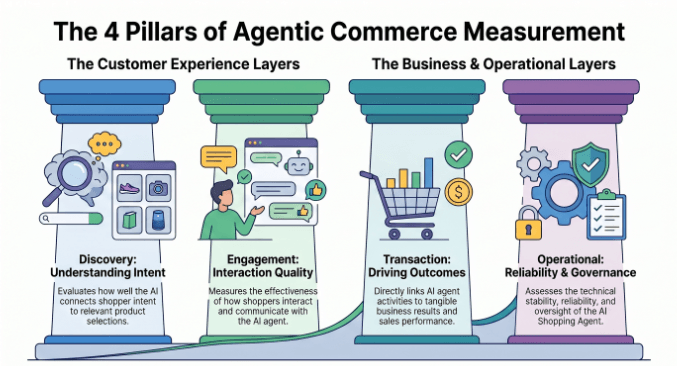
The most effective approach to agentic commerce measurement is a four-layer framework covering discovery, engagement, transaction, and operational performance.
Layer 1: Discovery metrics
Discovery metrics evaluate whether the AI Shopping Agent can successfully understand shopper intent and connect it to relevant products.
Agent query success rate
The percentage of agent queries that return at least one relevant product recommendation. This metric functions as the conversational equivalent of search success rate.
Intent resolution accuracy
The percentage of conversations where the agent correctly interprets shopper intent.
This often requires transcript reviews, human evaluation, or quality scoring models.
An agent that understands "lightweight waterproof hiking shoes under $120" correctly demonstrates stronger intent resolution than one that only recognizes "hiking shoes."
Layer 2: Engagement metrics
Engagement metrics evaluate how effectively shoppers interact with the AI Shopping Agent.
Agent session completion rate
The percentage of conversations that result in a recommendation, answer, or successful resolution.
Assisted conversion
Conversions that occur after an AI agent interaction within a predefined attribution window.
Unlike last-click attribution, assisted conversion acknowledges that the agent may influence decisions even when it is not the final touchpoint.
Layer 3: Transaction metrics
Transaction metrics connect agent activity to business outcomes.
Agent-assisted revenue
Revenue generated from sessions that included an AI agent interaction.
This metric requires lookback attribution rather than last-click measurement.
As organizations mature their autonomous commerce analytics capabilities, agent-assisted revenue often becomes the most closely monitored KPI.
Agent average order value (AOV)
The average order value for agent-assisted transactions compared with non-assisted transactions.
Higher AOV frequently indicates that the agent is matching products more effectively to shopper intent.
A useful benchmark is not the absolute number but the delta between assisted and non-assisted experiences.
Regret rate
The percentage of agent-assisted purchases that result in returns, cancellations, or exchanges.
A rising regret rate often signals recommendation quality issues.
Revenue growth without recommendation accuracy is not sustainable.
Layer 4: Operational Metrics
Operational metrics evaluate the reliability and governance of AI Shopping Agents.
Agent SLA Adherence
The percentage of responses delivered within acceptable latency thresholds.
Even highly accurate recommendations lose effectiveness if they arrive too slowly.
Human-in-the-Loop Trigger Rate
The percentage of conversations requiring human intervention or review.
This metric helps teams evaluate whether guardrails are functioning correctly.
False Positive Rate
The percentage of recommendations that appear relevant but fail to satisfy actual shopper needs.
Examples include recommending out-of-stock products or products that technically match criteria but fail contextual requirements.
Agent attribution models: The missing layer
A mature agentic commerce measurement program should also establish a clear attribution model.
Common approaches include:
- First-touch attribution: Credits the first interaction with the AI agent.
- Last-touch attribution: Credits the final interaction before purchase.
- Multi-touch attribution: Distributes credit across multiple touchpoints.
- Agent-assisted attribution: Assigns partial credit whenever an AI agent contributes within a defined lookback window.
For most retailers, agent-assisted attribution offers the most realistic representation of AI influence because it recognizes that agents frequently guide decisions without directly closing the sale.
Experiment design for AI shopping agents
One of the most common mistakes in agentic commerce is scaling before measuring.
A structured experiment framework helps organizations separate genuine performance improvements from anecdotal success stories.
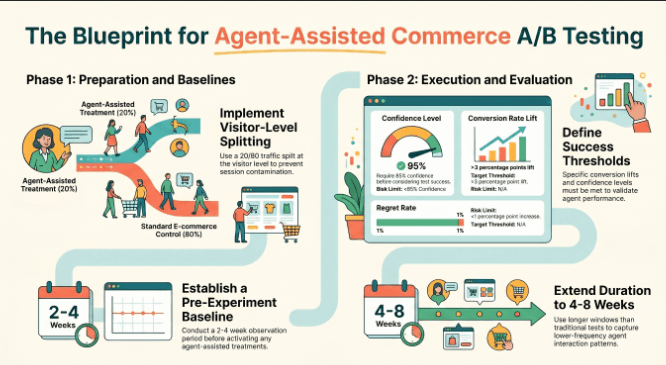
Step 1: Define test and control groups
Create two groups:
- Agent-enabled experience (test group)
- Standard search and browse experience (control group)
The split should occur at the visitor level rather than the session level to prevent contamination.
A 20% treatment group and 80% control group is often a practical starting point.
Step 2: Establish a baseline
Before activating the AI Shopping Agent, measure performance across all four KPI layers for two to four weeks.
The baseline period provides the reference point needed to evaluate lift accurately.
Without a baseline, teams often mistake seasonal fluctuations for agent impact.
Step 3: Define success thresholds before launch
Success criteria should be established before the experiment begins.
For example:
- Assisted conversion rate must exceed the control group by at least 3 percentage points.
- Agent-assisted revenue must increase by at least 5%.
- Regret rate must not exceed the control group by more than 1 percentage point.
- Results must achieve 95% statistical confidence.
Step 4: Run long enough to capture behavior
Agent interactions typically occur less frequently than standard clicks.
For that reason, experiments require longer observation windows.
A minimum four-week test period is recommended. Eight weeks is preferable when traffic volumes allow.
Longer windows account for weekly shopping patterns, seasonal variation, and repeat visits.
How Netcore Unbxd operationalizes measurement for agentic commerce
Measurement frameworks are only useful if teams can operationalize them.
Netcore Unbxd helps retailers translate measurement concepts into actionable workflows through three core capabilities.
Insights agent
The Insights Agent is a conversational analytics assistant embedded within the Netcore Unbxd reporting environment.
Practitioners can ask plain-language questions across search, browse, autosuggest, campaign, and merchandising reports without navigating multiple dashboards.
As agentic commerce measurement evolves, conversational analytics reduces the friction associated with investigating performance patterns and identifying optimization opportunities.
A/B testing
Netcore Unbxd's A/B testing capabilities provide the experimentation layer needed to evaluate AI-assisted experiences against traditional search and browse journeys.
Because testing is integrated with search and merchandising workflows, teams can measure performance consistently across experiences.
These capabilities provide the operational infrastructure needed to support modern autonomous commerce analytics programs.
Netcore Unbxd is also recognized as a Leader in the Gartner Magic Quadrant 2025 and a Strong Performer in the Forrester Wave Q3 2025, reflecting continued innovation in ecommerce search and product discovery.
Measure the agent before you scale it
AI Shopping Agents create value differently than traditional ecommerce experiences.
They influence decisions through conversations, resolve intent before a click occurs, and assist purchases that may happen across multiple channels and sessions.
Retailers that rely solely on traditional dashboards risk underestimating performance, misattributing revenue, and making scaling decisions based on incomplete data.
The future of agentic commerce measurement requires new KPIs, new attribution models, and new experiment frameworks. Organizations that establish these foundations early will be better positioned to evaluate agent performance objectively and scale with confidence.
Schedule a 30-minute strategy call: How to measure your Shopping Agent deployment.
FAQ
How do I know if my Shopping Agent ROI is actually positive?
Traditional metrics can be misleading for AI Shopping Agents. A positive ROI should be evaluated using agent-assisted revenue, assisted conversions, and incremental lift versus a control group, rather than relying only on CTR or last-click conversions.
To determine incremental revenue:
- Run an A/B test with agent-enabled and non-agent experiences.
- Measure agent-assisted revenue and assisted conversion rate.
- Compare performance against the control group.
- Account for recommendation quality using metrics such as regret rate (returns, cancellations, exchanges).
For example, if agent-assisted shoppers convert more often, spend more per order, and maintain similar return rates, the Shopping Agent is likely generating positive ROI, even if traditional metrics like CTR decline.
How long does it take to see statistically significant lift from an agent?
Most retailers should expect to run experiments for at least four weeks, with six to eight weeks preferred when traffic volumes allow.
This timeframe is important because:
- Agent interactions are typically less frequent than standard search clicks.
- Shopper behavior varies by day of week and season.
- Many purchases occur after multiple visits.
Before launch, define success criteria such as:
- Assisted conversion rate improvement
- Agent-assisted revenue growth
- Regret rate thresholds
Shorter tests often produce noisy results and can overstate or understate the agent's actual impact.
What's the difference between agent-assisted and last-click revenue?
Last-click revenue gives 100% credit to the final interaction immediately before a purchase.
Agent-assisted revenue gives credit to purchases where the Shopping Agent influenced the shopper's decision within a defined attribution window, even if the agent wasn't the final touchpoint.
How do I run an A/B test for an AI Shopping Agent deployment?
Create visitor-level test and control groups, establish a baseline period, define success thresholds before launch, and run the experiment for at least four weeks to capture meaningful behavioral data.
What is agent-assisted revenue and how is it measured?
Agent-assisted revenue refers to revenue generated from sessions where shoppers interacted with an AI Shopping Agent. It is measured using attribution windows rather than last-click tracking.
What is a good regret rate for AI agent-assisted ecommerce transactions?
There is no universal benchmark. The goal is to maintain a regret rate that is equal to or lower than non-assisted transactions while improving conversion and revenue outcomes.


