- ProductsSearch and BrowseRecommendationsCustomer Engagement
Agentic commerce starts with search: What product discovery teams need to do now


Key Takeaways
- AI shopping agents evaluate products differently, making traditional search optimization alone insufficient for future discovery.
- Complete product attributes, semantic understanding, and retrieval quality are now critical for AI-driven product discovery.
- Zero-result searches can cause AI agents to abandon a retailer entirely rather than reformulate the query.
- Most retailers still need stronger catalog enrichment, semantic search, and structured data foundations for agentic commerce.
- A six-dimensional audit helps teams identify gaps in search readiness before AI-agent ecommerce search becomes more mainstream.
- Product discovery teams, not marketing teams, will ultimately determine whether products remain discoverable in AI-powered shopping experiences.
A shopper types "best running shoes for a half marathon under $150" into a search bar. Your team has spent years tuning exactly this moment, relevance models, synonym libraries, ranking rules, merchandising logic. It works.
Now an AI shopping agent asks the same question. And everything you've built may not be enough.
AI agents don't browse. They don't refine. They don't scroll past the first result hoping something catches their eye. They interpret intent, evaluate constraints in parallel, scan product attributes for fit, and if your catalog can't answer the question cleanly, they move to the next retailer. No second chance, no reformulated query.
That's what makes agentic commerce product discovery a fundamentally different problem from traditional search optimization. This isn't about tweaking ranking signals or adding more synonyms. It's about whether your search infrastructure can speak a language that AI agents actually understand.
As agentic commerce search readiness becomes a real line item for engineering and product teams, the window to get ahead of it is narrow. Retailers investing in AI-agent ready ecommerce search infrastructure today will be better positioned to surface their products wherever AI-assisted shopping happens, whether on their own site or through emerging agent-driven discovery channels. Those who wait may find themselves structurally invisible to the next wave of product discovery in agentic commerce.
What does that readiness actually look like? It starts with understanding how AI agents shop, and how differently they behave from any human customer you've ever optimized for.
What AI agents actually need from your search stack
The most important thing to understand is that AI agents do not shop like humans.
Human shoppers browse, refine, compare, and adjust their queries when they encounter friction. AI agents are far less forgiving. They expect complete information, accurate retrieval, and meaningful results on the first attempt.
There are three major differences between traditional shopper searches and AI-agent searches.
1. Query construction is more complex
Most human shoppers use short search phrases containing two or three keywords.
AI agents typically generate detailed intent statements that include multiple constraints simultaneously. A single query may include category, budget, use case, specifications, availability requirements, and compatibility considerations.
For example:
"Waterproof hiking boots for women under $180 suitable for multi-day trekking with ankle support and available in size 8."
Traditional keyword search struggles with these requests. Search systems must be capable of interpreting multiple attributes and contextual relationships within a single query.
2. Product attributes become the decision layer
Human shoppers can visit product pages and manually evaluate product fit.
AI agents cannot.
Instead, they rely on the structured attributes returned by the search system to determine whether a product satisfies the shopper's requirements.
If critical information such as dimensions, compatibility, materials, specifications, or intended use is missing, the product effectively becomes invisible. Even a highly ranked item may never be recommended because the agent lacks sufficient evidence to evaluate it.
3. Zero results become a permanent failure
A shopper who receives zero results often tries another search.
An AI agent typically does not.
Many agent workflows treat a zero-result response as confirmation that the retailer cannot satisfy the request. The agent then moves to another source.
This is one reason search readiness matters so much. Mitre 10 reduced zero-result searches by 60% while driving a 261% increase in search usage after improving search relevance and discovery infrastructure. The scale of the opportunity is significant.
The challenge becomes even more urgent when considering catalog readiness. Industry estimates suggest fewer than 20% of retailers currently maintain metadata rich enough for effective AI discovery across emerging agentic shopping channels.
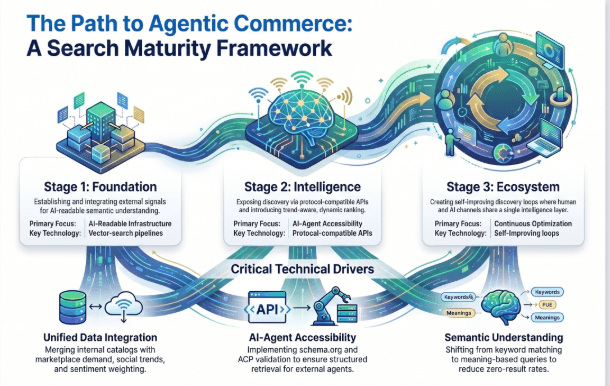
The search maturity model for agentic commerce
Agentic commerce readiness does not happen overnight. Most retailers progress through a series of maturity stages before becoming fully optimized for AI-driven discovery.
The following framework provides a practical way for product discovery teams to assess their current state and determine what comes next.
Stage 1: Foundation
The foundation stage focuses on creating AI-readable discovery infrastructure.
This includes integrating external signals such as reviews, marketplace demand data, and social trends alongside internal catalog information. Teams must establish vector-search pipelines for semantic understanding and improve attribute completeness across the catalog.
At this stage, search systems can understand meaning-based queries, reduce zero-result rates, and deliver more relevant results. However, they are not yet optimized for AI agents.
This stage forms the prerequisite for everything that follows.
Stage 2: Intelligence
The intelligence stage introduces trend-aware relevance and AI-agent accessibility.
Search systems begin incorporating behavioral signals, sentiment weighting, and dynamic ranking adjustments. Teams start exposing discovery capabilities through protocol-compatible APIs and structured retrieval mechanisms.
This is also where schema.org implementation, ACP validation, and natural-language product descriptions become critical.
Retailers at this stage can reliably respond to common AI agent queries across major product categories.
Stage 3: Ecosystem
The ecosystem stage represents continuous optimization.
Catalog enrichment, behavioral feedback, external intelligence, and AI-agent interactions create self-improving discovery loops. Search becomes a shared intelligence layer powering both on-site product discovery and external AI-agent discoverability.
At this stage, retailers are no longer optimizing separate experiences for humans and AI. Both channels are powered by the same continuously improving intelligence infrastructure.
How search capabilities change in agentic commerce
| Search capability | How human shoppers use it | How AI agents use it | What needs to change |
|---|---|---|---|
| Keyword Search | Enter short search phrases | Submit multi-intent natural-language queries | Add semantic understanding and intent parsing |
| Semantic Search | Improves result relevance | Serves as primary retrieval mechanism | Expand vector search coverage across catalog |
| Zero-Result Handling | Shoppers rephrase searches | Agents abandon retailer | Reduce zero-result rate below 2% |
| Faceted Navigation | Manual filtering | Automated constraint evaluation | Ensure attributes are complete and structured |
| Product Descriptions | Read after clicking products | Evaluated during retrieval | Shift toward natural-language, intent-oriented descriptions |
| Ranking Signals | Influence shopper behavior | Influence agent recommendations | Incorporate behavioral, contextual, and external signals |
AI agents interact with ecommerce search differently than human shoppers, requiring search systems to prioritize semantic understanding, structured attributes, and retrieval quality.
Most retailers today sit somewhere between Foundation and early Intelligence. Catalog enrichment and semantic search belong in Foundation. Protocol readiness and AI-agent accessibility belong in Intelligence.
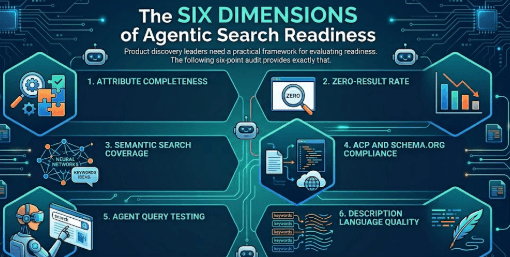
The six dimensions of agentic search readiness
Product discovery leaders need a practical framework for evaluating readiness. The following six-point audit provides exactly that.
1. Attribute completeness
Every product should expose the attributes an AI agent needs for evaluation.
This includes specifications, dimensions, compatibility information, use cases, materials, technical details, and category-specific attributes. Conduct category-by-category audits and measure the percentage of products with complete attribute coverage. Gaps here directly reduce discoverability.
2. Zero-result rate
Measure your current zero-result rate across different query categories.
Anything above 5% indicates meaningful discovery gaps that will negatively affect AI-agent interactions. Best-in-class retailers should target below 2%. Addressing synonym coverage, vocabulary mismatches, and attribute deficiencies is often the fastest way to improve performance.
3. Semantic search coverage
Semantic understanding should extend beyond simple keyword matching.
Test representative AI-agent queries containing multiple constraints and natural-language phrasing. Evaluate whether results accurately reflect shopper intent rather than isolated keywords. Semantic coverage should be measured across categories, not just on high-volume search terms.
4. ACP and schema.org compliance
External AI agents rely on structured data standards.
Validate product data against ACP requirements and ensure schema.org Product markup is implemented correctly. These standards help AI systems understand, retrieve, and evaluate catalog information accurately across external discovery channels.
5. Agent query testing
Create a library of realistic AI-agent queries and test them regularly.
For example:
"Commercial espresso machine for a 20-seat café under $2,000 with a milk frother and available this week."
Track relevance, attribute completeness, ranking quality, and zero-result frequency. These tests often reveal weaknesses traditional search evaluations miss.
6. Description language quality
Many ecommerce descriptions were written primarily for keyword optimization.
AI agents need something different.
Descriptions should clearly explain product benefits, intended use cases, compatibility considerations, and purchase-relevant details in natural language. The goal is helping an AI system understand product fit, not merely increasing keyword density.
What Netcore Unbxd gives search teams for agentic readiness
Once teams identify gaps through the readiness audit, the next challenge is addressing them efficiently.
Netcore Unbxd's agentic search portfolio focuses on helping search and merchandising teams improve visibility, diagnostics, and discoverability.
Insights agent and debugger agent
Insights Agent and Debugger Agent support the diagnostic layer.
Insights Agent allows teams to ask plain-language questions about search performance and receive immediate answers directly within analytics workflows. Debugger Agent provides explainability by showing why products rank where they do and why products may fail to appear in results.
Together, they help teams evaluate search readiness without extensive engineering involvement.
Enrichment for agentic commerce
Enrichment addresses three critical audit dimensions: attribute completeness, ACP compliance, and description quality. The platform enables retailers to make product catalogs AI-discoverable across emerging agentic shopping channels such as ChatGPT, Google Gemini, and Alexa while validating catalog data against ACP standards.
Agentic multimodal search
Agentic multimodal search addresses semantic search readiness by processing visual and language signals together. It represents a shift from string matching to meaning matching, and from static rules to agentic reasoning, helping retailers support increasingly sophisticated discovery journeys.
The strength of this approach has been recognized by industry analysts, with Netcore Unbxd named a Leader in Gartner's 2025 Magic Quadrant and a Strong Performer in the Forrester Wave Q3 2025 evaluation.
Search teams own the agentic commerce readiness problem: Start the audit
The infrastructure enabling agentic commerce is being built by technology providers, payment networks, AI companies, and standards organizations.
The search infrastructure that makes products discoverable, however, must be built by retailers themselves.
That responsibility sits squarely with product discovery, search, and merchandising teams.
The organizations that complete the six-dimension readiness audit today will be positioned to capture future AI-agent traffic as it scales. Those that wait may find themselves solving these challenges under significantly greater pressure.
If you want to understand where your organization stands, start with a search readiness assessment and identify the gaps before AI-driven discovery becomes a primary acquisition channel.
Book a demo today to understand how Netcore Unbxd can help you in this era of agentic commerce.
FAQ
What do AI shopping agents need from ecommerce search?
AI shopping agents need semantic search capabilities, complete product attributes, structured data, natural-language descriptions, and low zero-result rates. Unlike human shoppers, they evaluate products directly from retrieved information and often do not retry failed searches.
How is AI agent search different from traditional keyword search?
Traditional search focuses on matching keywords. AI-agent search focuses on understanding intent. Agents submit longer, multi-constraint queries and evaluate products using structured attributes rather than manually browsing product pages.
How do I optimize my ecommerce search stack for AI shopping agents?
If you are thinking how to optimize for AI shopping agents, start with a readiness audit covering attribute completeness, zero-result rates, semantic search coverage, structured data compliance, agent-query testing, and description quality. These six areas form the foundation of agentic commerce readiness.
What is the most common reason AI agents fail to find products on ecommerce sites?
Incomplete product data is often the biggest issue. Missing specifications, compatibility details, dimensions, or use-case information prevent AI agents from evaluating product fit, even when products technically exist in the catalog.
Which ecommerce search capabilities matter most for agentic commerce?
Semantic search, vector retrieval, zero-result prevention, structured product data, natural-language descriptions, and continuous catalog enrichment are the capabilities that most directly impact AI-agent discoverability and recommendation quality.


