- ProductsSearch and BrowseRecommendationsCustomer Engagement
What is the Agentic Commerce Protocol? ACP, OpenAI, and what it means for ecommerce


Key Takeaways
- ACP is a product data problem, not a payments problem.
- Fewer than 20% of retailers currently have metadata rich enough for AI discovery.
- Both ACP and UCP now explicitly support MCP, making the connectivity layer a converging standard underneath two otherwise competing protocols.
- Stripe appears on both the ACP and UCP rosters, indicating the payments layer is deliberately hedging across standards rather than committing to one.
- A missing product attribute is read as a product that fails the shopper's brief entirely, and the AI agent moves on.
Introduction
An AI shopping agent does not visit your storefront. It never sees your hero banner, or scroll a category page, and never clicks. It reads your product data, weighs it against a shopper's brief, and either picks your product or moves on. The plumbing that makes this possible is a new layer of open protocols, and the first one came from OpenAI and Stripe.
| The Agentic Commerce Protocol (ACP) is an open standard that defines how AI agents discover products, secure payment authorisation, and complete purchases on behalf of shoppers without merchants building a custom integration for every AI platform. OpenAI and Stripe co-developed it and govern it jointly as founding maintainers. The spec is maintained publicly on GitHub under the Apache 2.0 license. |
|---|
ACP started this category, but as of mid-2026 it shares the field with Google's Universal Commerce Protocol (UCP), which arrived in January with a retail coalition behind it. Two protocols, two tech giants, one identical demand on retailers: product data an AI agent can actually read.
Where ACP came from: OpenAI, Stripe, and the September 2025 launch
OpenAI and Stripe released ACP on September 29, 2025, under the Apache 2.0 license. The two companies govern the spec jointly as founding maintainers and have committed to a path toward broader community governance. Everything lives in a public GitHub repository, OpenAPI specs and JSON schemas included, so any merchant or platform team can read exactly what compliance requires.
The launch vehicle was ChatGPT's Instant Checkout. Etsy went live on day one. Shopify brands followed over the next few weeks, Glossier and Vuori and Spanx and SKIMS among them. PayPal signed on as a compliant payment provider on October 28, 2025, which mattered because it proved ACP was never meant to be a Stripe-only system. Stripe then shipped its Agentic Commerce Suite on December 11, 2025.
ACP specification updates and MCP support
The spec itself has been moving fast. Five versions since launch: September 29 and December 12 in 2025, then January 16, January 30, and April 17 in 2026. The April release was the big one. It added cart, feed, orders, and authentication capabilities, and it wired in explicit support for the Model Context Protocol (MCP). That last detail becomes important when we get to Google's protocol.
What changed after ChatGPT instant checkout?
OpenAI retired the first version of Instant Checkout in March 2026, saying it did not offer the flexibility the company wanted to provide. Merchants now run their own checkout while ChatGPT concentrates on product search and discovery, with purchases flowing through connected retailer apps. ACP development never paused. But read the strategic signal here: the AI platform with the largest assistant user base looked at agentic commerce and decided the contest is won at discovery, not at the buy button. Which puts the entire weight on whether an agent can find and correctly interpret your products.
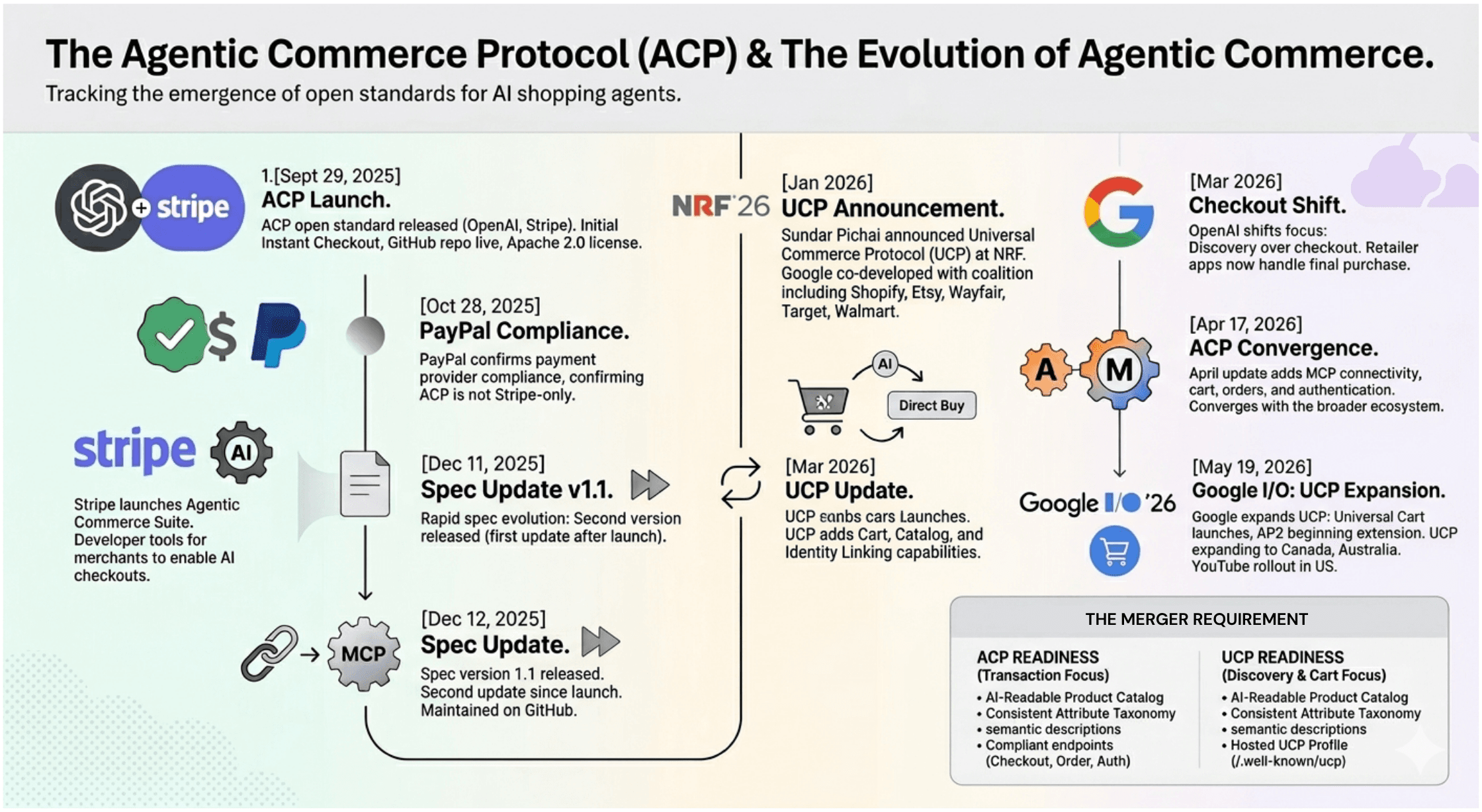
Strip everything else away and ACP does one job. It defines how an agent discovers products, secures payment authorization, and completes a transaction without the merchant writing bespoke code for each AI platform.
Google enters: UCP and what changed at I/O 2026
Sundar Pichai announced the Universal Commerce Protocol at NRF in January 2026. Google co-developed it with Shopify, with Etsy, Wayfair, Target, and Walmart involved in its creation. A March 2026 update added Cart, Catalog, and Identity Linking capabilities, expanding UCP from a discovery-only spec to one that could handle more of the purchase journey.
Then came Google I/O on May 19, 2026: Universal Cart launched, AP2 (the Agent Payments Protocol) began extending into Google's own products, UCP-powered checkout started expanding to Canada and Australia with the UK to follow, and UCP arrived on YouTube in the US, with hotel booking and local food delivery named as the next verticals.
The technical model borrows from something every web team already knows. Merchants host JSON profiles at /.well-known/ucp on their own domains, the same pattern as robots.txt. Publish your commerce capabilities once, and any compliant agent can read what you sell and how to transact with you. No per-platform integration, no gatekeeper.
The coalition backing UCP is notable for its breadth: Walmart, Target, Nike, Sephora, Ulta Beauty, Wayfair, Shopify, Klarna, Best Buy, Mastercard, Visa, Stripe, Adyen, Zalando. Stripe appears on both protocol rosters; the payments layer is hedging across standards rather than betting on one, and merchants should probably read that as directional.
AP2 deserves its own moment. It is the payment trust layer that lets agents make purchases within guardrails the shopper sets in advance: which brands: which brands, which products, how much. Google has donated AP2 to the FIDO Alliance to develop it as an open industry standard.
One line from Google's developer documentation frames the strategic picture clearly: UCP is explicitly compatible with MCP, A2A, and AP2. Pair that with ACP's April 2026 spec adding MCP integration, and both major commerce protocols now run on the same connectivity layer.
ACP vs. UCP: How they relate
The right frame here is not which is better. The two protocols approach the same goal from different ends, and a retailer in 2026 may well need to consider both.
ACP is the checkout and transaction layer. It defines how an agent presents products, secures payment authorization, and closes a purchase, with OpenAI's surfaces and Stripe's payment rails as the reference implementations. UCP is broader. It covers the whole journey from discovery through cart, identity, and post-purchase, with Google's coalition supplying the distribution. MCP sits underneath as the connectivity layer both can run on.
| ACP (Agentic Commerce Protocol) | UCP (Universal Commerce Protocol) | |
|---|---|---|
| Maintained by | OpenAI and Stripe, founding maintainers with an open governance roadmap | Google, co-developed with Shopify; Etsy, Wayfair, Target, and Walmart involved in creation |
| Launched | September 29, 2025 | January 2026 (NRF), expanded at I/O 2026 |
| Primary function | Agent-initiated checkout and transaction completion | End-to-end commerce orchestration: discovery, cart, identity, post-purchase |
| Key backers | OpenAI, Stripe, PayPal | Walmart, Target, Nike, Sephora, Shopify, Klarna, Best Buy, Mastercard, Visa, Stripe, Adyen, Zalando, and others |
| What it requires from product data | Complete, structured, AI-readable catalog attributes | Complete, structured, AI-readable catalog attributes, plus a hosted UCP profile |
| MCP compatible | Yes, explicit in the 2026-04-17 spec | Yes, per the Google developer specification |
What the table makes clear: regardless of which protocol an AI platform speaks, the requirement on retailer’s side is the same: AI-readable product data with complete attributes, consistent taxonomy, and semantic descriptions. The protocol decides how the agent transacts. Your catalog decides whether the agent finds the right product at all. And since both standards now sit on MCP, the connectivity question is converging too.
What these protocols require from product data
Ask what agentic commerce compliance actually means and the honest answer is unglamorous: it is mostly not a payments question or an API question. It is a product data question. An agent can only transact on what it can correctly interpret, and most catalogs were written for human eyes.
Three requirements sit underneath both protocols.
- Complete attribute coverage. Material, dimensions, compatibility, use case, specifications: the attributes that answer the questions an agent asks on a shopper's behalf. A missing attribute does not read as a small gap to an agent scoring options across five stores at once. It reads as a product that fails the brief.
- Consistent taxonomy. Category labels and attribute values that hold steady across the whole catalog rather than shifting per vendor or per upload. Agents compare within your catalog and against your competitors' simultaneously, and inconsistency looks like unreliability.
- AI-friendly descriptions. Natural language that carries real semantic content, structured so an agent can pull intent-relevant facts without untangling ambiguous marketing copy.
The scale of the gap is significant: less than 20% of retailers currently have metadata rich enough for AI discovery. For the other 80%, protocol readiness starts long before any endpoint goes live. It starts in the catalog.
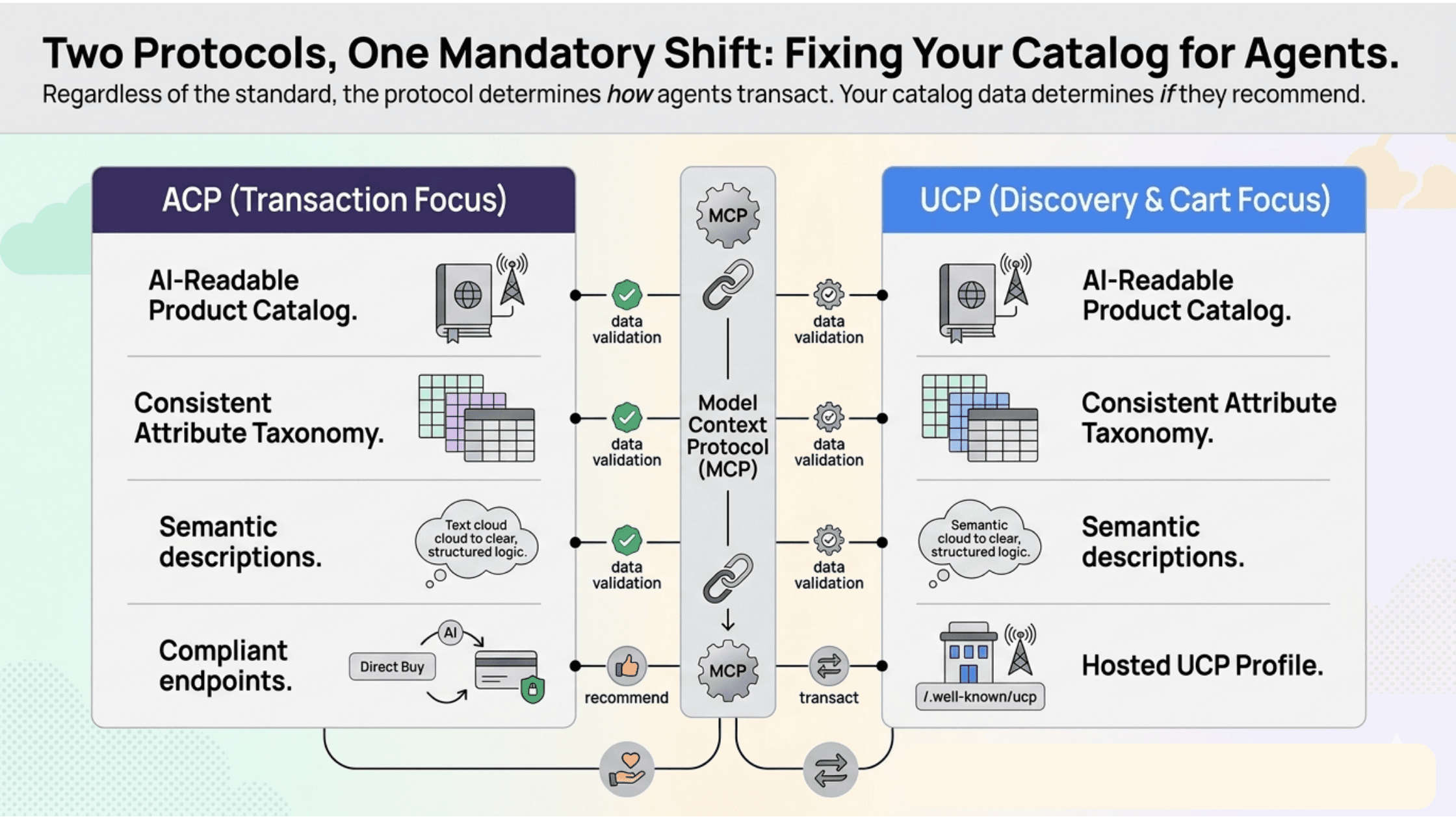
How Netcore Unbxd addresses protocol readiness
Understanding what agentic commerce is and being ready for it are two different things. The three requirements above map directly onto how Netcore Unbxd approaches agentic commerce.
Enrichment for Agentic Commerce goes after the data gap itself. It is a first-of-its-kind platform that enables retailers to make their product catalogues AI-discoverable across emerging agentic shopping channels like ChatGPT, Google Gemini, and Alexa. Enrichment validates against ACP standards, so the catalog work gets measured against the protocol agents actually use rather than against an internal style guide.
"If search was about SEO, agentic commerce is about data quality," says Rajesh Jain, Founder and Group MD, Netcore Cloud. "Retailers today are invisible to AI unless their data is structured, semantic, and ACP-ready."
The MCP/ACP Server handles connectivity. It connects the existing ecommerce stack (catalog, search, analytics, actions) to AI platforms through the Model Context Protocol, putting commerce capabilities inside AI-driven conversations. And because MCP is explicitly compatible with the current ACP spec and with Google's UCP per their published specifications, an MCP-based layer is relevant on both sides of the protocol divide.
"You can't build a smart agent on messy data," says Nishant Jain, Chief Strategy Officer, Netcore Cloud. "This enrichment layer ensures brands stay visible, discoverable, and ready for AI-native commerce both for humans and AI agents."
AI Shopping Agent is the layer shoppers actually meet: the conversational experience that runs once the catalog and connectivity work is done.
Netcore Unbxd is named a Leader in the 2025 Gartner Magic Quadrant for Search and Product Discovery, and a Strong Performer in The Forrester Wave: Commerce Search and Product Discovery Solutions, Q3 2025, where it earned the highest score in the Current Offering category.
The agentic commerce protocol is a product data problem. Start there
ACP opened the door. UCP is pushing it wide. Every protocol that follows will put the same question to retailers: can an AI agent understand your products well enough to sell them? The businesses who can answer yes are the ones agents will recommend and buy from while everyone else is still scoping an integration project. The work begins in the catalog, not the checkout. To see how Netcore Unbxd prepares product catalogs for protocol readiness, book a demo.
Frequently Asked Questions
ACP is an open standard that defines how AI agents discover products, collect payment authorization, and complete purchases with merchants. OpenAI and Stripe released it under Apache 2.0 in September 2025 and maintained it on GitHub.
OpenAI and Stripe co-developed ACP and govern it jointly as founding maintainers. PayPal joined as a compliant payment provider in October 2025, and the spec has a stated path toward broader community governance.
Launched at NRF in January 2026, UCP is Google's open standard for agentic commerce. Merchants publish JSON capability profiles at /.well-known/ucp on their domains, and compliant agents read them to discover products and transact. Backers include Walmart, Target, Shopify, Mastercard, and Visa.
ACP handles agent-initiated checkout and transaction completion. UCP spans the wider journey, from discovery through cart, identity, and post-purchase. Both are MCP-compatible, and both make the same demand of retailers: complete, structured, AI-readable product data.
In practice, it means an AI agent can interpret and act on your commerce data. That requires complete attribute coverage, consistent taxonomy, AI-friendly descriptions, and protocol-compliant endpoints. Fewer than 20% of retailers currently have metadata rich enough for AI discovery.
Not necessarily today, but the direction is hard to ignore. Agents route around stores they cannot read. For most retailers, the first step is not picking a protocol; it is fixing catalog data quality, which both standards depend on equally.


