- ProductsSearch and BrowseRecommendationsCustomer Engagement
The half-life of a merchandising insight


Key highlights
- Every merchandising insight has a half-life. The same number is worth more on Monday than on Friday, because the window to act closes faster than the data ages.
- The bottleneck has moved from data access to interpretation. Teams are not short of dashboards or exports, they are short of hours.
- Forrester estimates that 60% to 73% of enterprise data is never used for analytics, and McKinsey puts the share that is ever analysed at around 1%.
- A better dashboard makes the problem worse. More views mean more to read, and a dashboard can only answer questions someone built a chart for in advance.
- The market is racing toward autonomous AI. For anyone accountable for the number, buying speed by surrendering control is a poor trade.
- The right model is agentic: self-serve inquiry, answers in seconds, and the human kept firmly in the decision.
A merchandising insight starts losing value the moment it becomes available. A conversion dip you catch on Monday morning is worth far more than the same dip you find on Friday, after the report cycle has run and the week's revenue has already leaked away. The number is identical. The window to act is not.
That decay is the quiet failure mode of modern ecommerce analytics, and you cannot dashboard your way out of it. The instinct to build one more view is not just unhelpful, it is the precise move that made the problem worse. The bottleneck everyone is still tooling for was solved a decade ago, and almost nobody has retooled for the one that replaced it.
So the market is converging on an answer, and it is the wrong one for the people who actually own the number. The pitch is autonomy: let the AI run search and merchandising on its own, and ask the merchandiser to step back and supervise.
The better path is narrower and harder to sell, but it is the right one.
“Conversational analytics that are agentic, not autonomous.” Ask your search data a question, get a verifiable answer in seconds, and keep the decision yourself. This is the case for it.
The real bottleneck moved from access to interpretation
The dashboard was a genuine advance. It took data out of the hands of analysts and put performance in front of the merchandisers who needed it. But it was built for an era of scarcity, when data was expensive to collect and rare to see. The job back then was access. Get the numbers in front of more people.
That era is over, and the numbers say so plainly. Forrester has estimated that between 60% and 73% of enterprise data is never used for analytics, and McKinsey has noted that only around 1% of the data organizations generate is ever analyzed at all. The problem is no longer that merchandising teams cannot see data. It is that they are buried in it. They are not short of charts, exports, or reporting tools. They are short of hours. The long-standing rule of thumb, borne out in survey after survey, is that data practitioners spend roughly 80% of their time finding and preparing data and only the remaining fifth interpreting it.
So the constraint has flipped, from access to interpretation, from getting the data to making sense of it fast enough to matter. And almost every analytics investment of the last decade went into solving the old bottleneck while the new one quietly took over.
Why a better dashboard makes the problem worse
Here is the uncomfortable part. Adding another view does not reduce the work. It adds to it. Each new chart is one more thing to read, reconcile, and interpret before anyone can act. The tool that was supposed to speed teams up now slows them down by sheer volume.
There is a deeper limit too. A dashboard can only answer questions someone designed a view for in advance. It encodes yesterday's questions. But merchandising problems are novel almost daily, and the most valuable question is usually the one that just occurred to you, the one no one built a chart for. To answer it, the merchandiser still has to either build the report themselves or queue behind the analytics team. The dashboard that promised democratisation produced a new gatekeeper.
Now add the half-life. Insight decays with delay. Build the report, wait for an analyst, interpret the output, and the moment to act has often already passed. High latency is not a flaw in any one team's process. It is structural to the dashboard model itself. No amount of polish on the model fixes a problem that lives in its design.
Agentic vs Autonomous AI: The fork the market is walking into
The industry has noticed, and a clear answer is taking shape. Make the system autonomous. Let the AI run search and merchandising on its own, and ask the human to step back into oversight of a self-driving engine. The momentum is real and easy to mistake for consensus: Gartner predicts that 40% of enterprise applications will ship with task-specific AI agents by the end of 2026, up from less than 5% the year before.
It is a tempting pitch, and for some problems it is the right one. But for a merchandiser who is accountable for the number, speed bought by surrendering control is a poor trade. Autonomy is being sold as speed. For the operator, it is speed bought by giving away the one thing the job is actually made of. Acting autonomously on a misread signal is the single most expensive mistake in merchandising. The judgment about what a number means, and what to do about it, is precisely the part you do not want to hand away.
So there is a fork. One path is autonomous: hands off the wheel. The other is the one we would argue for, which is agentic but not autonomous. Make the operator self-serve on inquiry. Give them answers they can get in seconds and verify before they bet on them. Keep the human in the decision. The goal is not to replace the merchandiser's judgment. It is to remove everything that stands between that judgment and a trustworthy answer.
Conversational analytics is not a chatbot bolted onto a dashboard
MIT research in 2025 found that roughly 95% of enterprise AI pilots never made it into production, and Gartner expects more than 40% of agentic AI projects to be canceled by the end of 2027, undone by cost, unclear value, and weak controls. Skepticism is not just healthy here; it is correct.
Teams that have deployed these systems at scale will say: the last wave of conversational tools underdelivered. Chatbots got bolted onto everything, the experience was clumsy, and most of those efforts quietly stalled. The skepticism is correct, and it falls hardest on exactly the autonomous, hands-off-the-wheel pilots described above. Systems asked to act with no visible reasoning are the ones users trust least and abandon fastest.
But that skepticism conflates two different things. A deflection bot exists to close a support ticket. An analytics agent exists to reason over your search and merchandising data and return a decision. They are not the same animal. And the failure pattern behind both the 95% and the 40% is the same: tools that demanded trust without proof, asking users to believe the AI was right with no way to check how it got there.
That is the bar for an analytics agent. Not novelty, trust. When an agent hands you a number, the real danger is a confident, fluent, wrong answer. So the value of conversational analytics rests entirely on whether it can show its working: which queries, which time window, which segment, which definition. Explainability is not a nice-to-have here. It is the entire product, the difference between a tool you glance at and a tool you trust.
Where this is going: The Netcore Unbxd Insights Agent
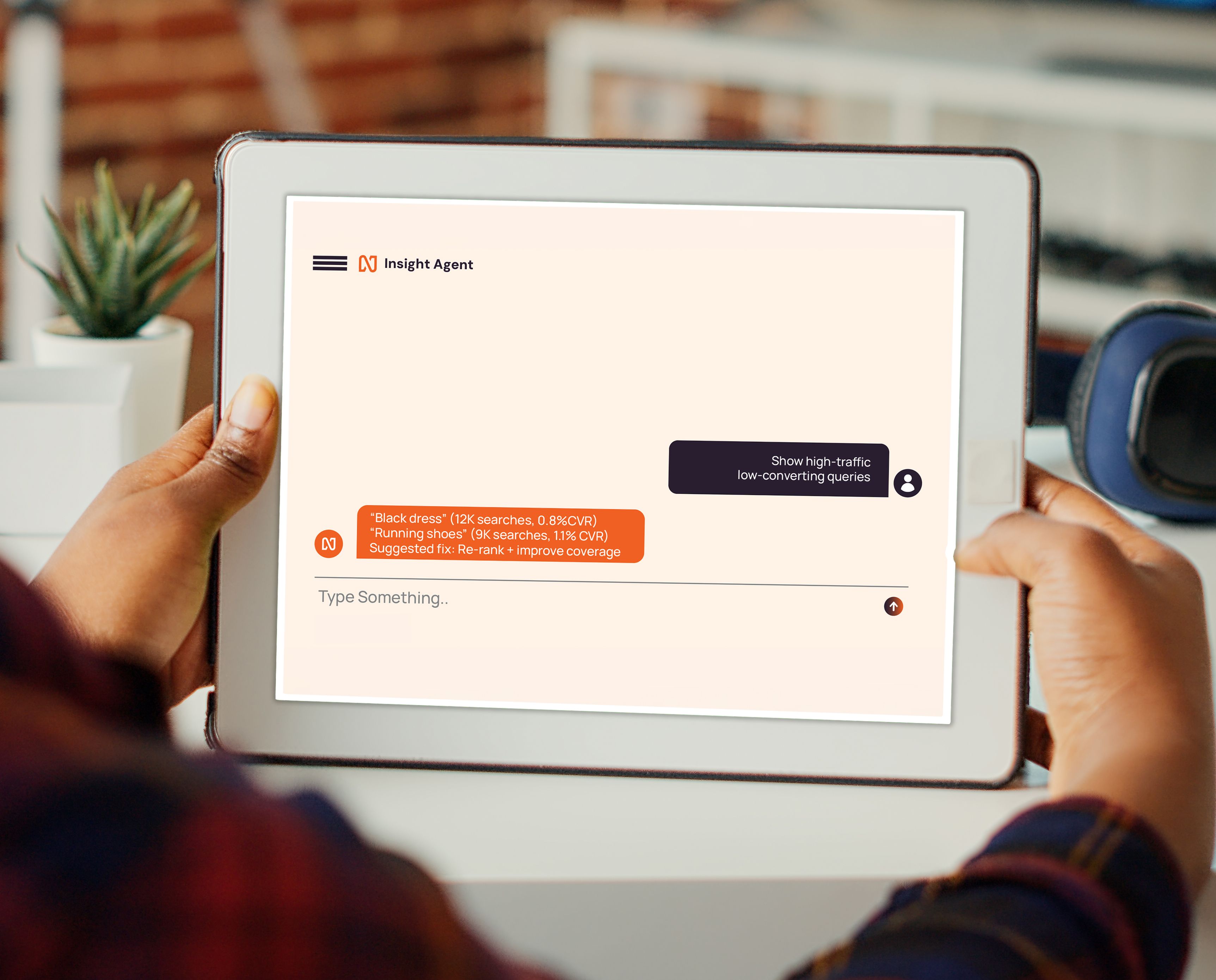
The thinking behind the Netcore Unbxd Insights Agent is that it lets merchandising and ecommerce teams ask questions of their search data in plain language and get answers in real time, with the reasoning visible so the answer can be checked rather than taken on faith. The Insights Agent does not act for you. It gets you to a decision you can stand behind, faster.
The merchandising skill that is changing
As the interpretation burden falls away, the skill that distinguishes a good merchandiser changes with it. Gartner expects 75% of new analytics content to be generated through AI by 2027, which means the act of building the view stops being where the value sits. Fluency in pivot tables stops being the differentiator. Knowing what to ask becomes it. The dashboard moves to the back end where it belongs, the interface to your data becomes a question, and the teams that make that shift do not just move faster. They keep their judgment in the loop while they do it.
The insight was always the point. The work was everything in the way of it.
Why is agentic analytics emerging now?
None of this was available three years ago, and none of it is optional three years from now.
On the technology side, the timing is not a coincidence. Large language models only recently got reliable enough at reasoning over structured data, not just generating text, to be trusted with a real number instead of a plausible-sounding paragraph. Retrieval and tool-use techniques matured to the point where an agent can run an actual query against your search index rather than guess at an answer from training data. And the cost of running that reasoning at the speed a merchandiser expects, seconds, not minutes, has fallen enough to make it viable for everyday use rather than a quarterly novelty. That stack simply did not exist in production-grade form until very recently.
On the business side, the pressure is not optional. Ecommerce cycles have compressed: flash sales, algorithmic repricing by competitors, and shifting demand mean the cost of a slow read on the data compounds faster than it used to. The teams still queuing behind an analyst for a same-day answer are not just slower, they are increasingly the only ones queuing at all, while competitors who have closed that gap react in the same shift the dip occurred in. At the same time, the well documented failure rate of bolted-on AI pilots has made buyers more discerning, not less interested. The market has moved past asking whether to bring AI into analytics, and into asking which approach earns enough trust to actually be used. That is a narrower, harder question, and it is the one this moment is forcing merchandising teams to answer.
Frequently Asked Questions
Conversational analytics lets merchandising and ecommerce teams ask questions of their search and merchandising data in plain language and get answers in real time. Instead of building a report or queuing behind an analyst, the merchandiser types a question and gets an answer they can verify, with the underlying queries, time window, and segment shown.
Autonomous AI runs search and merchandising on its own and asks the human to supervise. Agentic but not autonomous keeps the human in the decision: the AI does the inquiry and surfaces a trustworthy answer in seconds, and the merchandiser decides what it means and what to do. For a team accountable for the number, that distinction guards against acting on a misread signal, the single most expensive mistake in merchandising.
Dashboards and modern BI solved the access problem in an era of data scarcity. Today data is abundant, with Forrester estimating that the majority of enterprise data is never used, and the constraint is interpretation. A dashboard can only answer questions someone built a view for in advance, so the most valuable question, the one that just occurred to you, still goes to the analytics queue. By the time the answer arrives, the insight has lost much of its value.
No. A deflection chatbot exists to close a support ticket. An analytics agent reasons over your actual search and merchandising data and returns a decision you can act on. The bar for the second is trust, which is why explainability matters: a good agent shows which queries, which time window, and which segment it used so you can verify the answer before you bet on it.
The Insights Agent lets merchandising and ecommerce teams ask questions of their search data in plain language and get answers in real time, with the reasoning visible so the answer can be checked rather than taken on faith. It does not act for you. It gets you to a decision you can stand behind, faster.
No. As the interpretation burden falls away, the differentiating skill shifts from fluency in pivot tables to knowing what to ask. The dashboard moves to the back end, the interface to your data becomes a question, and the human stays in the loop on every decision.


