- ProductsSearch and BrowseRecommendationsCustomer Engagement
How AI agents prevent fraud in autonomous commerce: Verified payments and trust signals


In traditional ecommerce, fraud typically occurs when a malicious actor steals credentials, bypasses payment controls, or manipulates checkout workflows. Autonomous commerce changes this model. Instead of shoppers manually browsing, comparing, and purchasing products, AI agents perform these tasks on their behalf. They discover products, evaluate options, and initiate transactions using permissions granted by the shopper.
This shift introduces new trust challenges. An AI agent relies on the product information it retrieves and the payment credentials it is authorized to use. If either layer is compromised, fraudulent purchases can occur before a shopper has an opportunity to intervene.
As autonomous commerce continues to evolve, preventing fraud becomes a shared responsibility across payment networks, protocol providers, and merchants. While payment protocols secure transactions and verify AI agents, merchants play an equally important role by maintaining trustworthy, structured product catalogs that reduce opportunities for manipulation.
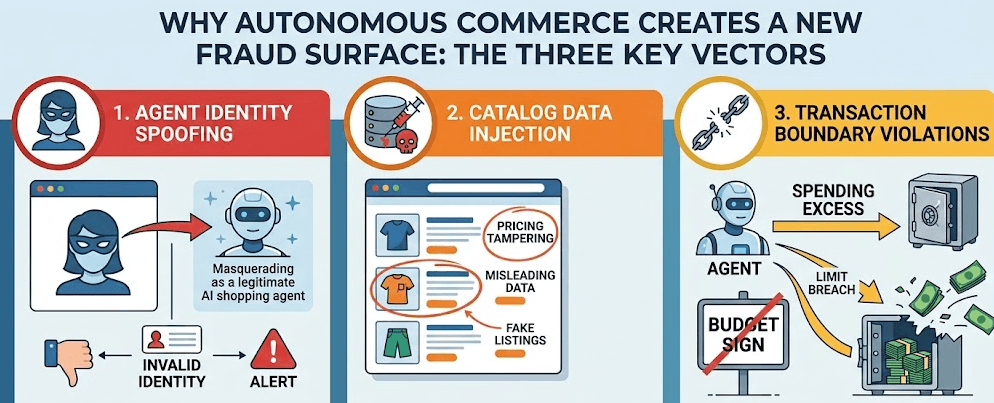
Why autonomous commerce creates a new fraud surface
Autonomous commerce introduces a fundamentally different attack surface because AI agents make purchasing decisions independently within shopper-defined guardrails. Fraud no longer targets only payment systems. It can also target the information AI agents consume before making decisions.
Agent identity spoofing
One emerging threat is agent identity spoofing. In this scenario, a malicious application impersonates a legitimate AI shopping agent using stolen or fabricated credentials. Without protocol-level identity verification, merchants and payment providers cannot distinguish an authorized agent acting for a customer from a malicious bot attempting unauthorized purchases.
Catalog data injection
Another risk is catalog data injection. Attackers may manipulate product information by introducing fraudulent listings, altering prices, changing availability, or inserting misleading product attributes. Since AI agents rely heavily on structured product data, they may unknowingly recommend or purchase manipulated products without any human review.
Unlike traditional ecommerce fraud, this attack targets the product catalog rather than the payment infrastructure. The integrity of product data therefore becomes an important component of autonomous commerce fraud prevention.
Transaction boundary violations
AI agents also require clearly defined purchasing permissions. Without spending limits, merchant restrictions, or transaction boundaries, an authorized AI agent could complete purchases beyond what the shopper intended.
Modern payment frameworks are designed to reduce this risk by ensuring AI agents operate only within predefined authorization limits established by the customer.
How verified AI agent payments reduce fraud in autonomous commerce
Verified AI agent payments reduce fraud in autonomous commerce by authenticating agent identities, securing payment credentials, enforcing shopper-defined spending limits, and ensuring transactions occur only within authorized boundaries. Together, these mechanisms establish trust between shoppers, merchants, payment providers, and AI agents.
Unlike traditional digital wallets, autonomous commerce requires payment systems to verify both the shopper and the AI agent initiating the transaction.
Protocol-based identity verification
Industry initiatives such as the Agentic Commerce Protocol (ACP) establish authentication standards that help verify an AI agent's identity before it interacts with merchants or payment services. These standards enable trusted communication between retailers and AI agents while reducing the likelihood of impersonation attacks.
Similarly, Visa's Trusted Agent Protocol provides an open framework that enables merchants to distinguish legitimate AI shopping agents from malicious bots. Built on existing web infrastructure and aligned with emerging industry standards, it strengthens trust during AI-initiated transactions.
Together, these identity frameworks help create a consistent trust layer across autonomous commerce ecosystems.
Verified payment credentials
Identity verification alone does not eliminate fraud. Payment credentials must also be protected.
Mastercard Agentic Tokens address this challenge by replacing sensitive payment information with secure, tokenized credentials that are linked to a verified AI agent. These tokens are designed for specific merchants and shopping sessions, reducing the possibility of unauthorized reuse.
Because the payment token is associated with a verified agent identity, merchants gain greater confidence that the transaction originates from an authorized source.
Google's Agent Payments Protocol (AP2) extends this approach by allowing AI agents to complete purchases within guardrails established by the shopper. Google has announced plans to contribute AP2 to the FIDO Alliance, supporting broader industry standardization for secure AI-powered payments.
Spending guardrails improve transaction security
Verified AI agent payments also reduce fraud through spending controls.
Instead of granting unrestricted purchasing authority, payment providers can define transaction limits based on:
-
Maximum spending amount
-
Approved merchants
-
Shopping session duration
-
Product categories
-
User-defined permissions
These controls ensure AI agents cannot exceed the purchasing authority granted by the shopper, reducing unauthorized transactions while preserving a seamless buying experience.
For readers interested in the broader ecosystem, this topic complements discussions on the Agentic Commerce Protocol and emerging payment standards from Visa, Mastercard, and Google.
How AI agents prevent fraud in autonomous commerce
Verified AI agents prevent fraud in autonomous commerce through four complementary layers: agent identity verification, transaction validation, behavioral anomaly detection, and human-in-the-loop approvals. Together, these controls ensure AI agents act only on behalf of authorized users, within defined spending limits, while suspicious activity is detected before transactions are completed.
As autonomous commerce matures, fraud prevention becomes a shared responsibility across protocol providers, payment networks, merchants, and AI platforms. No single technology eliminates fraud entirely. Instead, multiple trust mechanisms work together to secure AI-initiated purchases.
Agent identity verification
The first layer confirms that an AI agent is genuinely acting on behalf of an authorized shopper. Emerging standards such as the Agentic Commerce Protocol (ACP) authentication framework and Visa's Trusted Agent Protocol help merchants verify the identity of AI agents before allowing them to access product catalogs or initiate transactions.
This significantly reduces the risk of malicious bots impersonating trusted shopping assistants.
Transaction validation
Even trusted AI agents should operate within predefined boundaries. Payment providers are introducing transaction validation mechanisms that restrict what an agent can purchase.
Mastercard Agentic Tokens, for example, bind payment credentials to a verified AI agent while enforcing merchant-specific and session-specific spending limits. These controls prevent AI agents from completing purchases outside the shopper's approved scope.
Behavioral anomaly detection
Payment providers also analyze behavioral patterns during AI-driven transactions. Sudden spikes in purchase frequency, unusually large order values, abnormal product combinations, or rapid purchasing across multiple merchants can indicate fraudulent behavior.
Behavioral monitoring adds another layer of protection by identifying suspicious activity that identity verification alone may not detect.
Human-in-the-loop approvals
Autonomous commerce does not eliminate human oversight. Many AI purchasing systems include configurable approval workflows that require explicit customer confirmation before completing high-value or unusual transactions.
This safeguard balances automation with user control, ensuring shoppers retain authority over exceptional purchases.
Comparison: Trust mechanisms in autonomous commerce
| Mechanism | What it does | Who implements it | What it protects against |
|---|---|---|---|
| Agent identity verification | Verifies that an AI agent is legitimate and authorized | ACP, Visa Trusted Agent Protocol | Agent identity spoofing |
| Tokenized payment credentials | Replaces sensitive payment information with secure tokens | Mastercard Agentic Tokens | Credential theft and payment fraud |
| Transaction spending limits | Restricts AI purchases to shopper-defined boundaries | Mastercard, AP2 and payment providers | Unauthorized purchases |
| Behavioral anomaly detection | Identifies unusual purchasing patterns for review | Payment networks and fraud monitoring systems | Suspicious transaction activity |
| Catalog data integrity | Maintains accurate, complete, and structured product data | Merchants | Catalog manipulation and fraudulent product listings |
Table: Multiple trust mechanisms work together to reduce fraud across autonomous commerce ecosystems.
The role of catalog data integrity in fraud prevention
While payment protocols secure transactions and verify AI agents, merchants remain responsible for protecting another critical layer: the product catalog.
Catalog data injection differs from payment fraud because attackers manipulate the information AI agents rely on when making purchasing decisions. Incomplete product attributes, inconsistent taxonomy, duplicate listings, inaccurate pricing, or misleading availability signals increase the likelihood that AI agents will surface incorrect or fraudulent products.
This is where catalog data integrity becomes essential.
According to Netcore Unbxd's Brand Knowledge Base, less than 20% of retailers currently have metadata rich enough for AI discovery. As AI-powered shopping becomes more common, poorly structured catalogs create greater opportunities for manipulation and reduce AI confidence in product recommendations.
Netcore Unbxd's Enrichment for Agentic Commerce helps retailers prepare product catalogs for emerging AI shopping channels by improving attribute completeness, taxonomy consistency, natural language product descriptions, Schema.org compliance, and validation against ACP standards.
It is important to distinguish this capability from fraud prevention. Netcore Unbxd does not verify AI agents, authenticate payments, or detect fraudulent transactions. Instead, it strengthens catalog data integrity, which reduces catalog-level manipulation risk and makes anomalous listings easier to identify.
A structured, standards-compliant catalog improves both AI discoverability and trustworthiness. As autonomous commerce expands, maintaining clean product data becomes an important upstream control that complements payment verification and identity authentication.
What ecommerce brands need to build: A trust infrastructure for autonomous commerce
Fraud prevention in autonomous commerce requires a layered trust infrastructure rather than a single security solution. Ecommerce brands should focus on the following five priorities.
1. Implement protocol-compatible agent identity verification
Support industry standards such as the Agentic Commerce Protocol and frameworks like Visa's Trusted Agent Protocol to ensure only verified AI agents can interact with your commerce ecosystem.
2. Adopt tokenized payment credentials with spending guardrails
Use payment technologies such as Mastercard Agentic Tokens, AP2, or similar solutions that restrict AI purchases within shopper-defined spending limits and merchant permissions.
3. Maintain complete and structured catalog data
Ensure product information remains accurate, comprehensive, and compliant with industry standards. Complete attributes, consistent taxonomy, and structured metadata make catalog manipulation more difficult while improving AI shopping experiences.
4. Monitor transaction behavior continuously
Behavioral monitoring should identify unusual purchasing activity such as unexpected order velocity, abnormal spending patterns, or suspicious product combinations. Early detection helps payment providers investigate potentially fraudulent transactions before they escalate.
5. Define human approval thresholds
Determine which purchases require explicit customer approval. High-value transactions, purchases outside normal buying patterns, or orders involving sensitive products should trigger human confirmation before completion.
Autonomous commerce trust starts at the catalog layer
The future of autonomous commerce depends on trust across every layer of the purchasing journey. Payment providers are developing secure protocols that authenticate AI agents, tokenize payment credentials, and enforce shopper-defined spending limits. At the same time, merchants must ensure their product catalogs remain accurate, complete, and structured for AI consumption.
While payment networks protect transactions, retailers control the quality of the data AI agents use to make purchasing decisions. Investing in catalog readiness today positions brands to build trustworthy autonomous commerce experiences tomorrow.
Ready to prepare your product catalog for AI-powered shopping? Discover how Netcore Unbxd's Enrichment for Agentic Commerce helps retailers build AI-ready, standards-compliant product data for the next generation of commerce.
Frequently asked questions
How verified AI agents prevent fraud in autonomous commerce?
Verified AI agents prevent fraud by authenticating their identity before interacting with merchants, operating within shopper-approved permissions, using secure payment credentials, and triggering additional verification for suspicious or high-risk transactions.
How verified AI agent payments reduce fraud in autonomous commerce?
Verified AI agent payments reduce fraud through identity verification, tokenized payment credentials, merchant-specific spending limits, shopper-defined guardrails, and transaction monitoring that prevents unauthorized purchases and credential misuse.
What is the Trusted Agent Protocol?
Visa's Trusted Agent Protocol is an open framework that enables merchants to distinguish legitimate AI shopping agents from malicious bots. It helps establish trusted AI identities while supporting secure autonomous commerce transactions.
What are Mastercard Agentic Tokens?
Mastercard Agentic Tokens are tokenized payment credentials linked to verified AI agents. They include merchant-specific and session-specific spending controls that allow AI agents to complete purchases only within shopper-approved limits.
What role does catalog data play in autonomous commerce fraud prevention?
Catalog data influences the purchasing decisions made by AI agents. Accurate, complete, and structured product information reduces catalog manipulation risk, improves AI decision-making, and makes fraudulent product listings easier to detect.
Explore more


