- ProductsSearch and BrowseRecommendationsCustomer Engagement
Agentic Commerce by role: What changes for Marketing, Merchandising, Search, and IT


Key Takeaways
- The AI agent often becomes the first audience for a purchase decision, replacing the campaign as the shopper's first touchpoint.
- Merchandisers describe outcomes in plain language, the Merchandising Copilot drafts the rules, and humans approve them before anything deploys.
- Attribute completeness, taxonomy hygiene, and protocol-compatible APIs are the new fundamentals for search teams. Zero-result rate on agent-style queries is the KPI to watch.
- IT teams inherit two responsibilities: protocol-layer connectivity through ACP, UCP, and MCP, and agent governance covering human-in-the-loop design, spending limits, and audit trails.
- The work runs in parallel across all four layers, not sequentially. Treating agentic commerce as a marketing initiative is the most common failure mode, because the foundation is search and catalog infrastructure.
When a shopper hands product discovery and checkout to an AI agent, the daily work shifts for every team that touches the catalog or the shopper. Marketing loses its direct line. Merchandising stops writing boost rules. Search has to serve queries it was never built for. IT inherits a new governance layer.
The shift looks different in each function. What follows is a role-by-role breakdown of what changes, what disappears, and what new responsibilities each team picks up.
| Role | Primary impact of agentic commerce | Manual tasks that change or are eliminated | New responsibilities that emerge |
|---|---|---|---|
| Marketing | An AI agent, not a campaign, becomes the first point of contact for many purchase decisions | Building segments from historical profiles; waiting for next-session retargeting | Real-time, in-session segmentation; capturing and acting on multi-constraint agent intent data |
| Merchandising | Rule execution moves from manual configuration to outcome description | Choose to manually boost rules, slotting logic, and campaign configs; manual ranking diagnosis | Describing outcomes in plain language; reviewing and approving Copilot-generated rules; more time on strategy |
| Search / Product Discovery | Catalogs are now queried by agents, not only by humans typing keywords | Tuning for keyword recall; tolerating re-query behavior | Attribute completeness and taxonomy hygiene; exposing the catalog through external protocol-compatible APIs |
| IT / Engineering | Ecommerce begins running through open AI protocols | Maintaining bespoke point integrations for every channel | Standing up protocol-layer connectivity; owning agent safety, guardrails, and governance |
How agentic ecommerce changes the marketing team's job
The first thing marketing teams notice is who they are actually reaching. When a shopper hands a buying decision to an AI agent, the agent becomes the first audience for that decision. The campaign sitting in the Tuesday send queue arrives at a recipient who has already made up their mind.
Agent interactions actually produce richer intent data than most behavioral segmentation. The signals are precise: the exact product the shopper wanted, the price they would accept, the use case, the timing window. Behavioral patterns built from clicks and opens look thin next to that. Whether marketing can act on the new signals depends on whether the infrastructure can catch them during the visit.
That work belongs in real-time, session-aware segmentation. Predictive segmentation reads in-session signals like browsing speed, search patterns, depth of interaction, and purchase momentum, then adapts product discovery while the shopper is still on the site. It is segmentation tuned to what is happening in the current session, rather than what someone did three weeks ago.
How does the merchandiser's job change with AI agents
Agentic commerce keeps the merchandiser in the loop. What it removes is the keystrokes most merchandisers like least: writing and maintaining boost rules, slotting logic, and campaign configurations.
In a traditional setup, a merchandiser hand-builds those rules. In an autonomous setup, the merchandiser describes the outcome they want. "Feature the summer collection in running shoes through July 15, boost in-stock items, suppress products below three stars." The Merchandising Copilot drafts the configuration. The merchandiser reviews and approves. Nothing deploys without that approval step.
Diagnostic work changes along similar lines. The Insights Agent answers plain-language questions about what is happening in search and merchandising data. Work that used to take a couple of hours of digging now happens in a short conversation. The time that comes back goes into category strategy, where merchandisers actually add value.
What ecommerce search teams need to fix first
The search stack built for human keyword queries was not built for AI agents. Closing that gap falls to the search and product discovery team.
The work splits in two. The first half is attribute architecture. A human shopper who gets thin results will refine the query and try again. An agent will not. Agents issue multi-constraint queries (cotton, machine-washable, under forty dollars, ships within two days) and expect a clean answer the first time. Attribute completeness, a consistent taxonomy, and natural-language product descriptions are what let conversational AI resolve those queries cleanly. Zero-result rate on agent-style queries is the KPI to watch.
Site search used to mean the search bar on the brand's site. Now a shopper may be querying the catalog through ChatGPT, Gemini, or another platform the brand has no relationship with. The catalog has to be reachable through external, protocol-compatible APIs, not only through the on-site experience. The MCP Server closes that gap without forcing a stack rewrite.
Agentic Multimodal Search moves the engine from string matching to meaning matching, and catalog enrichment prepares product data for ACP validation. Competitors are already showing up inside AI platforms where catalogs without protocol-layer exposure are invisible. That is the gap worth closing first.
What IT actually has to build for agentic commerce
The IT question is straightforward. How much of the existing stack does this break, and how fast does the team have to move? The answer is reassuring on both counts.
ACP, UCP, and MCP are open protocols. Connecting an ecommerce stack to AI platforms through them does not require replacing what is already running. What it requires is an MCP-compatible server that exposes the catalog, search, analytics, and action capabilities through the Model Context Protocol.
Governance gets less airtime than it should. Once agents can initiate transactions, modify carts, or query inventory, engineering owns the controls that keep those actions inside the lines. Human-in-the-loop design, spending-limit enforcement, audit trails, and anomaly monitoring all live on the engineering side of the org chart. Agent identity verification and per-agent transaction limits sit in the same risk family and form the foundation of autonomous-commerce fraud prevention.
The cost profile shifts along with the work. Fewer bespoke connectors to maintain, more time spent on policy, observability, and the controls that govern agent behavior.
Who should own the agentic commerce rollout
No single team should. Each function owns a distinct layer of the program. Marketing owns shopper intelligence. Merchandising owns catalog and display logic. Search owns discovery infrastructure. IT owns connectivity and safety. These layers run in parallel rather than in sequence, and handoffs between them work only when the four teams share a vocabulary and a governance model.
A workable program needs a steering group with representation from all four functions, a written definition of what "agent-ready" means inside the company (agreed on by everyone in the room), and a sequenced plan that addresses each layer in turn rather than concatenating four wish lists.
The most common failure mode is treating agentic commerce as a marketing initiative when the foundation work is search and catalog infrastructure. Netcore Unbxd is a Gartner 2025 Magic Quadrant Leader and a Forrester Wave Q3 2025 Strong Performer, and the same platform maps onto all four layers.
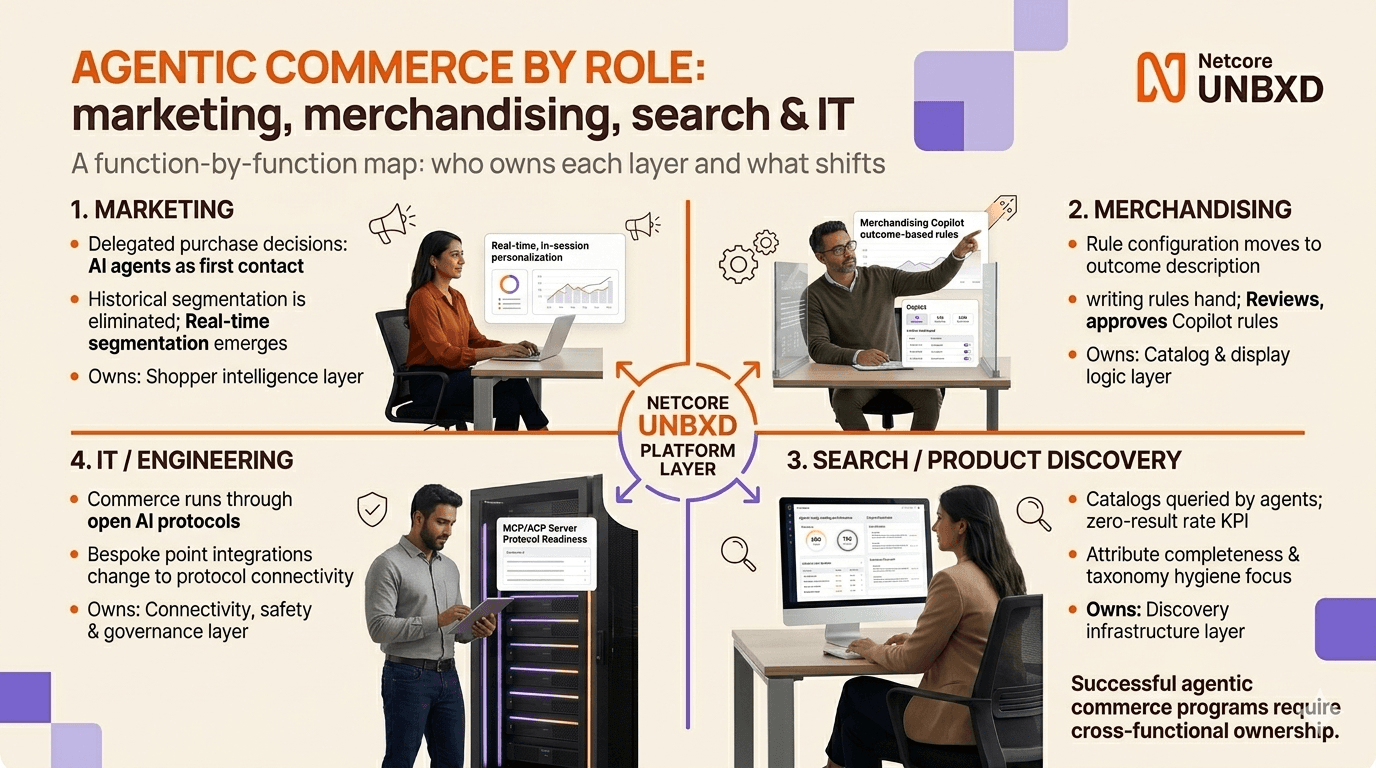
One program, four owners
Agentic commerce is not one team's problem. The catalog belongs to search and merchandising. Shopper intelligence belongs to marketing. Connectivity and safety belong to IT. Operational oversight belongs to ecommerce leadership. Retailers who plan this as a cross-functional program with clear ownership for each layer will outpace the ones who hand it to one team and hope the rest follows. To map where each of your four functions stands today, book a cross-functional agentic commerce readiness assessment with Netcore Unbxd.
Frequently Asked Questions
Merchandisers stop hand-writing configuration rules. They describe the outcome they want in plain language, and the Merchandising Copilot drafts the rule for human review and approval. Diagnostic work that used to take hours now happens in short conversations with the Insights Agent and Debugger Agent.
Marketing shifts from segmenting on historical profiles to segmenting in real time, often with an AI agent as the shopper's first point of contact rather than a campaign. Predictive segmentation reads in-session signals like browsing speed and purchase momentum, then adapts discovery while the shopper is still on the site. Intent data from agent interactions is more granular, not less, because agents send multi-constraint requests instead of vague queries.
Two things. Protocol-layer connectivity through an MCP-compatible server that exposes the existing stack to AI platforms, and agent governance covering human-in-the-loop design, spending-limit enforcement, audit trails, and anomaly monitoring.
Search teams move from keyword-recall optimization to attribute architecture, because AI agents do not tolerate incomplete results the way human shoppers do. Catalogs need complete attributes, a consistent taxonomy, and natural-language product descriptions to resolve multi-constraint agent queries cleanly. Zero-result rate on agent-style queries becomes the primary KPI. Discovery also extends beyond the on-site search bar to external, protocol-compatible APIs, which is where shoppers' agents are now searching.
No single team. Agentic commerce needs a cross-functional steering group with clear layer ownership: marketing for shopper intelligence, merchandising for display logic, search for discovery infrastructure, and IT for connectivity and safety. Treating it as a marketing-only initiative is the most common failure mode, because the foundation work is infrastructure.


