- ProductsSearch and BrowseRecommendationsCustomer Engagement
The ultimate guide to holiday gift discovery: How AI helps shoppers find the perfect holiday gift faster (2026 edition)


Every holiday season, millions of shoppers know exactly who they're buying for but have no idea what to buy. Shoppers rarely start with a specific product in mind. Instead, they begin with broad, intent-driven queries such as:
- Gifts for a coffee lover
- Holiday gifts under $50
- Best gifts for new parents
- Luxury gifts for him
- Sustainable gift ideas
- Last-minute Christmas gifts
These searches reflect exploration rather than certainty. Customers are looking for inspiration, guidance, and confidence before making a purchase.
For ecommerce retailers, this creates a significant challenge. Traditional keyword-based search often struggles to interpret these broad, conversational requests, leaving shoppers with irrelevant results, overwhelming product lists, or dead ends. During the holiday season, when purchase decisions are time-sensitive and competition is fierce, every poor search experience can translate into lost revenue.
This is where AI-powered gift discovery makes the difference.
Rather than forcing shoppers to know exactly what they want, modern product discovery platforms understand intent, personalize recommendations, and guide customers toward products they'll love, turning uncertainty into confident purchases. According to a report, 85% of Gen Z and Millennial consumers have adopted AI, compared with 70% of Gen X and 41% of Baby Boomers.
Why gift discovery matters more than ever
During holiday periods, search queries shift from product-specific intent ("Nike running shoes") to problem-oriented intent ("gift for a marathon runner under $100"). Retailers that optimize only for product keywords often miss this discovery phase. And this is a big concern given that the 2025 holiday season marked the first-ever quarter-trillion-dollar online shopping season, with consumers spending a record $257.8 billion, representing a 6.8% year-over-year increase.
Several factors make effective gift discovery essential:
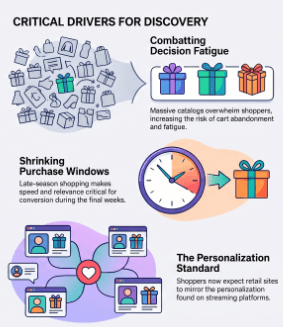
Massive product catalogs
Large retailers often manage tens of thousands or even millions of products. While assortment provides more choice, it also increases the difficulty of finding the right item quickly.
Decision fatigue
Too many options can overwhelm shoppers. When customers spend excessive time browsing, they become less likely to complete a purchase.
Shorter purchase windows
Many shoppers postpone holiday buying until the final weeks, making speed and relevance critical. Every unnecessary click increases abandonment risk.
Rising expectations
Customers have grown accustomed to personalized experiences across streaming platforms, social media, and online marketplaces. They now expect ecommerce sites to understand their preferences just as effectively.
Mobile-first shopping
Holiday shopping increasingly happens on mobile devices, where navigation space is limited. Search, recommendations, and curated experiences become even more important on smaller screens.
Mobile shopping reached a major milestone in 2025, becoming the first full year in which mobile devices accounted for more than half of all online spending. During the holiday season, mobile generated a record 56.4% of online revenue.
The biggest challenges holiday shoppers face
Understanding customer frustrations is the first step toward improving gift discovery.
Too many choices
A search for "holiday gifts" can return thousands of products. Without intelligent ranking and personalization, shoppers struggle to identify the best options.
Generic search results
Someone searching for "gift for someone who loves baking" isn't looking for products containing the word "baking." They're looking for thoughtful ideas, whether that's premium cookware, baking tools, recipe books, or decorative accessories.
Keyword matching alone often misses this intent.
Budget constraints
Price remains one of the strongest purchase factors during the holidays. Customers frequently search using budget-based phrases such as:
- Gifts under $25
- Gifts below $100
- Luxury gifts over $250
Retailers that don't support these discovery paths create unnecessary friction.
Last-minute shopping
Late shoppers prioritize availability, fast shipping, and relevance over endless browsing. They need recommendations they can trust immediately.
How AI transforms gift discovery
Artificial intelligence enables retailers to move beyond simple search and create intelligent shopping journeys.
Semantic search that understands intent
Instead of matching exact keywords, semantic search interprets what customers actually mean.
For example, a shopper searching for:
"Gift for someone who loves camping"
doesn't expect products containing the word "camping."
Instead, AI understands related concepts and surfaces products such as:
- Portable cookware
- Hiking backpacks
- Sleeping bags
- Outdoor lanterns
- Multi-tools
- Camping accessories
This creates a far more intuitive shopping experience.
Personalized recommendations
Every shopper has different preferences.
AI recommendation engines analyze signals such as:
- Browsing history
- Purchase history
- Product affinity
- Category preferences
- Similar customer behavior
- Real-time interactions
The result is highly relevant product suggestions that feel tailored to each individual customer.
Instead of showing the same products to every visitor, retailers create unique shopping experiences that improve engagement and conversion. 71% of consumers expect personalized interactions, and 76% get frustrated when they do not find them.
Dynamic merchandising
Holiday shopping trends can change in an instant. Imagine a toy going viral on TikTok just three days before Christmas. Within minutes, thousands of shoppers begin searching for it. Instead of waiting for a merchandising team to manually update the website, AI immediately recognizes the surge in demand. It automatically promotes the trending toy across search results, homepage collections, gift guides, and personalized recommendations, while simultaneously demoting out-of-stock alternatives and highlighting similar products when inventory starts running low.
The same intelligence works across every category throughout the holiday season. AI continuously analyzes inventory availability, sales velocity, seasonal demand, profitability, and business priorities to determine which products deserve greater visibility.
Collections such as Gifts Under $50, Best Sellers, Trending Gifts, Stocking Stuffers, Last-Minute Gifts, and Luxury Gifts are refreshed automatically as shopper behavior and inventory change. This ensures customers always see the most relevant products, while merchandising teams can focus on strategy instead of spending hours manually updating collections.
Intelligent filters
Filtering plays a major role in gift discovery.
Modern AI-powered filtering supports exploration based on:
- Recipient
- Occasion
- Budget
- Brand
- Age Group
- Interests
- Product Rating
- Delivery Timeline
Rather than narrowing choices through technical attributes alone, these filters align with how customers naturally think about buying gifts.
Conversational product discovery
Customers increasingly use natural language when searching online.
Examples include:
- "I need a gift for my dad who enjoys gardening."
- "Show me premium skincare gifts under $100."
- "Find sustainable home décor gifts."
- "Best gifts for a gamer who already has everything."
AI interprets these conversational queries and delivers relevant recommendations, reducing search effort and improving satisfaction.
Four gift discovery experiences that drive holiday conversions
1. AI gift finder
Interactive gift finders ask shoppers simple questions:
- Who are you shopping for?
- What's your budget?
- What are their interests?
- What's the occasion?
AI uses these responses to recommend highly relevant products, eliminating guesswork.
2. Visual search
Sometimes shoppers know what they like but struggle to describe it.
Visual search allows customers to upload an image and instantly discover visually similar products. The global Visual Search market size was valued at USD 41.72 Billion in 2024 and is expected to reach USD 151.60 Billion by 2032, at a CAGR of 17.50% during the forecast period.
This is especially valuable for:
- Fashion
- Home décor
- Furniture
- Accessories
3. Personalized product recommendations
Recommendation engines continuously adapt throughout the shopping journey.
Customers can receive suggestions such as:
- Similar Products
- Frequently Bought Together
- Complete the Look
- Customers Also Viewed
- Recommended For You
Each recommendation increases opportunities for cross-selling and larger basket sizes.
4. Curated holiday collections
Thoughtfully organized gift collections help shoppers explore without feeling overwhelmed.
Examples include:
- Gifts for Her
- Gifts for Him
- Gifts for Kids
- Tech Gifts
- Wellness Gifts
- Sustainable Gifts
- Gifts Under $50
- Premium Holiday Gifts
These curated experiences inspire discovery while reducing decision fatigue.
Best practices for creating high-converting gift discovery experiences
Successful holiday retailers combine AI with thoughtful merchandising strategies.
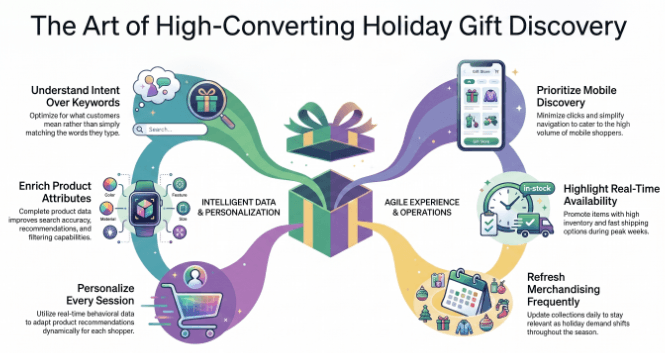
Understand intent instead of keywords
Optimize for what customers mean, not simply what they type.
Enrich product data
Complete product attributes improve search accuracy, recommendations, and filtering.
Personalize every session
Use behavioral data to adapt recommendations in real time.
Refresh merchandising frequently
Holiday demand changes daily. Dynamic collections keep experiences relevant throughout the season.
Prioritize mobile discovery
Simplify navigation, optimize search, and minimize unnecessary clicks for mobile shoppers.
Highlight availability
Promote products with sufficient inventory and fast shipping options, especially during peak holiday weeks.
Continuously test and optimize
Monitor search performance, recommendation engagement, conversion rates, and zero-result searches to identify opportunities for improvement.
How Netcore Unbxd makes holiday gift discovery smarter
Holiday shoppers expect ecommerce experiences that understand their needs instantly. Netcore Unbxd's AI-powered product discovery platform helps retailers deliver those experiences at scale.
Key capabilities include:
- AI-powered Search that understands shopper intent beyond exact keywords
- Hybrid Search combining lexical and semantic understanding for greater relevance
- Personalized Recommendations based on shopper behavior and preferences
- AI Merchandising that dynamically promotes products aligned with business goals
- Attribute Enrichment to improve search quality across large product catalogs
- Visual Search that enables image-based product discovery
- Dynamic Collections that automatically surface trending and seasonal products
- Behavioral AI that continuously learns from customer interactions to improve relevance
Together, these capabilities reduce friction across the shopping journey, helping customers discover the right gifts faster while supporting higher engagement, stronger conversions, and increased average order value during the busiest retail season.
Holiday gift discovery checklist
Before peak holiday traffic arrives, ensure your ecommerce experience includes:
- AI-powered search
- Personalized recommendations
- Intelligent merchandising
- Dynamic holiday collections
- Budget-based gift categories
- Recipient-focused gift guides
- Conversational search support
- Visual search capabilities
- Smart filters
- Inventory-aware product ranking
- Mobile-optimized shopping experiences
- Continuous merchandising optimization
Retailers that invest in these capabilities are better equipped to meet evolving shopper expectations and maximize holiday revenue.
Top mistakes to avoid this holiday season
As holiday traffic surges, even small friction points can lead shoppers to abandon their purchase. Many retailers still rely on ecommerce experiences that aren't designed for how customers actually shop for gifts.
One of the biggest challenges is relying solely on keyword-based search, which struggles to understand intent. A shopper searching for "gift for a coffee lover" may receive few or irrelevant results because the exact keywords don't exist in product descriptions. Poor catalog enrichment further limits discoverability, making it difficult for great products to surface when shoppers need them most.
Many retailers also depend on static gift pages and manually curated collections that quickly become outdated as inventory changes and shopping trends evolve. A collection featuring sold-out products or missing newly trending items creates frustration and missed revenue opportunities. Similarly, generic product recommendations that ignore individual shopper preferences fail to inspire confidence or encourage additional purchases.
The experience often becomes even more challenging on mobile devices, where cumbersome filters and complex navigation make it difficult for shoppers to narrow down products by recipient, budget, occasion, or delivery timeline. During the busy holiday season, every extra click increases the likelihood of cart abandonment.
AI helps eliminate these friction points by understanding shopper intent, enriching product discovery, personalizing recommendations, dynamically updating collections, optimizing merchandising based on inventory and demand, and delivering intuitive filtering across every device. Together, these capabilities create a seamless gift discovery experience that keeps shoppers engaged, improves conversion rates, and maximizes holiday revenue when it matters most.
Conclusion
Gift discovery has evolved from helping customers search for products to helping them discover the right products with confidence.
As shoppers increasingly rely on conversational search, personalized recommendations, and AI-assisted shopping experiences, retailers must move beyond traditional keyword search. Intelligent product discovery reduces friction, inspires exploration, and creates memorable shopping journeys that drive measurable business outcomes.
This holiday season, retailers that combine AI-powered search, personalization, merchandising, and rich product data will be best positioned to delight shoppers, improve conversion rates, and turn gift discovery into a lasting competitive advantage.
Discover how AI-powered product discovery helps shoppers find the right gifts faster with intelligent search, personalized recommendations, and dynamic merchandising. Schedule a demo with Netcore Unbxd.
Frequently asked questions
What is gift discovery in ecommerce?
Gift discovery is the process of helping shoppers find the most relevant gifts using AI-powered search, personalized recommendations, curated collections, filters, and merchandising. It simplifies exploration and makes holiday shopping faster and more enjoyable.
How does AI improve holiday gift shopping?
AI analyzes shopper intent, browsing behavior, product attributes, and historical interactions to recommend relevant products. This reduces search time, improves personalization, and increases the likelihood of purchase.
What is an AI gift finder?
An AI gift finder is an intelligent recommendation experience that suggests products based on information such as the recipient, budget, interests, occasion, or shopping behavior. It helps customers discover gifts even when they don't know exactly what they're looking for.
Why is gift discovery important for ecommerce retailers?
Effective gift discovery reduces decision fatigue, improves product relevance, increases conversion rates, boosts average order value, and enhances customer satisfaction during the highly competitive holiday shopping season.
What features should an ecommerce gift discovery experience include?
An effective experience should include AI-powered search, personalized recommendations, conversational search, recipient-based gift guides, budget filters, curated collections, visual search, intelligent merchandising, and inventory-aware ranking to help shoppers quickly find meaningful gifts.


