- ProductsSearch and BrowseRecommendationsCustomer Engagement
Commerce platforms with autonomous fulfillment agents: What they are and how to evaluate them


Key Takeaways:
- Commerce platforms with autonomous fulfillment agents combine two distinct layers: upstream agentic discovery that decides what gets bought, and downstream autonomous fulfillment that routes, allocates, ships, and returns the order.
- Autonomous fulfillment agents run a five-step loop for every order: order confirmation receipt, inventory allocation, carrier selection, shipping trigger, and return routing, all without manual assignment for standard orders.
- Agentic commerce discovery is the upstream layer where an AI agent interprets intent, surfaces options, and initiates a transaction, and it is the layer Netcore Unbxd addresses.
- The two layers connect at order confirmation, where the fulfillment agent inherits the product, variant, quantity, and address chosen by the discovery layer.
- A fulfillment agent is only as accurate as the discovery layer feeding it, because flawless execution on the wrong SKU still produces the wrong order.
- Three discovery-layer factors determine downstream fulfillment accuracy: attribute completeness, inventory signal accuracy, and protocol-layer connectivity via the MCP/ACP Server.
- Five criteria separate platforms built for autonomous agents from those that automate isolated tasks: agent coordination capability, catalog data integration, human-in-the-loop controls, protocol compatibility with ACP and MCP, and discovery-to-fulfillment handoff accuracy.
"Commerce platforms with autonomous fulfillment agents" covers two things that get conflated in nearly every vendor pitch. The first is autonomous fulfillment: the downstream operations layer that routes orders, allocates inventory, and selects carriers without manual assignment. The second is agentic commerce discovery: the upstream layer through which an AI agent finds and selects the product that gets fulfilled. These are different layers of the same stack. Understanding where they connect, and where they do not, is the starting point for any platform evaluation. This post covers both: what autonomous fulfillment agents do, how the discovery layer connects to them, how to evaluate platforms on both dimensions, and where the B2B use case is strongest.
What commerce platforms with autonomous fulfillment agents are
Two terms, frequently conflated, need to be separated before any platform evaluation makes sense.
Autonomous fulfillment agents are AI systems that manage downstream commerce operations after a purchase decision has been made. They automate order routing across fulfillment nodes, inventory allocation based on proximity and availability, carrier selection based on cost and speed constraints, shipping confirmation triggering, and returns routing to the correct processing center. They operate without manual assignment at each step. The agent is doing the work that a fulfillment coordinator, a routing engine, and a returns specialist would otherwise do in sequence.
Agentic commerce discovery sits upstream. An AI agent querying a retailer's catalog on behalf of a shopper, interpreting intent, surfacing options, and initiating a transaction is performing discovery-to-checkout automation. This is the layer Netcore Unbxd addresses. It is the layer that determines what gets purchased before any fulfillment step begins.
The two layers connect at the moment a transaction is confirmed. What the fulfillment agent receives is the output of the discovery layer: the product, the variant, the quantity, and the delivery address. The quality of that handoff determines the accuracy of everything that follows. A fulfillment agent that executes flawlessly on the wrong SKU still produces a wrong order. A discovery layer that surfaces the right SKU but cannot pass clean structured data downstream still produces a wrong order. Both layers have to work, and they have to work together.
How autonomous fulfillment agents work
The mechanism is a five-step sequence the agent runs for every order.
-
Order confirmation receipt: The fulfillment agent receives a confirmed order with product, variant, quantity, and delivery address from the commerce platform. This is the handoff point from the discovery layer. The agent treats the inputs as authoritative.
-
Inventory allocation: The agent queries inventory across fulfillment nodes and allocates the SKU from the nearest in-stock location that meets the delivery window. Allocation logic factors in node-level stock accuracy, reservation conflicts, and the merchant's defined service-level rules.
-
Carrier selection: Based on cost, speed, and weight constraints defined by the merchant's fulfillment rules, the agent selects the carrier and service level. The selection considers contracted rates, zone-skip eligibility, and any active service disruptions.
-
Shipping trigger: The agent generates the shipping label, notifies the warehouse system for pick-and-pack, and triggers the customer shipping confirmation. The handoff to warehouse execution is automated end to end.
-
Return routing: On a return request, the agent identifies the originating node, applies return eligibility rules, and routes the return to the correct processing center. Disposition (restock, refurbish, liquidate) is decided against the merchant's returns policy.
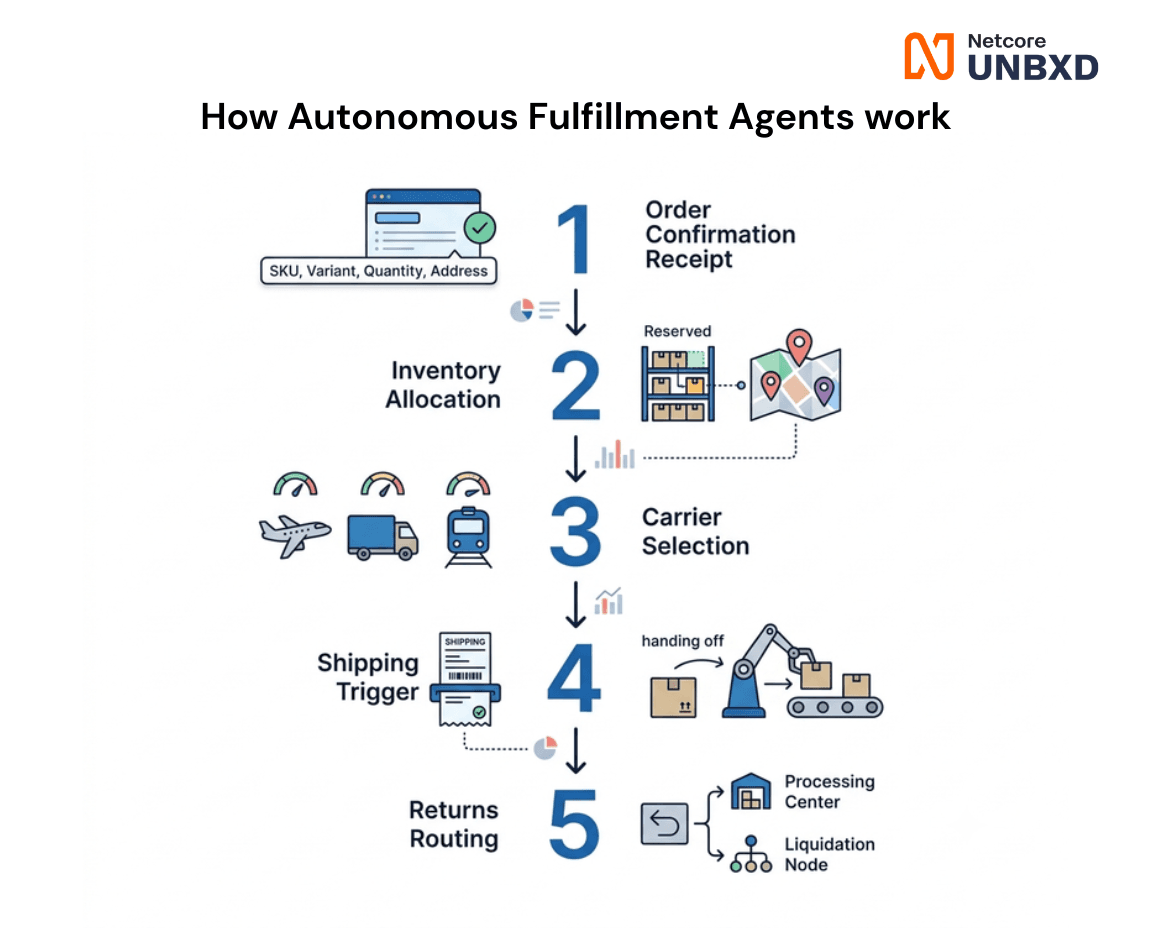 A visual breakdown of the automated five-step sequence an autonomous fulfillment agent executes for every order.
Autonomous fulfillment agents can execute all five steps at any order volume, at any hour, without a human in the loop for standard orders. The human-in-the-loop trigger is reserved for exceptions: low-confidence allocations, high-value orders that breach a review threshold, or any rule the merchant configures to escalate.
How the discovery layer connects to autonomous fulfillment
The link between discovery and fulfillment is the quality of the handoff at transaction confirmation. An autonomous fulfillment agent receives a product ID, variant, and quantity. If the discovery layer surfaced the wrong product variant because the catalog had ambiguous or incomplete attribute data, the fulfillment agent fulfills the wrong order, accurately and at speed. The discovery layer's accuracy is the upstream input that determines fulfillment accuracy.
Three ways the discovery layer affects downstream fulfillment quality:
Attribute completeness: A product listing that clearly exposes the variant-determining attributes (size, color, compatibility, configuration) produces a transaction confirmation with an accurate SKU. A listing that ambiguates variant attributes, by collapsing two configurations into one parent or by leaving a fitment attribute blank, produces a fulfillment error that the fulfillment agent has no way to detect. The error is invisible until it arrives at the customer.
Inventory signal accuracy: Real-time inventory availability surfaced in the discovery layer prevents the AI Shopping Agent from recommending a product that is out of stock, which would generate a fulfillment failure downstream. Netcore Unbxd's AI Shopping Agent delivers 5x add-to-cart rates compared to traditional search, and the value of that uplift compounds only when inventory signals are clean enough to convert intent into shipped orders.
Protocol-layer connectivity: The MCP/ACP Server connects Netcore Unbxd's ecommerce stack (catalog, search, analytics, actions) to AI platforms through the Model Context Protocol. "Actions" is the capability class through which downstream operations, including fulfillment triggers, can be reached. Specific named fulfillment system integrations are not documented as out-of-the-box; the MCP/ACP Server is the protocol mechanism through which such connectivity is configured in the merchant's specific stack. The protocol layer is what makes the discovery layer reachable to external AI agents, including those that orchestrate fulfillment.
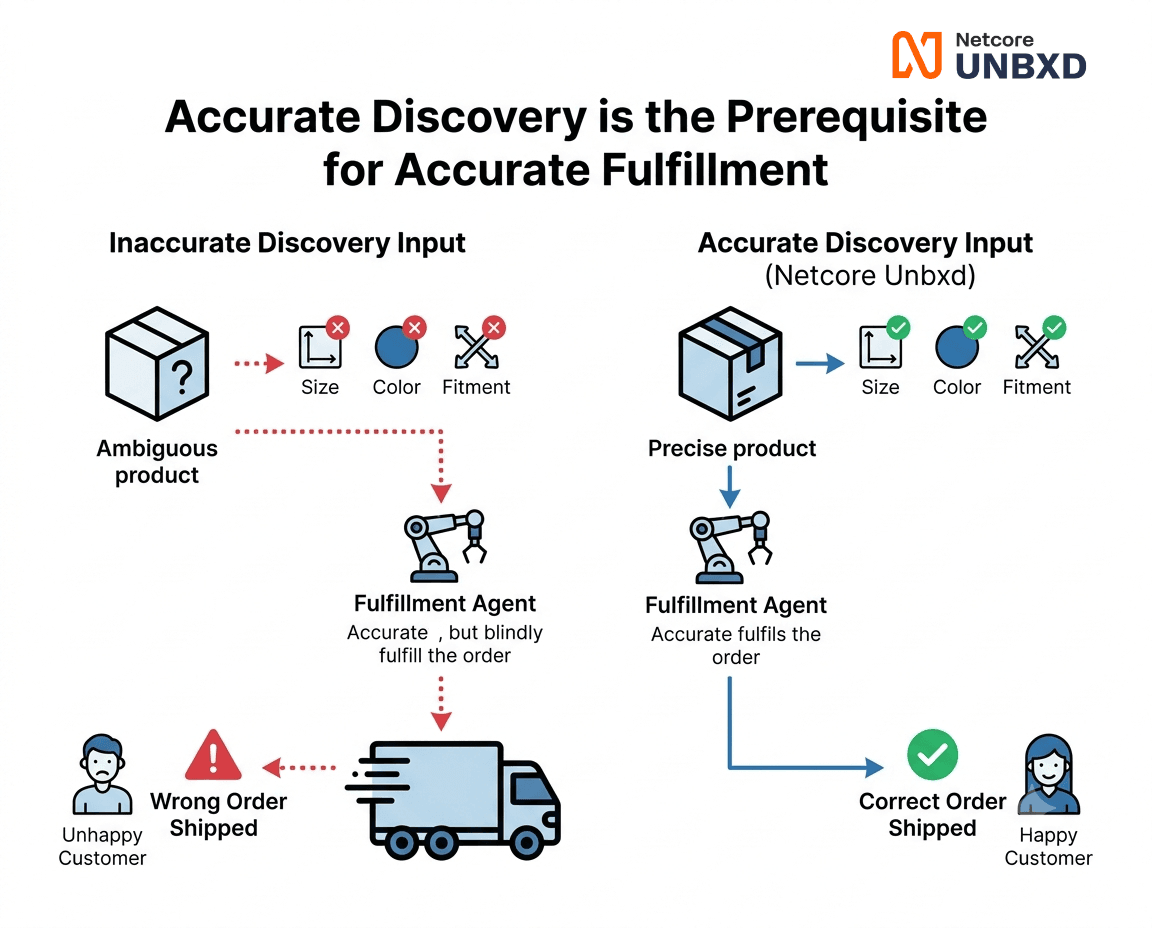 A visual comparison showing how the accuracy of the upstream discovery layer determines the accuracy of downstream fulfillment.
Evaluation criteria for commerce platforms with autonomous agents
Generic ecommerce evaluation criteria (uptime, scalability, vendor stability) apply here too, but they do not separate platforms that work in an autonomous-agent stack from platforms that do not. Five criteria do.
Agent coordination capability: Can the platform coordinate multiple agents (discovery, merchandising, fulfillment, personalization) on shared data without producing conflicting signals? A merchandising agent that boosts a SKU the fulfillment agent cannot ship to a given region is a coordination failure.
Catalog data integration: Can the platform ingest, enrich, and normalize product data from multiple sources (vendors, PIMs, ERPs) at the speed and scale the merchant's order volume demands? The autonomous stack runs on structured data. The integration layer is the rate-limiting input.
Human-in-the-loop controls: Does the platform provide configurable thresholds for when agent decisions require human review, and an audit trail of what each agent decided and why? Without this, exceptions cannot be governed and post-mortems cannot be conducted.
Protocol compatibility: Is the platform compatible with ACP and MCP standards so its discovery and fulfillment capabilities are accessible to external AI agents operating on behalf of shoppers? Platforms without protocol compatibility cannot participate in agent-initiated commerce as it evolves.
Discovery-to-fulfillment handoff accuracy: Can the platform demonstrate, with data, that the product surfaced by the discovery layer matches the product successfully fulfilled? This is the measure of handoff quality that determines fulfillment error rates.
| Capability | Why it matters for autonomous fulfillment | What to look for in a platform evaluation |
|---|---|---|
| Autonomous order routing | Decides which node fulfills each order without manual assignment | Configurable routing rules; node-level stock accuracy; latency from order to allocation |
| Inventory allocation logic | Determines whether the right unit is reserved from the right node | Real-time inventory sync; reservation conflict handling; multi-node failover |
| Carrier selection logic | Sets cost, speed, and reliability of every shipment | Rules engine that factors zone, weight, SLA, and active carrier disruptions |
| Returns automation | Routes returns to the right processing center under the right disposition | Eligibility rules engine; disposition automation; node-aware return routing |
| Discovery-to-fulfillment handoff quality | Determines whether the agent fulfills the order the shopper actually meant | Variant-attribute completeness; inventory signal accuracy; SKU integrity at confirmation |
| Agent coordination capability | Prevents agents from issuing conflicting signals across the stack | Shared data layer; orchestration model; conflict resolution logic |
| Audit trail and human-in-the-loop controls | Makes autonomous decisions reviewable and governable | Per-decision logs; configurable escalation thresholds; reviewer workflows |
Evaluation criteria that separate platforms built for autonomous-agent operations from platforms that automate isolated tasks.
Why the B2B use case is especially high-value
B2B operators face greater discovery-to-fulfillment complexity than B2C: complex product configurations, SKU variants that differ by specification rather than visual attribute, procurement compliance requirements, and order quantities that make fulfillment errors significantly more costly. A wrong consumer order is a return. A wrong industrial order can shut down a production line.
ibSupply, a US B2B industrial marketplace, faced the catalog-scale problem directly. When the catalog grew beyond what in-house search could handle, Netcore Unbxd's AI-powered search and catalog infrastructure delivered a 40% lift in total revenue from site search in six weeks, a 35% lift in revenue per search session, a 22% increase in search conversion rate, and an 11% lift in AOV. As Harley Thomas, Sr. Director of Corporate and Digital Marketing at ibSupply, put it: "As ibSupply.com's catalog grew, we needed site search to scale and meet the needs of shoppers." These are search and catalog results, not autonomous fulfillment results. They matter to this evaluation because the catalog discipline that made them possible (structured attributes, consistent taxonomy, AI-readable descriptions) is the same foundation that makes autonomous fulfillment accurate downstream.
YPO, a UK public-sector procurement operator, runs 23,000+ SKUs across 100+ procurement frameworks. A wrong product recommendation in a procurement context has compliance implications, not just commercial ones. With Netcore Unbxd, YPO saw a 2x improvement in search speed over its previous solution, alongside 9.66% YOY revenue growth and 29.35% YOY session growth. David O'Brien, Ecommerce and Digital Solutions Manager at YPO: "The speed of results using Netcore Unbxd had over a 2x improvement over the previous search solution, this ensures customers see what they need quickly, which is paramount for a lot of YPO customers where time is precious, efficiency is key." Again, a discovery and catalog story. And again, the prerequisite layer for any autonomous fulfillment investment that follows.
Netcore Unbxd is a 2026 Gartner Magic Quadrant Leader and a Forrester Wave Q3 2025 Strong Performer in this category.
The fulfillment agent is only as accurate as the discovery layer that feeds it
Autonomous fulfillment agents are available today from logistics and OMS platforms. What determines whether they work accurately is the quality of the product data and discovery infrastructure upstream. Fulfillment automation built on a catalog with incomplete attributes, inconsistent taxonomy, and ambiguous variants will execute the wrong order autonomously, at scale. The investment in discovery infrastructure is not separate from the investment in fulfillment automation: it is the prerequisite. Talk to us about a discovery-to-fulfillment readiness assessment for your stack.
Frequently Asked Questions
They are platforms that combine AI-driven discovery (search, recommendations, agentic checkout) with AI-driven downstream operations (order routing, inventory allocation, carrier selection, returns routing). The fulfillment agent handles operations after purchase; the discovery layer handles selection before it. Both have to work for the stack to deliver accurate, autonomous order execution.
They run a five-step sequence per order: receive the confirmed order, allocate inventory from the optimal node, select the carrier and service level, trigger shipping and warehouse pick-and-pack, and route returns when they arrive. Standard orders move through this loop without human assignment. Exceptions escalate to a reviewer based on merchant-defined thresholds.
Autonomous fulfillment is the downstream operations layer: what happens after a purchase is confirmed. Agentic commerce is the upstream discovery layer: how an AI agent finds, selects, and transacts on a product. The two connect at order confirmation. Confusing them leads to evaluating only half the stack.
Five criteria separate viable platforms from the rest: agent coordination capability, catalog data integration depth, human-in-the-loop controls and audit trails, protocol compatibility (ACP and MCP), and demonstrable discovery-to-fulfillment handoff accuracy. Generic ecommerce evaluation criteria are necessary but not sufficient.
B2B catalogs have complex configurations, specification-driven variants, procurement compliance requirements, and high-cost fulfillment errors. The accuracy gains from clean discovery infrastructure compound downstream in ways B2C cannot match. ibSupply and YPO show what discovery infrastructure at scale delivers; autonomous fulfillment is the next layer of the same investment.
Recommended reading for you


