- ProductsSearch and BrowseRecommendationsCustomer Engagement
The cold-start problem in peak season: Why holiday 2026 is decided before it begins


Every retailer with a mature catalog carries years of accumulated signal. Peak season is the one moment that signal cannot help you, and in 2026 the shopper reading your catalog will not wait for it to recover.
Key takeaways
• Peak demand arrives in languages your systems were never trained on, so the confidence built over eleven months quietly expires at the start of the twelfth.
• Holiday season triggers three cold starts at once: queries your logs have never seen, seasonal SKUs entering the catalog with zero engagement history, and regular customers shopping so far off their usual pattern that they look brand new.
• An AI shopper reads a catalog once and decides. There is no rough opening to learn from and no second impression to earn. The first read is the only read.
• The fix is a signal that does not depend on history: real-time intent, semantic understanding of unseen queries, and a catalog made legible before the season tests it.
What is the cold-start problem?
The cold-start problem is a limit in search and recommendation systems that learn what to surface from the history of interactions, such as clicks, conversions, and engagement. When that history is missing, the system has nothing to rank against. It either guesses, surfacing poor matches that push shoppers to exit, or it returns nothing at all.
For most of the year, a mature catalog hides this. Your best-selling queries have years of signal behind them, so search looks smart. Then the holiday season arrives, and the history disappears underneath you.
Why peak season is a cold-start machine
Three cold starts land at once during the holidays:
Query cold start
Shoppers arrive asking for things they never asked for in October. Matching family pajamas, a white elephant gift under a set price, stocking stuffers for teens, gifts for someone who has everything. These queries carry no history in your logs, so search falls back to thin keyword matches or an empty page, for demand that is very real.
Product cold start
Seasonal SKUs, gift sets, and new arrivals enter the catalog with thin data and zero engagement history. There is nothing for the system to learn from, so even well-stocked products stay invisible.
Behavioral cold start
Peak brings shoppers buying outside their own patterns. A regular customer shopping for a niece they never buy for looks like a brand-new user to any system that leans on personalization. The signal that usually carries them breaks right when volume is highest.
 New queries, new products, and new behavior show up during the holiday season, is your product discovery prepared?
Individually, each cold-start is manageable. Together, in the weeks that decide the quarter, they are the reason a catalog that felt ready in the summer starts returning nothing in November.
Why are established catalogs the most exposed?
There is a version of the cold-start problem everyone in the industry recognizes: the one that hits a brand-new store with no history to learn from. If that is the version you picture, your own setup looks safe. You have years of behavioral data, your search feels sharp, and your recommendations convert. A cold start looks like a problem for startups.
Then the season arrives, and the ground resets underneath you.
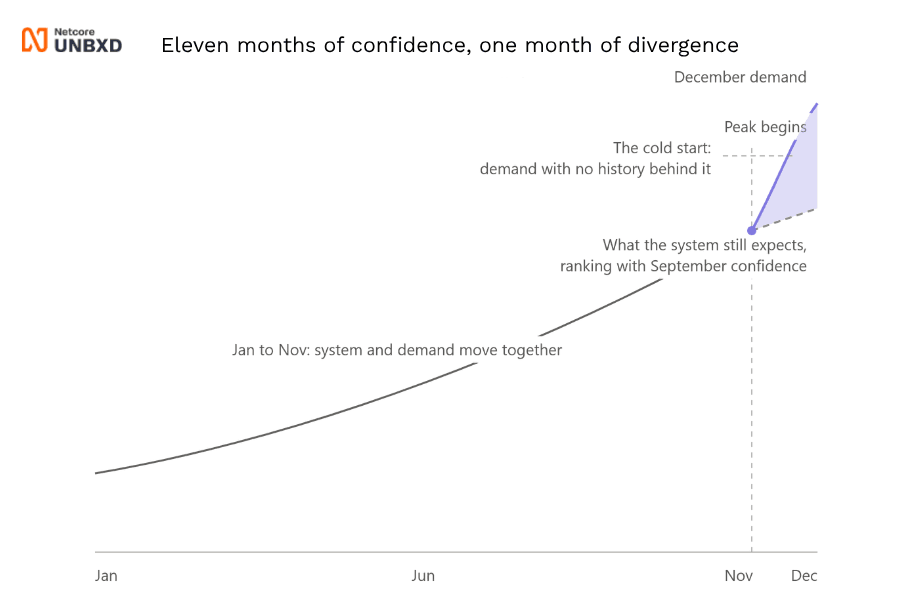
A catalog that has learned its shoppers well for eleven months grows confident in exactly the patterns the twelfth month breaks. Demand shows up phrased in ways your logs have never seen, aimed at recipients your regular shoppers never buy for, attached to products that entered the catalog last week with no history behind them. The system does not know it is suddenly working on thin ice. It ranks with the same confidence it had in September, against a demand curve that no longer looks anything like it did in September.
That is why peak season is not an edge case of the cold-start problem. It is the clearest example of it: it arrives on a fixed date, at the moment the stakes are highest, for the retailers least inclined to expect it.
Peak season used to correct itself
Until now, the season came with a repair mechanism built in.
The opening days of the peak were always noisy. Search missed things, recommendations ran cold, and some categories underperformed for reasons no one could immediately explain. But the same volume that made those failures painful was also what fixed them. Every query, click, and abandoned basket fed the system with fresh signals at an enormous scale, and within a week or two, the cold started to thaw. By the middle of December, the catalog had effectively re-learned the season, and the back half of peak ran on the intelligence the front half had paid to acquire.
Most retail teams built their operating posture around that loop. War rooms were staffed for the first fortnight, and everyone braced for a rocky open in the knowledge that the machine would settle. The cost of entering the season cold was real, but it was recoverable, because the season taught you how to sell into it while you were still selling.
That assumption is the thing quietly breaking, and most teams have not noticed yet.
AI shoppers read once, then move on
When the shopper researching your product is an AI agent rather than a person, the recovery loop stops working, because the behavior it depended on is gone.
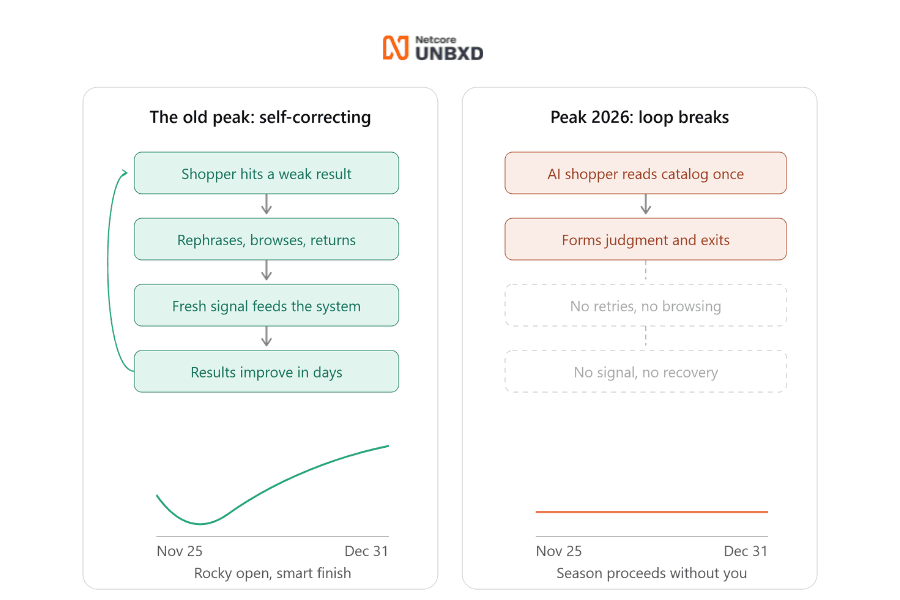 The old peak came with a repair mechanism: shoppers retried, signal flowed, results improved by mid-December. An AI shopper reads once and exits, so the loop never runs.
A person who hits a weak result gives you another chance. They rephrase the query, they browse, they come back tomorrow. Each of those second chances is a data point, and in aggregate they are what let the old cold start thaw. An AI shopper does none of that. It reads what your catalog presents, forms a judgment, and moves on. If your product data was thin or unclear on the read that counted, the product does not get surfaced, the human never sees it, and no follow-up interaction ever tells you something went wrong.
So the correction never runs. There is no noisy opening week resolving into a smart back half, because the failures no longer generate the signal that used to fix them. The season stops teaching you how to sell into it. It simply proceeds, with or without you, based on how ready your catalog was the first time an agent looked at it.
That is the real shift of the agentic era, and it is bigger than it sounds. This is not a harder version of the old problem. It is the same problem with the safety net removed. Entering peak cold used to mean a slow start. In holiday 2026, it means the whole season is decided before the season even begins.
Solving the cold start without history
The cold start cannot be fixed with more history, because history is exactly what peak takes away. It can be fixed with signals that exist from the first second of a session, and this is where AI-native discovery platforms like Netcore Unbxd change the equation.
Real-time intent mapping reads clicks, filters, dwell time, and search refinements as they happen, building an evolving picture of what each session wants without waiting for a profile to exist. We have broken down how this works for first-time shoppers with zero purchase history.
Semantic search powered by NLP understands what a query like stocking stuffers for teens actually means, even when the phrase has never appeared in your logs, by matching intent to catalog attributes instead of keywords to keywords. New seasonal language stops landing on empty pages.
Anonymous behavioral cohorts let a brand-new pattern borrow relevance from similar live sessions, so recommendations keep working for the regular customer shopping wildly off their usual pattern.
Session-based personalization keeps all of this privacy-safe, working equally well for anonymous shoppers and opt-outs, which matters as tracking continues to erode. We have covered why this approach is becoming the default in a cookie-less, privacy-first world.
The common thread: none of these signals depend on the past. They make a catalog answerable on the first read, which is the only read an AI shopper gives you.
The work has to happen before the season
Once the recovery window is gone, the logic of when to do the work turns over completely.
The instinct built up over years of retail is to concentrate effort inside the peak, because that is where the revenue is and where the failures show. But the value of in-season effort collapses the moment the shopper stops giving you the reads that make in-season learning possible. You cannot fix a judgment in a war room when that judgment was already made and never surfaced. The hours that used to pay off in the second week of December now have to be spent in July, against demand that has not arrived yet, for a return you will not see until it does.
This is a hard ask for an enterprise, because it runs against how retail organizations are built. Budgets, headcount, and attention are tuned to the rhythm of the season, ramping as demand ramps. What the shift asks for is the opposite. Treat the quiet months as the season that matters, because they are the only months in which the outcome is still in your hands. Treat the catalog as a living asset that has to be legible before it is tested, enriched and structured for the questions agents will ask, not a feed you tune once the results start coming back.
Teams that make that change will not look heroic in November. There will be no dramatic recovery to point to, because there will be nothing to recover from. The catalog will simply have been readable when the first agent looked, and the season will run quietly in their favor while their competitors stare at flat numbers and try to reconstruct what they never saw happen.
Being ready before the season gets the chance to test you is the whole game now. It is worth deciding, well ahead of peak, which of those two seasons your organization is actually staffed for.
Frequently Asked Questions
The cold-start problem is a limitation of search and recommendation systems. Because these systems learn what to surface from historical signals such as clicks and conversions, they perform poorly for anything they have no history on, whether that is a new product, a new shopper, or a query they have not seen before. With nothing to rank against, the system either guesses or returns nothing.
Because peak resets the conditions the system learned under. A mature catalog is confident in the patterns it observed across the year, but holiday demand arrives in new language, aimed at unfamiliar recipients, and attached to products with no history. The system keeps ranking confidently against a demand curve that no longer matches what it was trained on, so maturity offers less protection than it appears to.
The season used to correct itself. High volume fed the system enough fresh signal that an imperfect opening week improved on its own within days. An AI shopper reads a catalog once and moves on without generating that corrective signal, so the recovery loop never runs. The quality of the first read now decides the outcome, with no second impression to earn.
Not reliably. In-season effort used to pay off because shoppers kept interacting and teaching the system. When an agent forms a judgment on a single read and does not resurface a product it skipped, there is no interaction to learn from and no way to correct a decision you never saw being made. The effective window for the work has moved to before the season.
Well before demand ramps, in the quiet months, because those are the only months in which the outcome is still controllable. The organizational challenge is that budgets and attention usually ramp with the season, which is the opposite of what the shift now requires.
By replacing historical signals with real-time and semantic signals. Session-based AI personalizes from live behavior in the current visit, NLP-driven search interprets the intent behind queries it has never seen, and catalog enrichment makes new SKUs legible before the first agent or shopper reads them. Platforms like Netcore Unbxd are built for exactly this, so readiness work done in the quiet months compounds through the season.


