- ProductsSearch and BrowseRecommendationsCustomer Engagement
How AI-powered Search Fixes the Pain Points of Traditional Ecommerce Search


In part 1 of this series, we looked at where traditional search breaks down. It misses intent, leads shoppers into dead ends, trips over different words for the same product, shows everyone the same results and needs constant manual upkeep. Baymard's 2026 benchmark found that 56% of ecommerce sites fail to adequately support users' search needs.
Adding more rules and synonym lists to a keyword engine only goes so far. These problems come from the way traditional search works, so fixing them takes a different kind of search. This post explains what AI-powered site search is, where AI shopping agents fit in and how each capability solves one of the five problems.
Key Takeaways
- AI-powered site search understands what shoppers mean, not only the words they type, using natural language processing, machine learning and behavioral data.
- An AI shopping agent adds conversation on top of AI-powered search. Shoppers describe what they need in their own words, and the agent asks follow-up questions to narrow it down. Both can solve all five pain points.
- Intent understanding reads "lightweight laptop for travel under $1,000" as a product, an attribute, a use case and a budget.
- Smart autosuggest, measurement handling and close alternatives keep shoppers away from zero-results pages.
- Semantic search, spell correction and catalog enrichment connect the words shoppers use with the words in your catalog.
- Real-time personalization adapts results to every shopper, including first-time visitors with no history.
- Self-learning ranking removes most manual upkeep, while merchandisers stay in control of goals and guardrails.
What is AI-powered site search?
AI-powered site search is the search bar on your store, rebuilt around understanding instead of matching. Traditional search compares the words in a query with the words in your product data. AI-powered search uses natural language processing to understand what the shopper means, machine learning to learn from what shoppers click and buy, and behavioral data to adapt results to each person.
To the shopper, it still looks like a search bar. The difference is in what comes back: results that fit the need behind the query, ranked for that shopper, even when their words don't match your catalog.
Where AI shopping agents come in
An AI shopping agent builds on AI-powered search and adds conversation. Instead of typing a few keywords, the shopper can describe what they need in their own words. The agent keeps context throughout the visit, asks a clarifying question when a request is vague and narrows the options step by step, much like a good store associate.
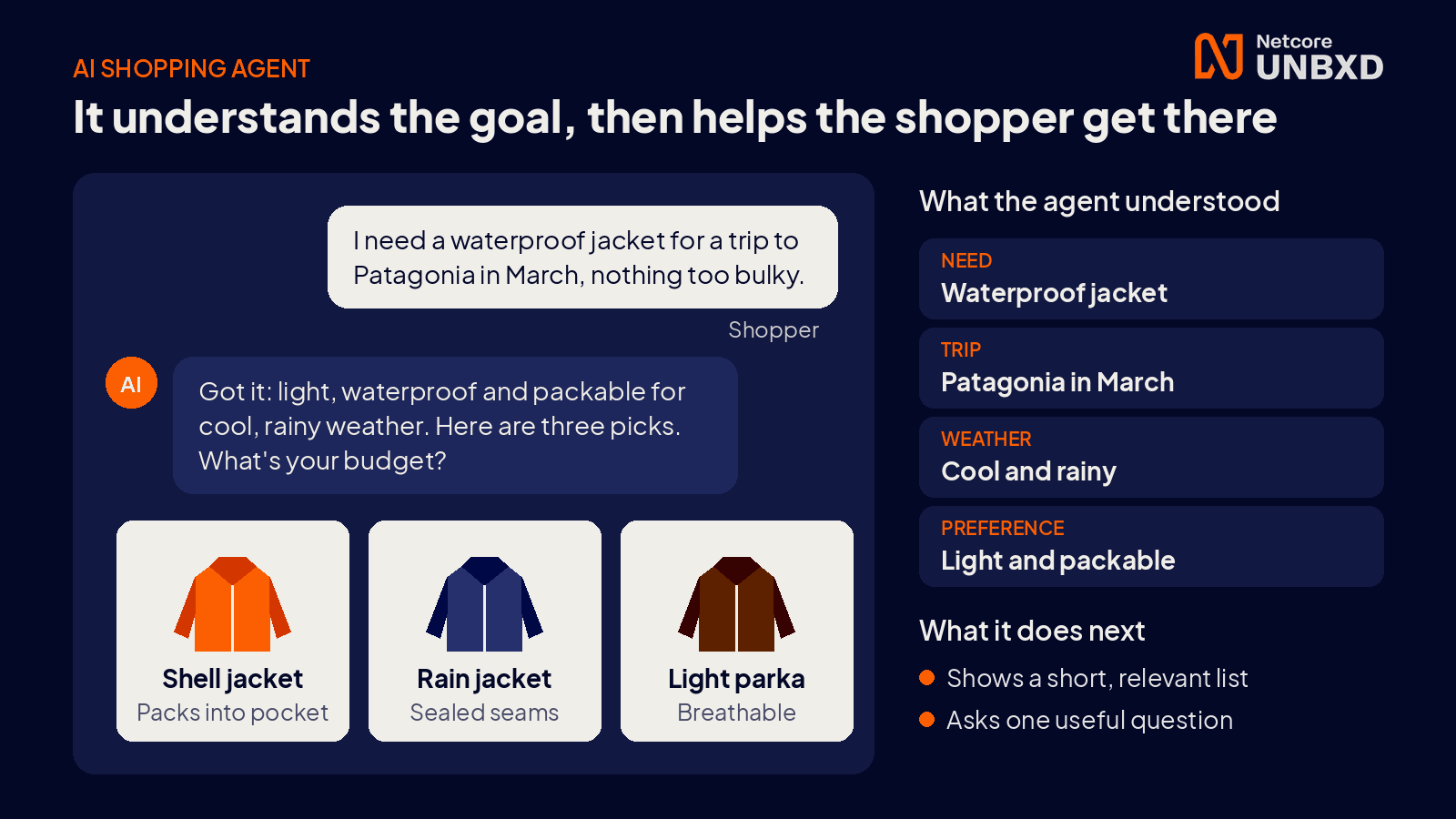
Because it runs on the same capabilities, an AI shopping agent can solve the same five problems as AI-powered search. The difference is the experience. A search bar suits shoppers who know roughly what they want, while an agent helps shoppers who'd rather explain their situation and be guided to the right product. Most retailers will want both.
Here's how AI-powered search handles each pain point from part 1, and where a shopping agent adds to it.
1. It understands intent
Fixes: search that misses intent
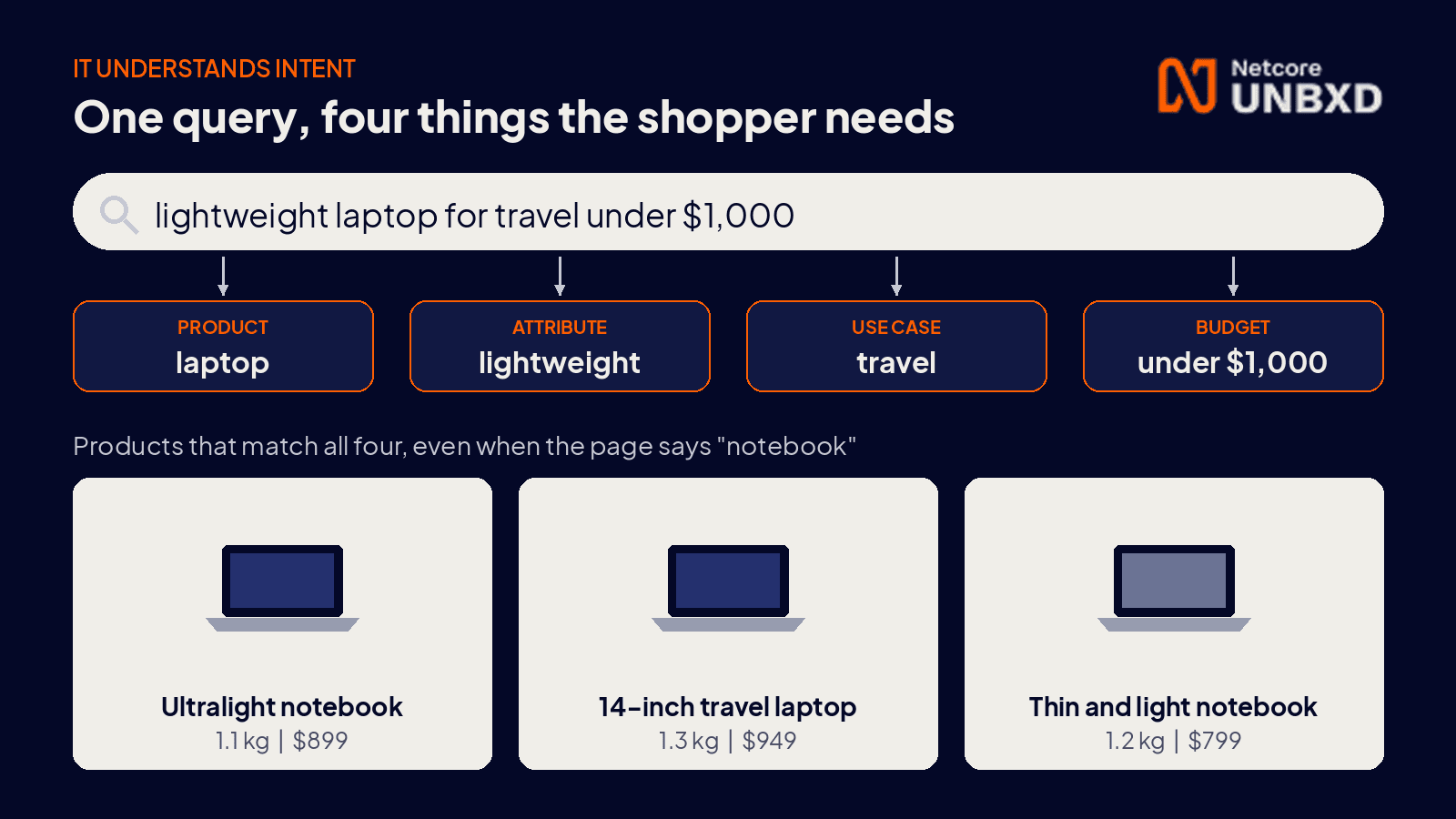
Keyword search reads "lightweight laptop for travel under $1,000" as a string of separate words. It returns anything containing them, in whatever order the default ranking decides.
AI-powered search uses natural language processing (NLP) to break that query into parts: the product (laptop), the attribute (lightweight), the use case (travel) and the budget (under $1,000). It then looks for products that meet all four, even when the product page never uses those exact words. Semantic matching adds another layer, so a laptop listed as a "notebook" still shows up.
The same goes for a query like "knee pain." Instead of returning everything with "knee" in the title, AI-powered search understands that the shopper has a problem to solve and surfaces sleeves, braces and supports.
With a shopping agent: intent carries through the conversation. If the shopper follows up with "something with a longer battery," the agent narrows the same list instead of starting a new search.
2. It guides shoppers past dead ends
Fixes: zero results and irrelevant results
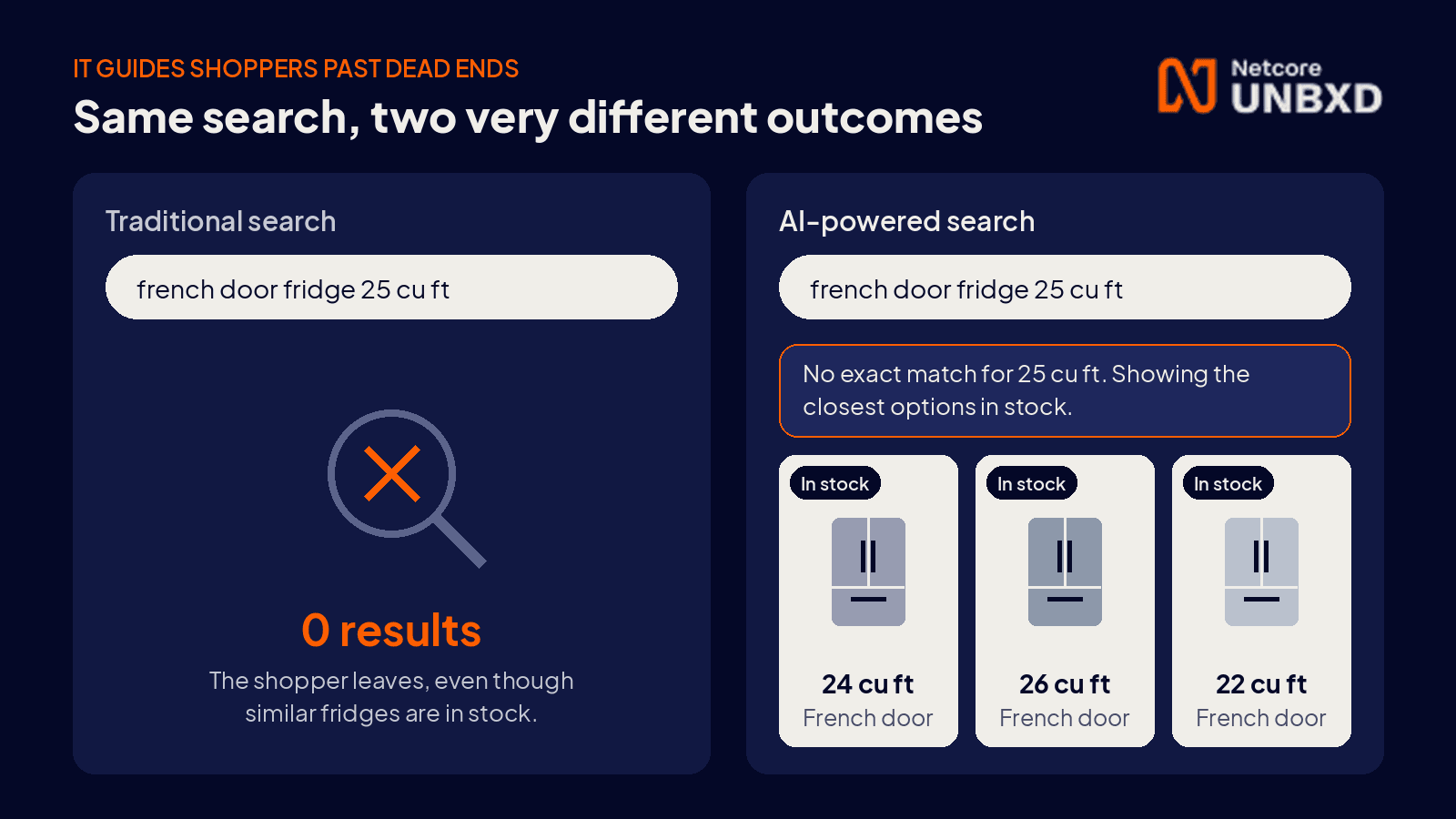
A zero-results page tells shoppers you don't have what they want, even when the product is in your catalog. AI-powered search prevents this in three ways.
It guides the search as the shopper types. Autosuggest predicts the query, ranks suggestions by how likely they are to lead to a purchase and fixes typos before the search runs. It also reads partial intent, so someone typing "nail pol" sees nail polish while "nail ca" points to nail care.
It understands measurements. Shoppers who search with sizes and capacities know exactly what they need. AI-powered search understands units in any format, so "200L," "200 liter" and "200 liters" all map to the same capacity.
It shows close alternatives instead of an empty page. When nothing matches exactly, AI-powered search returns the closest options in stock rather than a dead end.
With a shopping agent: the agent can go a step further and ask a quick question, like "Would a slightly smaller model work?", turning a dead end into a conversation.
3. It speaks the shopper's language
Fixes: shoppers and catalogs using different words
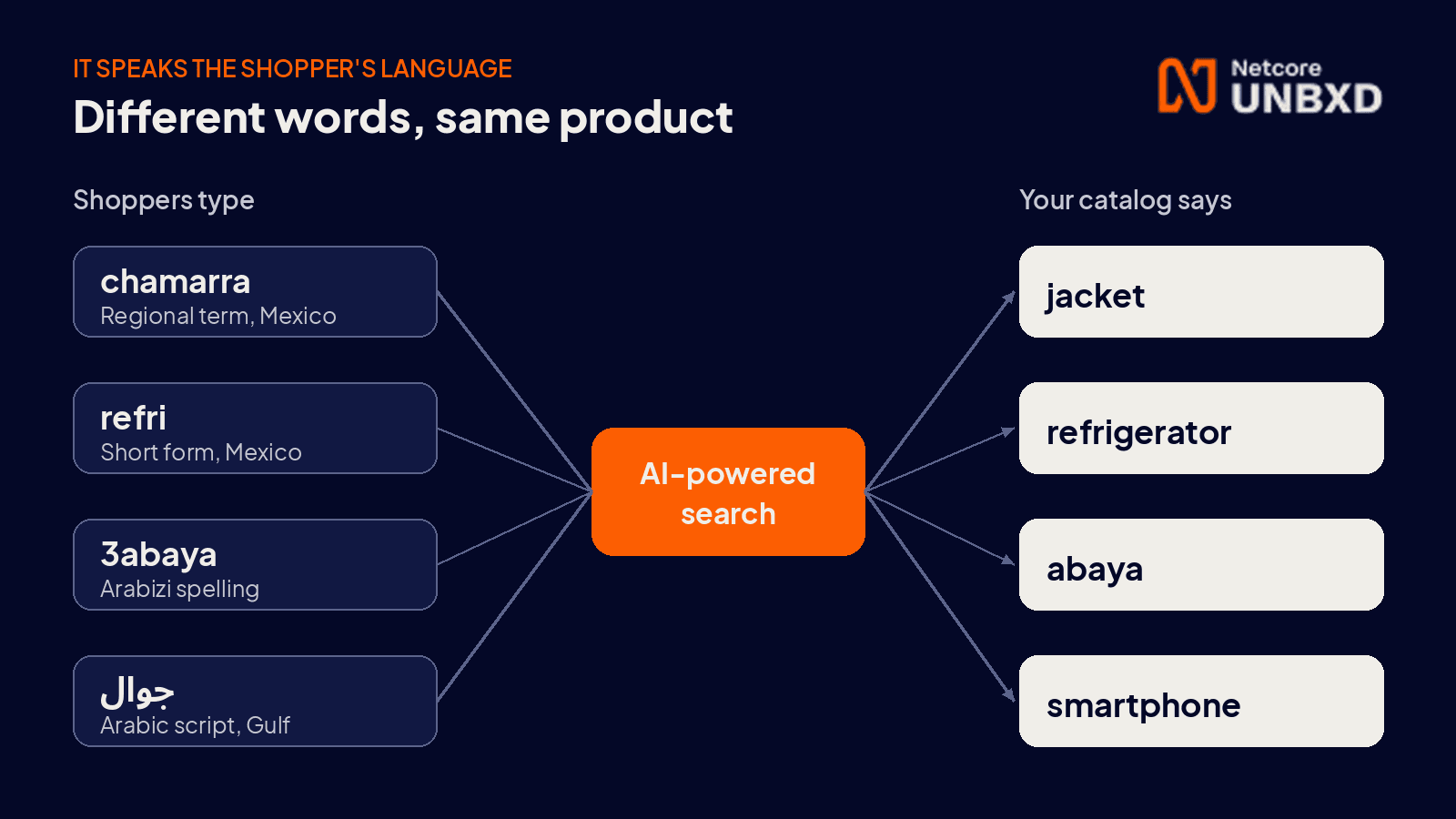
Shoppers type "couch" and the catalog says "sofa." A shopper in Mexico types "tenis" and the catalog says "running shoes." AI-powered search closes that gap from both sides.
On the query side, semantic search understands that related words mean the same thing, and spell correction catches phonetic typos like "Keurick" for Keurig. On the catalog side, enrichment improves the product data itself. AI reads product descriptions and images and pulls out structured attributes such as material, style, fit and use case. A retailer that labels items "top," "shirt" and "tunic" ends up with all three findable, whichever word the shopper types.
This matters most in multilingual markets like India and Latin America, where the same product goes by different names from one region to the next.
With a shopping agent: shoppers can describe a product they can't name, like "the coffee machine that uses pods," and the agent works out what they mean.
4. It personalizes every visit
Fixes: everyone seeing the same results
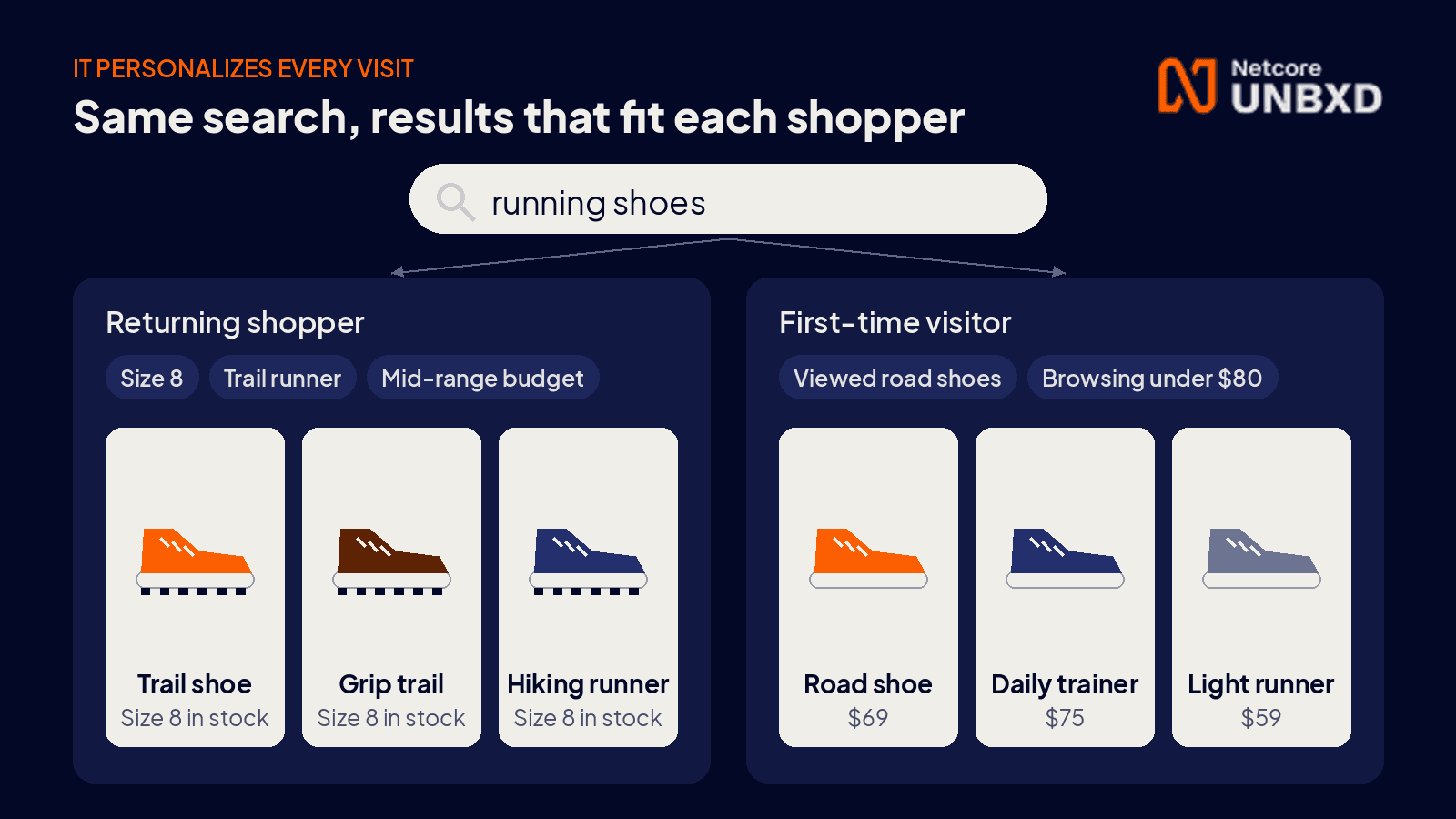
A loyal customer and a first-time visitor shouldn't see the same results. AI-powered search adapts to each shopper in two ways.
It learns during the visit. In-session personalization builds an anonymous profile from what the shopper clicks, the categories they browse, the price ranges they look at and the device they use. Rankings shift as the shopper shows what they like. This works for first-time visitors with no login or purchase history.
It ranks for what's likely to sell. Instead of a fixed relevance score, dynamic ranking orders results using behavior like clicks, add-to-carts and purchases, along with business goals like stock levels and margin. Out-of-stock items drop down the list automatically.
With a shopping agent: the shopper can simply say what matters to them. If they mention they wear a size 8 or want vegan materials, the agent keeps that in mind for the rest of the visit.
5. It learns on its own
Fixes: endless manual upkeep
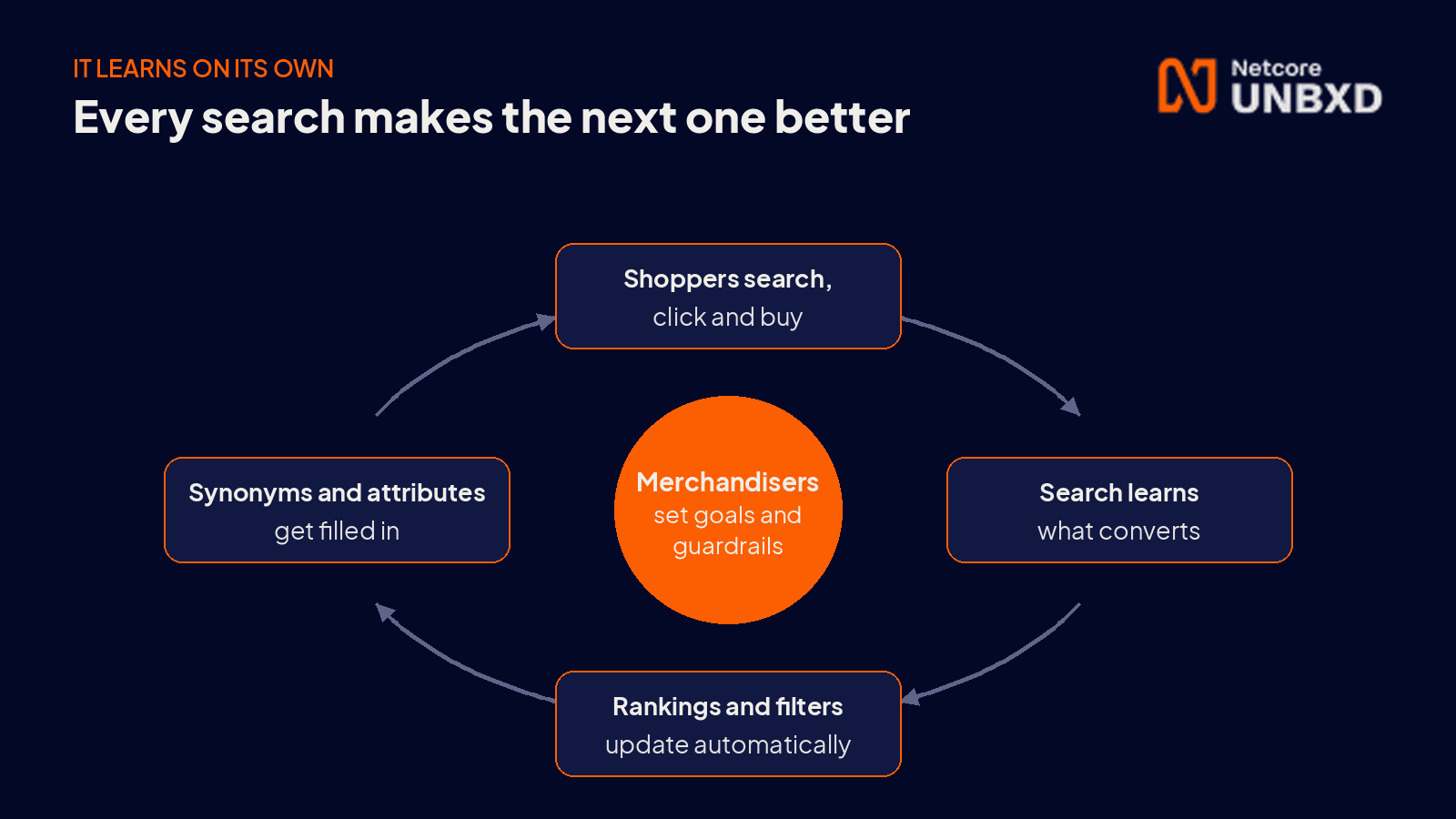
With keyword search, every synonym, redirect, boost and product tag has to be added by hand. AI-powered search takes most of that off your team's plate.
Rankings adjust as shoppers click and buy. Enrichment fills in missing product attributes. Filters adapt to each set of results, so a search for "dining tables" leads with seating capacity and material, while "office chairs" leads with adjustability, without anyone setting them up category by category.
Merchandisers stay in charge. They set the business goals and guardrails, plan campaigns and use built-in A/B testing to try changes without waiting on developers. The system handles the repetitive work, which frees the team to focus on strategy.
With a shopping agent: the same learning powers the conversation, so the agent gets better at understanding shoppers with every interaction.
Search that works the way shoppers do
Shoppers already search the way they talk. Traditional search asks them to guess your catalog's exact words, and most of them won't. AI-powered search turns that around. It reads intent, understands any vocabulary, adapts to each shopper and keeps learning without constant upkeep. Add an AI shopping agent on top, and shoppers who'd rather explain than search get the same help through conversation.
Frequently Asked Questions
AI-powered site search is an ecommerce search engine that uses natural language processing, machine learning and behavioral data to understand what shoppers mean, rank products by how likely they are to convert and personalize results in real time. It replaces exact keyword matching with an understanding of intent.
Keyword search matches the exact words in a query against product data and shows every visitor the same results. AI-powered search understands intent, synonyms and misspellings, uses signals like clicks, purchases and stock levels to rank results, and adapts to each shopper during their visit.
An AI shopping agent is a conversational assistant built on AI-powered search. Shoppers describe what they need in their own words, and the agent keeps context, asks clarifying questions and narrows down products, much like a store associate. Unlike a scripted chatbot, it's connected to your catalog and search engine.
Both solve the same core problems, and they work best together. AI-powered search serves shoppers who type a quick query and want results right away. A shopping agent serves shoppers with open-ended needs who'd rather explain their situation and be guided. When both run on the same engine, they share what they learn about your catalog and your shoppers.
No. It takes over repetitive work like maintaining synonym lists, tagging products and setting up filters. Merchandisers still set business goals, plan campaigns and decide what to test, with more time to spend on strategy.


