- ProductsSearch and BrowseRecommendationsCustomer Engagement
Every agentic feature Netcore Unbxd has shipped: What each one does and why it matters


Key takeaways
- Netcore Unbxd has shipped six agentic commerce products, split across an internal operations loop and an external commerce/connectivity layer.
- Insights Agent, Debugger Agent, and Merchandising Copilot form a three-step loop: spot the issue, explain it, fix it.
- AI Shopping Agent is a conversational AI which allows shoppers to share image and text input together.
- Restaurant Equippers saw 60% search engagement and a 20% revenue lift after deploying the AI Shopping Agent.
- The MCP Server connects catalog, search, analytics, and actions to AI platforms like ChatGPT and Gemini, etc.
Agentic commerce isn't a single switch you flip. It changes how the whole stack behaves, and it does that in two directions. Internally, the platform needs to notice what's happening in search and merchandising and act on it, without someone monitoring every move all the time.
Externally, the catalog needs to be something an AI shopper buys on a person's behalf, on a platform like ChatGPT, Gemini, wherever it can actually read and buy from. Netcore Unbxd has built six features across both sides of that. Below is what each one does, where it lives in the stack, and how they connect.
| Feature | What it does | Who uses it | Where it sits in the stack |
|---|---|---|---|
| Insights Agent | Answers plain-language questions about search and merchandising data | Merchandisers, analytics teams | Operational intelligence layer |
| Debugger Agent | Explains why a product ranks where it does, or why it's missing from results | Merchandisers | Operational intelligence layer |
| Merchandising Copilot | Turns plain-English instructions into merchandising configurations | Merchandisers | Operational execution layer |
| AI Shopping Agent | Runs multi-turn conversational shopping journeys, including unified visual + text search | Shoppers (external) | Consumer-facing layer |
| Enrichment for Agentic Commerce | Makes the catalog discoverable to external AI agents | Catalog and ecommerce teams | Catalog readiness layer |
| MCP Server | Connects the ecommerce stack to AI platforms via the Model Context Protocol | Platform and integration teams | Connectivity layer |
The six agentic products Netcore Unbxd has shipped, mapped by function and where each sits in the stack.
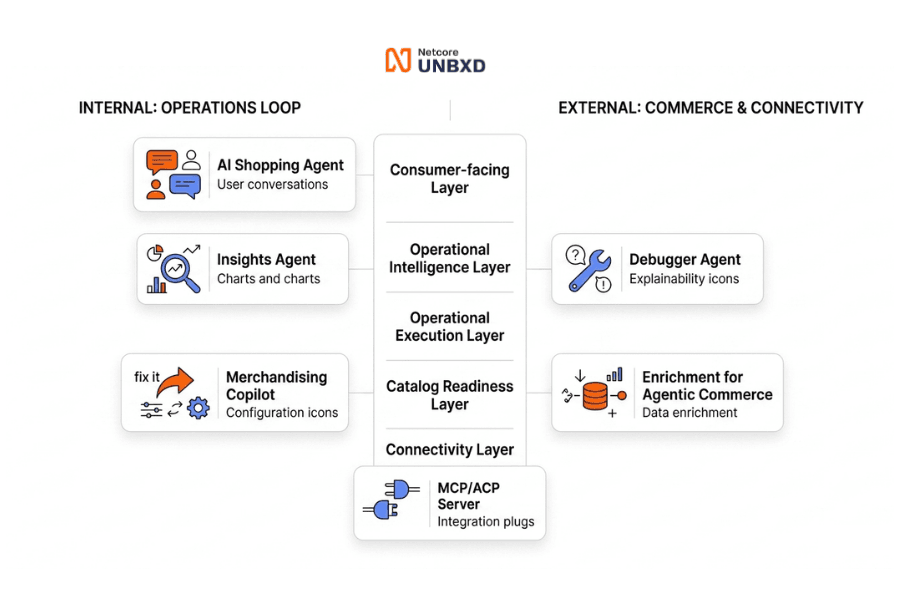
The operational loop: Insights Agent, Debugger Agent, and Merchandising Copilot
A merchandising problem usually breaks down into three separate jobs: someone notices a metric has moved, someone figures what to change, and someone fixes it. Split those across three tools and three skill sets, and the gap between noticing and fixing is where revenue quietly leaks out.
Netcore Unbxd built three agents to close that gap by running those jobs as one connected loop instead of three disconnected tools.
The Insights Agent sits inside the reporting experience across the console. Ask it a question in plain language and it answers on the spot, instead of making you dig through dashboards to piece together a number.
Then comes the Debugger Agent which gives you a solution. It handles the questions merchandisers ask most often: why does this product rank here, and why is that other one missing entirely. The explanation comes back in plain language, so you don't need an engineer to translate it.
The Merchandising Copilot does the actual fix. Give it an instruction like "boost new arrivals in running shoes through month-end and suppress out-of-stock items," and it builds the configuration with boosts, slotting, pinning, filters, and campaign timelines across results, category pages, autosuggest, and banners. It flags conflicts, shows its reasoning before anything ships, and nothing goes live until the merchandiser clicks publish.
Run together, the three agents close the loop: Insights Agent spots what changed, Debugger Agent helps solve it, Merchandising Copilot builds the fix from a plain description of the outcome.
AI Shopping Agent: The consumer-facing layer
Shoppers rarely type the exact word your catalog is indexed on. They arrive with intent, context, and follow-up questions, and a traditional search box tends to flatten all of that into one keyword. The AI Shopping Agent is what shoppers actually talk to instead. It holds a multi-turn conversation across the full journey, so someone can refine, compare, and decide without starting over each time.
Five things make that work: conversations that hold context across turns, merchandising alignment so conversational results follow the same rules as the rest of the store, adaptive intent recognition, a learning loop that improves from each interaction, and omni-context integration that folds in the signals around each shopper.
Restaurant Equippers saw 60% growth in search engagement and a 20% revenue lift after deploying it. Angela Maynard, their Director of Ecommerce Operations, said: "The Shopping Agent has been a real game-changer for us."
One of the capabilities built into the Shopping Agent is: multimodal search. Shoppers often remember what something looked like before they can name it, and the catalog wants the exact term that gap between a mental image and a keyword is where intent usually gets lost. Instead of running visual search and text search as two bolted-together experiences, the Shopping Agent reads both in one flow. A shopper can start from an image and refine with words, or type first and add a photo, and the agent also handles typed and voice queries, phonetic variations, and transliterated terms in the same pass.
Enrichment for Agentic Commerce: Making the catalog visible to AI agents
An AI agent can only recommend what it can actually read, and most catalogs were written for humans, not machines. Less than 20% of retailers currently have metadata rich enough for AI discovery. Enrichment for Agentic Commerce is an AI feature that makes product catalogs discoverable across emerging agentic shopping channels like ChatGPT, Google Gemini, and Alexa, etc.
MCP/ACP Server: Connecting the ecommerce stack to AI platforms
AI Enrichment makes the catalog readable. The MCP Server makes it reachable. It connects catalog, search, analytics, and actions to AI platforms through the Model Context Protocol, so commerce can happen inside an AI conversation rather than sitting behind it.
In practice: a shopper asks ChatGPT to find something, the request reaches the retailer's catalog, and the purchase completes without the shopper ever leaving the assistant. This matters because AI platforms are increasingly where product discovery starts, and a catalog those platforms can't reach is one they can't recommend.
How the stack connects
The six products split roughly down the middle. On the operations side, the three-agent loop runs internally: Insights Agent surfaces what's happening, Debugger Agent explains why, Merchandising Copilot fixes it, so that search and merchandising keep performing without constant manual rule-writing. On the commerce side, three products face outward. The AI Shopping Agent runs the shopper conversation, including unifying visual and text intent through its multimodal search capability. Enrichment for Agentic Commerce readies the catalog for external agents. The MCP/ACP Server wires the stack to AI platforms. Getting to agentic readiness takes both halves: the operational agents to run the platform, and the commerce/catalog products to make it reachable by the agents now shopping on your shoppers' behalf.
Which product fits where you are now
You don't need all six at once. The operational loop which consists of Insights Agent, Debugger Agent, and Merchandising Copilot, handles the internal search and merchandising problem. The AI Shopping Agent is the shopper-facing layer for teams ready to run conversational commerce. Enrichment and the MCP/ACP Server are the external discoverability play. Netcore Unbxd is a Gartner 2026 Magic Quadrant Leader and a Forrester Wave Q3 2025 Strong Performer. Book a demo to see how these map to your stack and where you're starting from.
Frequently Asked Questions
On operations: the Insights Agent, Debugger Agent, and Merchandising Copilot. On commerce and connectivity: the AI Shopping Agent, Enrichment for Agentic Commerce, and the MCP/ACP Server. The first group runs internal merchandising; the second makes the catalog reachable by external AI agents.
They work as a loop. Insights Agent identifies what's happening in search and merchandising data. Debugger Agent explains why a product ranks where it does or goes missing. Merchandising Copilot executes the fix from a plain-English instruction, checking for conflicts and waiting for a human to publish.
Enrichment readies your catalog so external agents on ChatGPT, Gemini, and similar channels can discover your products. The AI Shopping Agent is the conversational agent shoppers talk to on your own site. One prepares the catalog for outside agents; the other runs the shopper conversation directly.


